10 Design-Forward Menorahs for a Meaningful (and Artful) Hanukkah

 2
2
 0
0Summary
The most compelling menorahs honor tradition while functioning as true design objects. These ten pieces use material, proportion, and restraint to create Hanukkah rituals that feel personal, artful, and relevant long after the candles are extinguished.
Reflection Questions
How do material, scale, and finish influence whether a ritual object feels integrated into a home or temporary and decorative?
Where does your own taste fall between tradition and experimentation when it comes to ceremonial objects?
What makes an object feel worthy of remaining on display beyond the season it was designed for?
Journal Prompt
Think about a ritual object in your own home or one you might design or source for a client.
What qualities would allow it to live comfortably in the space year-round? Write about how material choice, proportion, and restraint could transform a ceremonial piece into something that feels permanent, personal, and deeply considered.
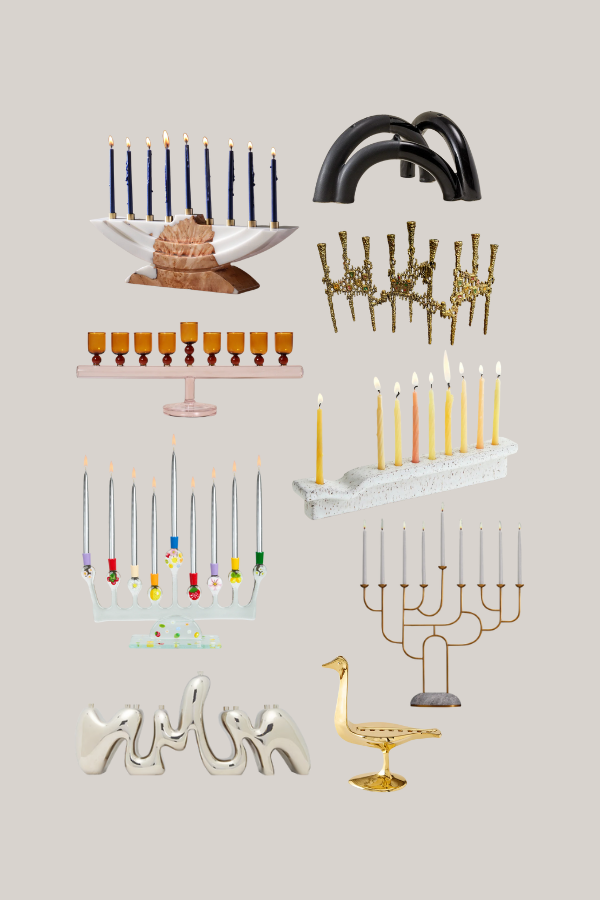
Hanukkah objects tend to fall into one of two categories. Some lean heavily on tradition and sentiment. Others chase novelty and forget the ritual altogether. The most stunning and enduring menorahs sit somewhere in between. They take the requirements seriously while still holding space for material, proportion, and point of view. You can place them on a table, light the candles, and feel like the object belongs in your home the other nights of the year too.
This roundup focuses on menorahs that function as real design objects. Pieces where brass, glass, ceramic, and wood are as forward as the silhouette itself. Som of these menorahs are polished, while others are rougher around the edges. A few are quite playful. Others are very restrained. All of them deserve a closer look, both lit and unlit, and each brings its own perspective to a ritual that repeats night after night.
10 Design-Forward Menorahs for a Meaningful (and Artful) Hanukkah
Jonathan Adler’s Vienna Menorah
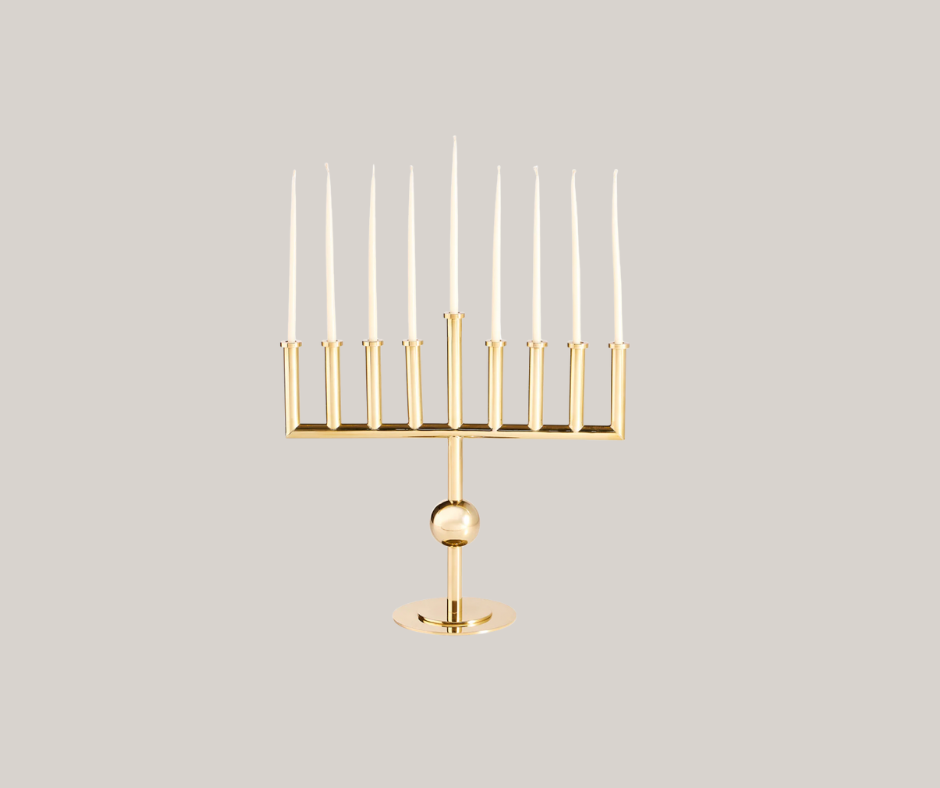
Jonathan Adler’s Vienna Menorah is compact, polished, and unapologetically glamorous. Cast in solid brass, it has a weight that’s immediately apparent, even at a modest scale. The form feels architectural rather than ornamental. Clean lines, rounded edges, and a symmetry that reads as intentional instead of rigid. It sits comfortably on a console or dining table without asking for too much space.
The surface finish is gorgeous. Light reflects softly across the brass. There’s a hint of Deco influence, though it never tips into pastiche. The proportions are tight. Nothing feels exaggerated or decorative for decoration’s sake. This is a menorah that looks considered from every angle.
What makes the Vienna Menorah appealing is its clarity. It doesn’t rely on novelty. It relies on material, proportion, and finish. It feels at home in a modern interior, but it wouldn’t feel out of place alongside older pieces either. That flexibility is part of its appeal.
Via Maris’ Glass Chanukiah
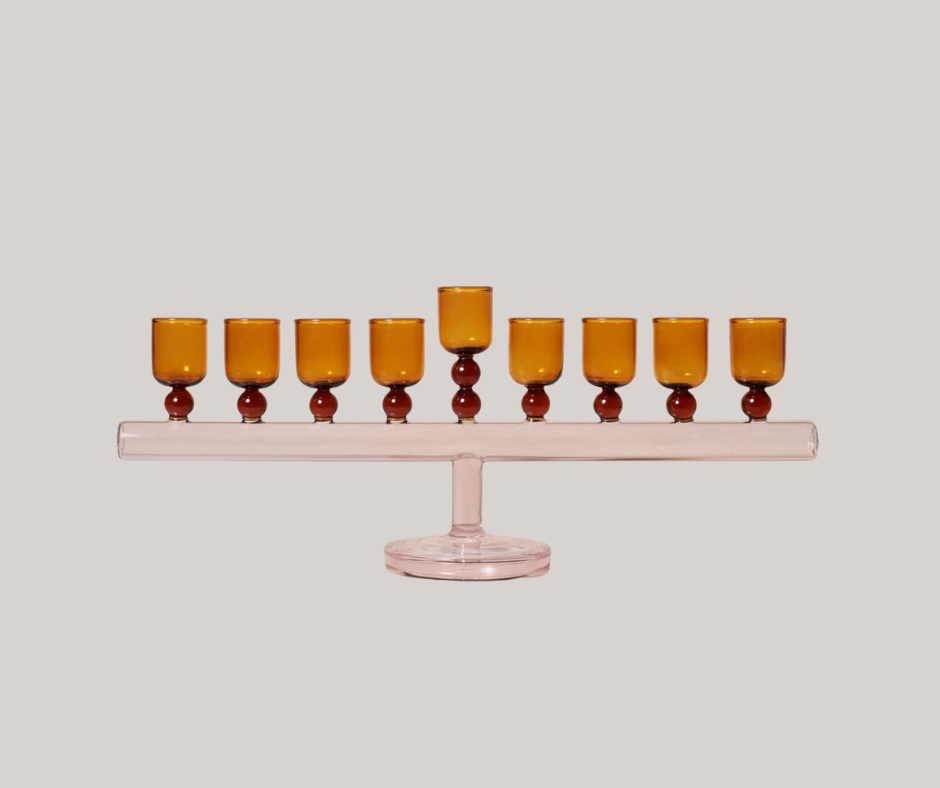
The Via Maris Glass Chanukiah feels light, literal, and striking. Made from borosilicate glass, its transparency changes the way candlelight flickers. Flames reflect and refract through the curved forms, giving the piece a softness that shifts throughout the evening. Even unlit, the glass has presence.

Each candle cup is supported by a rounded glass form, spaced evenly across a slender horizontal base. The structure feels deliberate but not heavy. There’s an airiness around it. On a windowsill or sideboard, the Chanukiah almost disappears during the day, then comes into focus once the candles are lit.
This piece works especially well in pared-back interiors. It doesn’t compete with surrounding objects. Instead, it interacts with light, shadow, and movement. It feels contemporary yet timeless.
Studio Per Diem’s Shana Menorah in Noir Glass
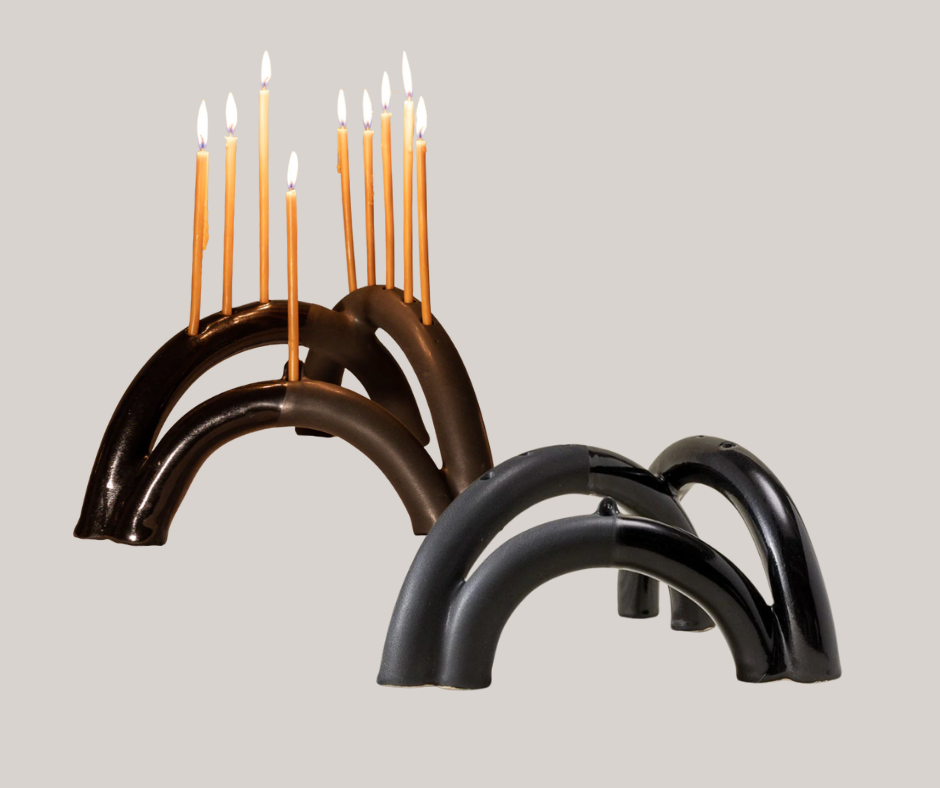
The Shana Menorah by Studio Per Diem has a strong sculptural presence we adore. Made in noir glass, its intersecting arches form a low, grounded silhouette that reads more like an object of design than a traditional candelabra. The shape is graphic and self-contained, with no excess detail.
The finish absorbs light rather than reflecting it. When candles are lit, the contrast between flame and dark glass sharpens the form. Each arch feels purposeful so the result is bold but not loud.
This is a menorah that feels comfortable living out year-round. On a shelf or credenza, it holds its own even when unlit. The piece feels closer to a ceramic or sculptural object than a holiday-specific item, which makes it especially appealing for design-forward homes.
A Midcentury Brutalist Menorah from Casa Mare Vintage
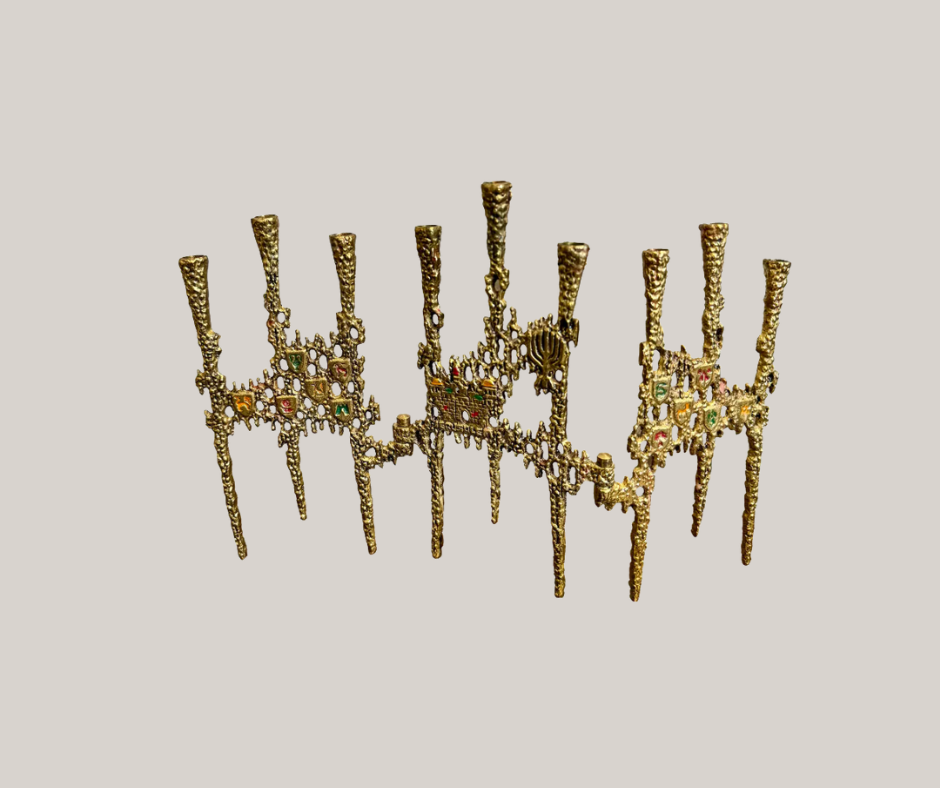
Perhaps the most unusual menorah on this list, this midcentury Brutalist piece has a raw, almost industrial quality. Cast in brass with a heavily textured surface, it feels hand-worked and unapologetically rough. The form is irregular, with candle holders rising at slightly different angles. Nothing about it feels polished or refined.
Its weight is visual as much as physical. The brass has aged, picking up a darker patina in recessed areas. Small imperfections remain visible. That wear feels integral rather than distracting. It is almost medieval.
Fuel your creative fire & be a part of a supportive community that values how you love to live.
subscribe to our newsletter
*please check your Spam folder for the latest DesignDash Magazine issue immediately after subscription

Placed on a table or mantel, it brings a sense of history into the room. It doesn’t try to soften or minimize itself for contemporary settings. Instead, it provides contrast. Clean interiors benefit from that tension, and this menorah delivers it effortlessly.
Jonathan Adler’s Brass Bird Menorah
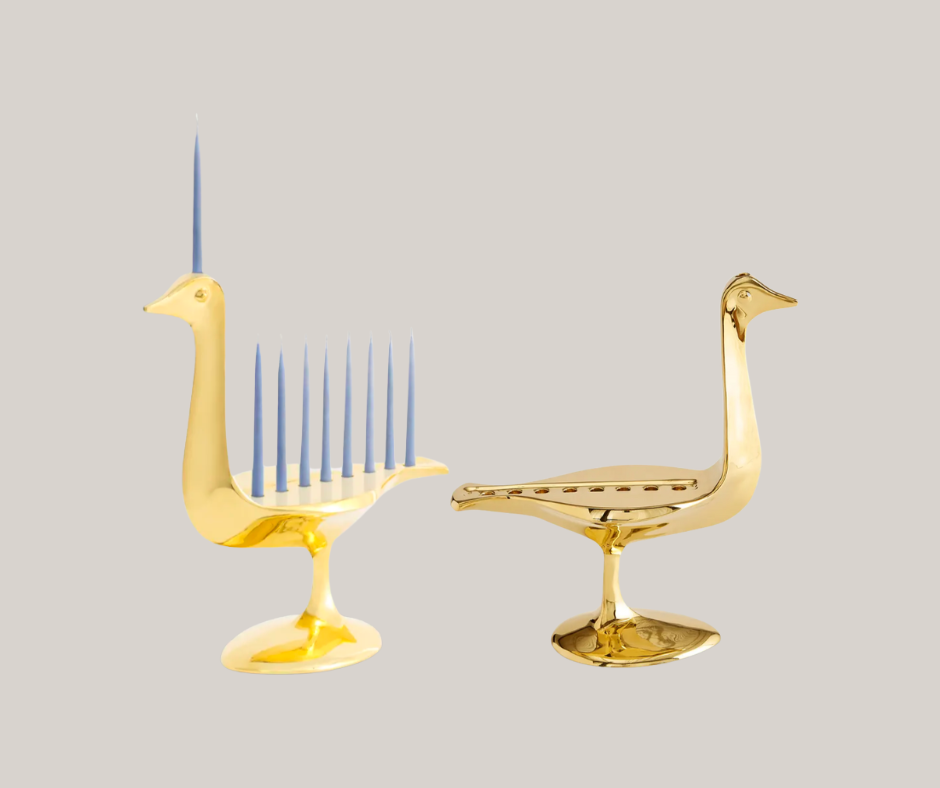
Jonathan Adler’s Brass Bird Menorah is playful, sculptural, and immediately recognizable. Shaped like a long-necked bird, the candles run neatly along its back, turning the form into both object and function. The brass finish gives it cohesion, preventing the design from slipping too far into novelty.
Despite the figurative shape, the proportions are disciplined. The base is stable, the profile clean. It reads as intentional rather than whimsical. Perched (see what we did there?) on a tabletop, it is a focal point but it doesn’t overpower the setting.
This menorah works best in spaces that don’t take themselves too seriously. It has personality, but it’s grounded by material and finish. It is confident, graphic, and a little charming without being precious.
Susan Alexandra’s Kaleidoscope Menorah
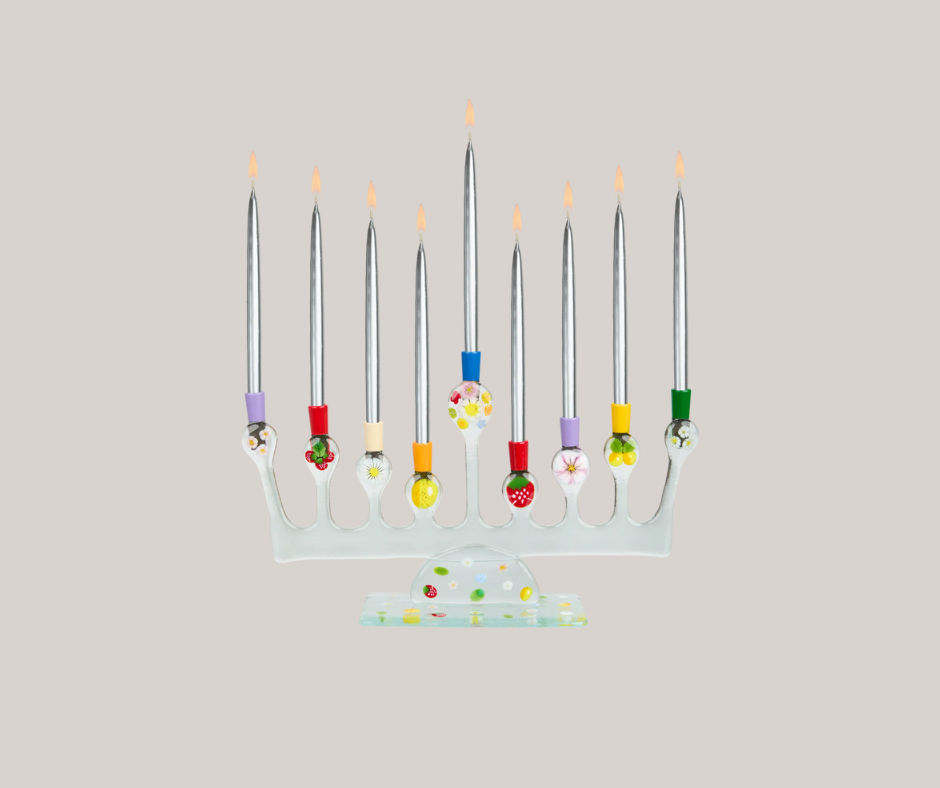
Susan Alexandra’s Kaleidoscope Menorah leans into color and ornament without apologizing for it. Made from fused glass and scattered with floral murrini, the surface feels busy in a way that’s intentional rather than overwhelming. Each candle cup is painted by hand, which introduces variation you can spot immediately. No two sections look exactly alike.
The structure itself is fairly straightforward. A horizontal base, evenly spaced holders, nothing trying to distract from the material. That restraint matters. It gives the color somewhere to live without turning the whole piece into visual noise. When the candles are lit, light moves through the glass unevenly. Some areas glow. Others stay opaque.

This is a menorah for people who already like objects with personality. It doesn’t blend in. It doesn’t try to soften itself for neutral interiors. You could argue it works best in rooms that already allow for a little chaos. On a crowded table, it would probably hold its own.
Hannah Polskin’s Limited Edition Menorah
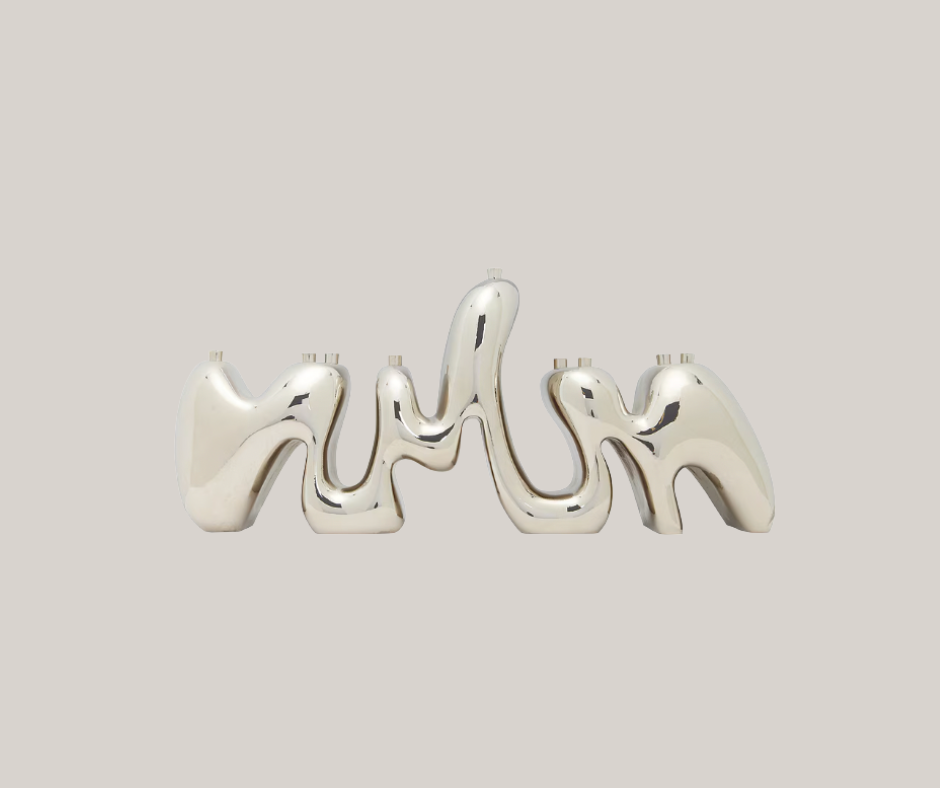
Hannah Polskin’s Limited Edition Menorah is heavy, reflective, and unmistakably sculptural. The silver surface curves in long, continuous lines, creating a form that feels deliberate without looking engineered. Candle holders are embedded directly into the shape rather than added on later. That decision keeps the object visually unified.
The scale matters here. This isn’t a piece you tuck into a crowded shelf. It wants breathing room. Light behaves differently across its surface depending on where you stand, which gives it a shifting quality throughout the evening. Brass candle cups add contrast, though the silver remains dominant.
This menorah suits interiors that already value strong objects. Minimal rooms benefit most, since there’s nothing competing with it. It doesn’t rely on symbolism or ornament to justify itself. The form does the work.
L’Objet’s Rova Menorah
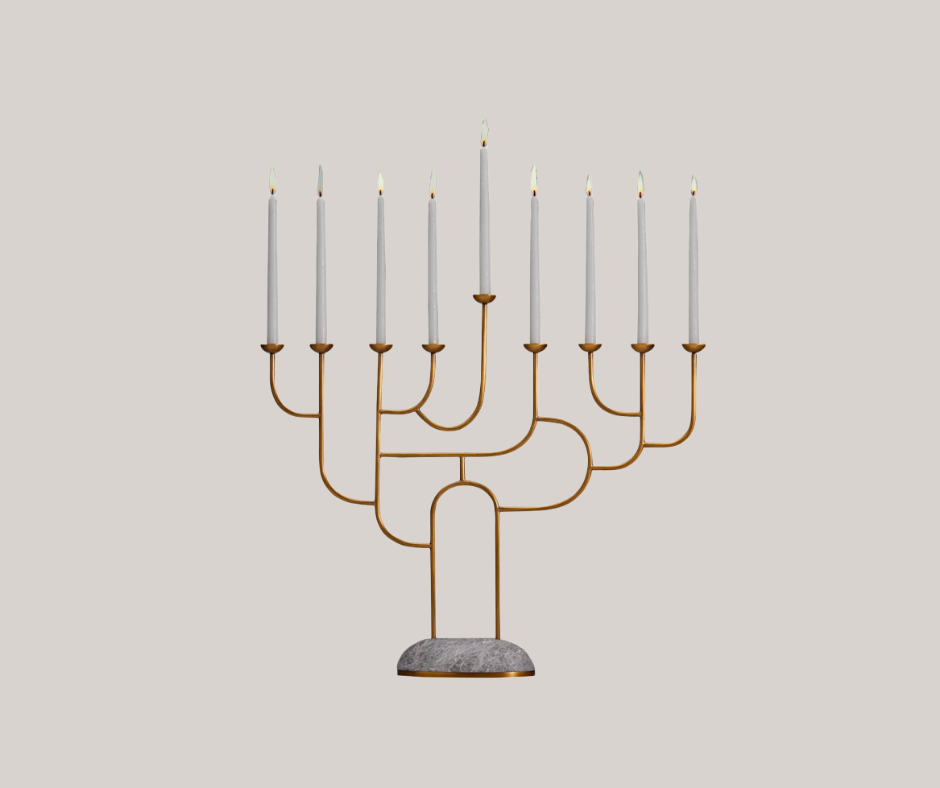
The Rova Menorah from L’Objet takes a more architectural approach. Brass lines intersect at measured intervals, supported by a compact marble base. The reference to Jerusalem’s old city comes through in the layout rather than in any decorative detail. There’s a sense of planning here, almost like a small-scale model.
Brass and marble carry different kinds of weight, and the combination keeps the piece from feeling fragile or overly precious. The geometry never feels rigid, though. Slight variations in spacing prevent it from turning into a diagram.
This menorah works well in rooms that already lean modern but still allow for warmth. It doesn’t demand attention immediately. Over time, the balance becomes clearer. That slow recognition feels appropriate for an object used over multiple nights.
Zavissen’s Live Edge Menorah with Center Shamash
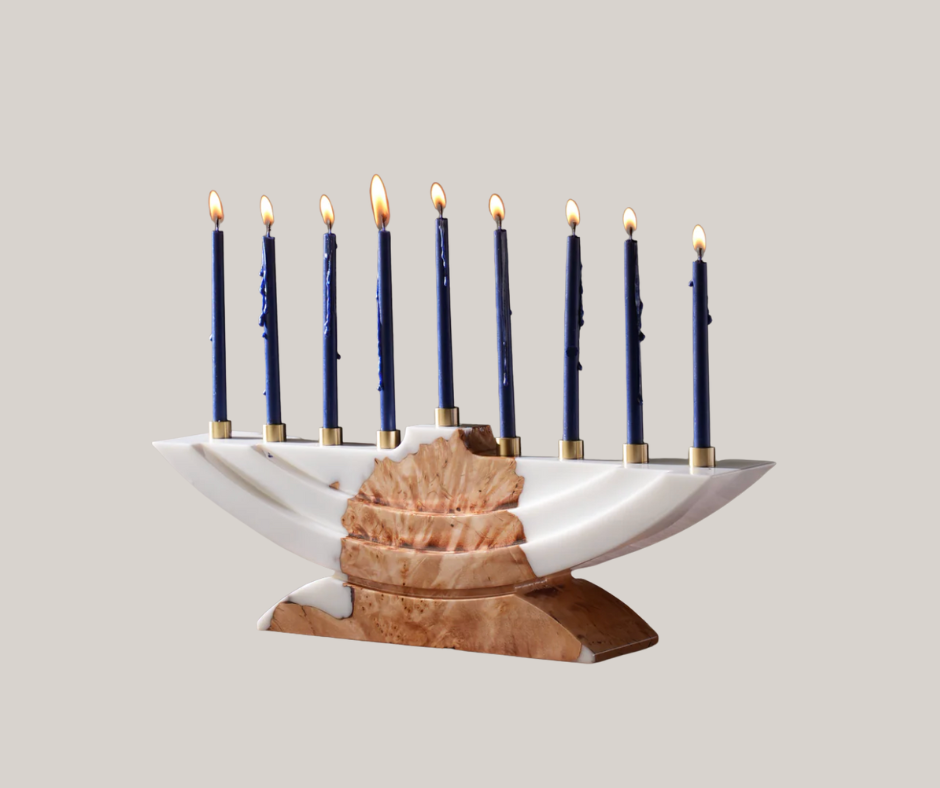
Zavissen’s Live Edge Menorah focuses on material first. Birch burl forms the base, finished in glossy white while keeping the natural contours visible. You can see where the wood shifts and thickens. Brass hardware introduces a cleaner counterpoint, especially around the candle holders.
The center shamash, made from epoxy, sits slightly apart from the rest of the piece. That separation feels intentional without drawing too much attention to itself. Nothing here feels overly polished. Small irregularities remain visible, which gives the object a grounded presence.
This menorah fits comfortably in spaces that mix modern furniture with tactile materials. Wood, stone, and metal already feel at home nearby. It doesn’t try to smooth out its own edges, and that restraint makes it easier to live with year after year.
Ceramic Menorah by JST & ANK Ceramics
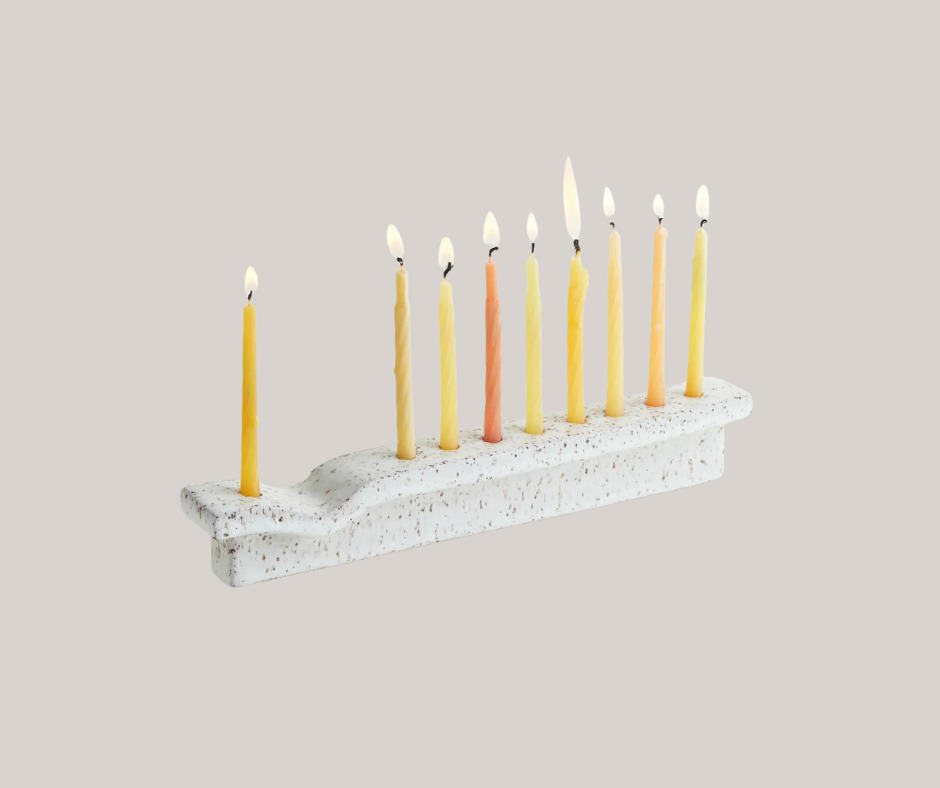
This ceramic menorah by JST & ANK Ceramics keeps everything low and linear. Made from mid-fire stoneware, the piece sits close to the surface it’s placed on. The glaze has depth but avoids shine, which helps the candles stand out once lit.
There’s an ambiguity to this object that feels intentional. Without candles, it could pass for a sculptural shelf piece or a small architectural element. Nothing about it signals ceremony right away. That understatement gives it flexibility.
It works well on a mantel or credenza where objects tend to stay put. You don’t feel the need to pack it away once Hanukkah ends. That question of permanence seems built into the design, and it’s part of what makes the piece appealing.
Written by the DesignDash Editorial Team
Our contributors include experienced designers, firm owners, design writers, and other industry professionals. If you’re interested in submitting your work or collaborating, please reach out to our Editor-in-Chief at editor@designdash.com.
Related Posts
Unique Mother’s Day Card Ideas to Show How Much You Care
Here are 17 creative and heartfelt Mother's Day card ideas that offer

Counting Down Our Most Listened-To Episodes of 2025: Jamie Young
On the DesignDash Podcast, enjoy Jamie Young's insights on building a

From Film Festivals to Art Shows: Events in Aspen 2024
With its world-class festivals, outdoor adventures, and artistic endea
Women, In Their Own Words: Mimi Meacham
Houston-based interior designer Mimi Meacham of Marian Louise Design d

These Are the Best Boutique Hotels in Paso Robles, CA
Whether you seek elegant suites for a romantic escape or an inn with e
All About Helene Schjerfbeck: The Finnish Painter with an Ever-Evolving Artistic Style
From her beginnings at the Finnish Art Society to her later years as a