


Do I Actually Want to Scale My Firm, or Just Make More Money?

 2
2
 0
0Summary
Firm owners often use the word “growth” to describe two very different goals. One owner wants stronger profit from the projects already on her calendar. Another wants a team and a larger firm that can produce beyond her own time. This article walks through that distinction using Melissa Grove and Laura Umansky’s perspective on capacity, margins, cash flow, billing structure, leadership, and the operational changes that come with expansion.
Reflection Questions
Am I actually out of capacity, or am I underpricing projects and letting too much profit leak out?
When I say I want growth, do I mean higher profit from my current model or a larger firm with more people and more structure?
How much of my week do I want to spend on design decisions, and how much am I willing to spend on hiring, leadership, and oversight?
Do I have a clear sense of what cash in the account actually belongs to the business, what is owed to vendors, and what is true profit?
If I hired tomorrow, would that solve a real capacity problem, or would it add payroll on top of pricing and process issues I have not fixed yet?
Journal Prompt
When you picture a healthier, more profitable version of your firm one year from now, what exactly has changed? Write about your pricing, project mix, cash flow, workload, and daily role in detail. Then ask yourself whether that picture requires a larger team or whether it asks for tighter margins, firmer boundaries, and better financial discipline inside the business you already have.
Designers talk about growth all the time, but they don’t always mean the same thing when they say it. One designer wants higher profit from the work she is already doing. Another wants help because her calendar is full. Another wants a firm that continues to earn when she is not involved in every decision. All of those get grouped under the same word, even though they lead to very different businesses.
A larger firm also means a greater spectrum of work and a far different organizational structure. More revenue and more projects come with hiring, payroll, documentation, and decision-making that is way beyond design itself. As a designer, you were selecting finishes, managing clients, developing concepts, and carrying a project through its install. But as a boss, you are setting expectations, reviewing performance, and making calls that affect other people’s time and income.
In this Q&A, we asked Laura Umansky and Melissa Grove of Laura U Design Collective how they think about that distinction, when a designer should focus on margins, and what firm owners often overlook when we say we want to scale.

What “Growth” Actually Looks Like in an owner’s Head
When a firm owner says she wants to grow, she’s often picturing a version of the future that feels expansive but still familiar. More projects come in. Revenue goes up. There may be one or two hires. The firm feels more established, but she still spends a large part of the week in design work, and the business still revolves around her taste, her judgment, and her direct involvement. That makes complete sense theoretically, but it also leaves out a few key things.
A larger firm introduces more people, by necessity. More people make decisions. More people need direction. Work is handed off, reviewed, adjusted, and sometimes redone. Payroll, process, and oversight exist alongside the design work, and one cannot happen without the other. Someone has to define how the work moves from one step to the next and who is responsible for each step. This is why it’s so important to distinguish between whether you want to scale or simply make more money. One path keeps the work centered on you, the owner. The other builds a structure that includes multiple people and makes you the business leader instead of the senior designer.
Answer the Capacity Question First
Once your calendar fills up, you’ll feel the sting of those limitations. Meetings start to run into each other. All emails are handled at the end of the day because there was no time earlier. A client needs a decision before a contractor can move forward, and that decision stalls with you because you have absolutely no time available. Install dates overlap. Procurement questions interrupt design work. The work keeps chugging along, but it depends on you at each and every step.
It’s easy to look at that bottleneck and assume hiring is your next move. There is clearly more work than one person can comfortably handle. But a full calendar doesn’t say much about each project’s profit. A project can take up weeks of attention and still return far less than it should based on your initial estimates. That expectation gap usually connects back to pricing, scope, or how much time the work actually took once it got underway.
A packed schedule with low profit usually points back to the structure of your operations. The initial pricing may not reflect the amount of time the work actually requires. The scope may expand over time without a corresponding adjustment in fees. Revisions may accumulate beyond what was originally accounted for. Each of those decisions adds time to the project, and that time is not always compensated. This brings us to our next section.
Next, Look at Your Margins
Melissa’s recommendation might sound a bit unsatisfying because raising rates is scary, especially in an industry rocked by rising material costs and unpredictable tariffs. Changing your billing structure or prices can also feel “too small” because it doesn’t change how your schedule looks, and it doesn’t reduce the amount of work sitting in front of you. But it does change how each project performs financially, and that will matter a lot more over time than adding additional work into an already full calendar.
Margins are shaped by little decisions that are easy to ignore or breeze by when you’re in the middle of a project. You spend more time sourcing than you expected because the client keeps adjusting direction. You revise a scheme again even though the original scope only accounted for a set number of revisions. A vendor issue takes hours to resolve, and that time is never financially compensated because you don’t do hourly billing. None of those decisions seem significant on their own, but they accumulate and that accumulation eats away at your profit.
Fuel your creative fire & be a part of a supportive community that values how you love to live.
subscribe to our newsletter
*please check your Spam folder for the latest DesignDash Magazine issue immediately after subscription

It can take a few projects before that pattern is obvious. You alone are exceeding 40 hours a week every week (not to mention the work your team is putting in), but the return doesn’t reflect the amount of time involved. At that point, adding another project or bringing in a new staff member won’t automatically fix the issue. The structure underneath your work and your finances will largely stay the same.
There’s a practical limitation here, too. When your schedule is already full, it is difficult to step back and review how your projects are actually performing. But these unprofitable processes will continue until you pause, assess, and alter.
When You Just Want to Make More Money

Instead of looking at revenue, paying every expense, and hoping enough is left over, the owner sets a profit goal first and builds the year around it. Hiring isn’t the only way to increase income. A solo designer may need better pricing. She may need firmer scope. She may need to stop treating profit like whatever’s left after samples, software, photography, travel, and every other expense has already been approved.
Melissa and Laura also tie that thinking to the type of revenue the firm is bringing in. Remember, design revenue and furniture revenue aren’t billed in the same way. One is tied to hours and the other may come in larger deposits; those larger deposits are committed elsewhere. They’re not free-flowing cash.
Don’t Confuse Cash With Profit

Remember, a strong balance can include money that is already owed to vendors. A designer may look at the account and think there’s room for a hire, a branding shoot, or a large expense, when a big portion of that cash is already spoken for through purchasing.
Billing structure can cut into profit, too. Laura says that before hourly billing, she was floundering financially. In most cases, there is no “big mistake” that instantly evaporates your profit. Little allowances slowly drain profit instead. Committed to seeing a project through and keeping the client happy, you spend weeks in vendor follow-up, site coordination, procurement questions, and schedule changes. The project moves forward, but the margin gets thinner every time another hour slips by without a charge attached to it.
Every hour you spend on a project is billable if you actually track it. So yes, a solo owner can make more money without building a larger firm. She can raise prices, tighten scope, bill more accurately, protect her margins on furnishings, and pay closer attention to what cash is actually hers and not just waiting to be spent on another part of the project. There’s still a limit, of course. One person only has so many hours in a week. But before hiring, it helps to ask whether the firm has truly run out of capacity or whether too much profit is leaking out first.
When You Actually Do Want a Larger Firm
A larger firm requires other people to do parts of the job you used to do yourself. Someone else handles sourcing for a presentation. Someone else follows up on orders. Someone else answers a client question before it turns into a delay on site. If every one of those decisions still routes back to the owner, the firm may have more employees, but it is still operating like a solo practice with payroll layered on top.
Pay close attention to how integrating new staff members changes (or doesn’t change) your firm and consider whether the cause is growing pains or poor structure. Also consider whether you can live with the changes that employees actually bring with them.

For example, a firm who has run projects mostly through instinct and memory now has to hand off pieces of the process to people who do not share that private set of habits. A project manager may know how to build a schedule and still send client emails in a tone the owner would never use. A junior designer may pull options for a scheme and miss the level of restraint or precision the owner expects. Can you loosen the reins and accept this transitional phase?
Hiring can add pressure before it saves time. The owner may spend weeks reviewing presentations, revising email drafts, checking vendor communication, and answering questions that never had to be spoken aloud before because she was answering them silently in her own head. Some owners assume that means the hire was premature. Sometimes it does, but many times, the hire is fine and the firm is simply in the ugly early stretch where delegation still requires constant review.
Melissa’s perspective on scaling vs boosting profit helpfully separates two different ambitions. One owner wants better returns from the projects already on her desk. Another wants a business that can move projects forward through other people. These two goals will lead to different hiring decisions, different pricing decisions, and a very different use of the owner’s time.
What Changes When a Firm Expands
We usually develop SOPs when the same confusion and same errors pop up again and again. A client asks for an update and three people are not sure who should reply. A purchase order goes out with missing information because each person assumed someone else had confirmed the details. A designer waits to send a drawing package because she doesn’t know whether the project lead or the owner is supposed to review it first. These seemingly “random” mistakes eventually form a pattern and indicate missing structure.
This is what separates a solopreneurship from a multi-person firm. A solo designer can run a lot of a business from memory. She knows when to check on a proposal, when to confirm lead times, when to push a client for a decision, and when to step in with a contractor. A team cannot operate that way for very long (if ever). Once several people are involved, routine decisions have to live somewhere outside the owner’s head.
This guide improves efficiency, yes, but it also forces the owner to define parts of the business she may have kept vague for years. How many revisions should a project lead handle before pulling in the principal? Which vendor issues can procurement solve without approval? When can a junior designer send options directly to a senior designer and when do those options need another round of editing first?
Documentation can also expose how much unnecessary review has built up around the owner. If every materials board, every vendor question, and every schedule adjustment has to pass through one person, the problem is no longer a capacity one. The business has never fully defined authority; of course, writing things down won’t solve that on its own, but it forces the issue into view. And sunlight, as they say, is the best disinfectant.
Remember, Rules Are Not the Same as Rigidity

A lot of firm owners resist hierarchy because it sounds corporate, and “corporate” is usually the opposite of what drew them into this field in the first place. They wanted control over the client experience, the design direction, and the shape of the day. They wanted to run a studio, not manage a bureaucracy. So when someone starts talking about reporting structures, responsibilities, and rules, it can sound like the firm is drifting away from the very thing that made it appealing to build.
But with clear SOPs, a junior designer can proceed confidently because she knows the project lead will review selections before anything goes to the client. A project manager can answer timeline questions directly when budget and scope limits are already clear. Procurement can resolve shipping problems without starting a long internal chain of comms.
Without clear roles, senior staff spend a huge amount of time cleaning up avoidable confusion. They answer questions that don’t actually need their input. They correct errors that trace back to vague responsibility. They follow email chains that should have ended three messages earlier. If the owner says she wants more time for design review, client strategy, or even just a simpler week, then authority has to be assigned somewhere else. Otherwise every “small” decision keeps climbing the ladder until it lands on her desk.
A Larger Firm Changes Your Job Before It Changes Your Identity
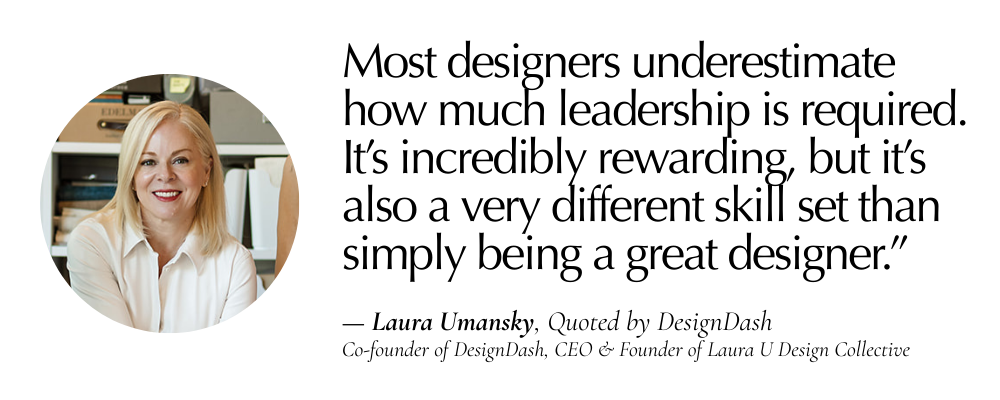
Structure can solve a lot, but if you don’t have the temperament to run a big business, it might not make sense to go there in the first place. A firm owner can want more revenue and still have very little interest in managing a larger team. She can want relief from an overloaded schedule and still dislike the actual duties that come with leadership. Hiring, reviews, compensation, difficult conversations, repeated follow-up, deciding whether someone is underperforming or just unsupported. Some owners grow into that role. Some don’t want it, even if they are perfectly capable of doing it.

That is worth asking yourself directly because if you adore design and want to focus solely on creating, being a “business leader” might impact your ability to do that. You may spend less time making selections and more time reviewing someone else’s selections. Less time writing client emails and more time deciding whether the team is handling communication well. Less time solving project problems yourself and more time deciding who should solve them. Plenty of owners enjoy that, but others miss the direct design involvement. Of course, how you structure your business and who you hire will determine where your time is spent.
But remember, there is no prize for wanting the bigger version of the business. A smaller firm with strong margins can be a better fit for the owner who wants close contact with the design and the client relationship. A larger firm can be rewarding too, but only if the owner is willing to spend a meaningful part of the week on management, which is a separate skill and, honestly, a separate job.
So, Do You Want to Scale or Do You Want Relief?

A packed schedule can push an owner toward hiring when the real problem is profit margin. Fees may be too low for the amount of revision each project requires. Scope may have loosened so much that every job eats up more hours than the proposal ever assumed. Too many projects may be active at once, which leaves no time to think clearly about any of them. Another employee will not automatically fix those things.
Relief can come from several smaller decisions that sound more mundane and less impressive than an expansion. Raise your prices. Cut back the number of active projects. Limit revisions. Stop accepting project types that always run long and underperform financially. Review where owner time is being spent and which tasks should be delegated at a lower cost.
Scaling is an entirely different animal. It empowers the firm to take on more volume than one person can manage alone. That can increase revenue, and it can also give the business more stability if responsibility is distributed properly. But scale means payroll, structure, training, review time, clearer authority, and much more attention to management than a lot of owners anticipate when they first say they want to grow.
Exhaustion complicates all of this. An exhausted owner may want help, more money, fewer client demands, and a better schedule all at once. That bundle of frustrations can make hiring sound like the obvious next move. Sometimes hiring is indeed the right decision, but sometimes the business needs a pricing adjustment and a smaller project load before it needs another salary on payroll.
Join DesignDash Growth Studio for Clarity, Direction, and Community
If this article raised bigger questions about pricing, profit, team structure, or the kind of firm you are actually trying to build, DesignDash Growth Studio was made for that exact stage of business. Growth Studio is our 6-month pathway for interior designers who want a more profitable, stable, and scalable firm built around five core pillars: People, Profit, Promotion, Process, and Purpose.

Enrollment for the next Growth Studio cohort, running July through December 2026, opens in April. If you want clearer structure, better margins, stronger leadership habits, and a business that supports your life instead of draining it, join the waitlist now. After Growth Studio, you’ll also have the option to continue inside our private alumni DesignDash Community for ongoing support and accountability.

Related Posts

The Courtesan Charged as a Witch: Venetian Poet Veronica Franco
Veronica Franco was a Venetian courtesan, poet, and alleged witch who


What is a Horticulturist, and How Do I Become One?
Let's explore the required education, many specializations, and potent

Sustainable Practices in Interior Design Businesses
LIKE 0 LEAVE COMMENT 0 8 min read Summary Reflection Questions Journal


How Should Interior Designers Be Thinking About Freight in 2025?
Freight is still shaping design projects in 2025. Learn why rising shi

POST COMMENT
You must be logged in to post a comment.