



How Do I Talk About My Work Socially Without Feeling Self-Promotional?

 0
0
 0
0Summary
Talking about your work socially feels different once you own the firm. Without the buffer of a studio name or shared credit, even casual questions can feel loaded. The key is not avoiding these conversations or turning them into pitches, but learning how to speak about your work with confidence, curiosity, and restraint. As Laura and Melissa explain, excitement, clarity, and genuine engagement create connection far more effectively than over-explaining or minimizing your role.
Reflection Questions
When someone asks what I do, do I tend to minimize my work or over-explain it?
Which parts of talking about my firm feel uncomfortable: confidence, visibility, or fear of judgment?
Do my conversations feel like exchanges, or do they start to feel like performances?
Am I allowing my excitement about my work to come through, or am I trying to protect myself by sounding smaller?
Journal Prompt
Think about the last few times someone asked what you do for work. How did you respond?
Write out a version of how you’d like to describe your work that feels honest, grounded, and human; not promotional, not apologetic. Then reflect on what makes that version feel easier to say. What beliefs about visibility, confidence, or success might need to shift for that language to feel comfortable out loud?
When designers start their own firms, conversations about work suddenly feel a lot different. You’re no longer talking about “the studio” or “my team.” You’re talking about yourself. Your decisions. Your projects. Your ideas. That change can be surprisingly uncomfortable, especially for people who are used to collaborative environments where credit was shared. Now, all of a sudden, you’re supposed to know where the line between promoting your business and sharing in social situations is? That line used to be so clear. It’s not anymore, is it?
When you’re networking at an industry event, it’s easy and natural to talk about your business. So most of the awkward moments happen somewhere other than a conference or an ASID event. They’re at a dinner party or a kid’s school fundraiser. It’s a neighbor asking what you do now or someone’s friend who just moved into a new house and wants to “pick your brain.”
Those questions sound casual, but they aren’t, not really. In the early days of ownership, every conversation has a tiny bit of pressure attached to it. You want to sound competent. You want to sound normal. You don’t want to sound like you’re “working the room” when you’re there for social reasons.
Of course, the annoying part is that you can’t really opt out. If you clam up every time someone asks about your work, you end up hiding the business you’re trying to build. If you launch into a full explanation of your services, you feel like you’re pitching a stranger (or worse, a friend) over drinks.
In this Q&A, we spoke with Laura Umansky and Melissa Grove of Laura U Design Collective about how to discuss your work socially without feeling self-promotional, what language works well in these settings, and which habits make those moments feel awkward instead of relational.
Why Talking About Your Firm Socially Seems Harder Than It “Should”

For many new firm owners, discomfort around self-promotion doesn’t come from insecurity about skill. Rather, it comes from their recent identity shift. When you worked inside a firm, your role existed within a larger structure. The work belonged to the studio and any “wins” were collective. Language around those “wins” was predictable and safe. Firm ownership removes that buffer.
Now, when someone asks what you do, they’re asking about you. Your taste. Your judgment. Your decisions. Your pricing. Even if the question is casual, it can feel strangely intimate and pressuring. You’re no longer describing a job or someone else’s ideas; this is all you, and that’s scary.

That’s often why designers default to minimizing language early on. “I’m just starting out.” “It’s still small.” “I’m kind of figuring it out.” The instinct is to lower expectations before anyone has a chance to judge; that’s normal, but it’s not very helpful.
That instinct tends to create more discomfort, not less. When you speak apologetically about your business, people are confused (and way less likely to work with you). They’re not sure how seriously to take what you’re saying. Laura took the opposite approach and it worked out well for her.
“I was genuinely excited about my work and loved talking about it! People connect to excitement and it’s okay to talk about your firm. I started my firm with the mantra ‘do great work and tell everyone about it!’”
Excitement sounds like confidence, even when the firm is young. You don’t need a massive portfolio to speak with confidence. You just need to believe that what you’re building matters and that it’s true to you.
Of Course, There’s a Difference Between Sharing and Selling

Most designers worry about coming across as salesy, but very few social interactions actually become awkward because someone shared too little. They become awkward when someone shares too much, too fast, without any space for dialogue. There’s a big difference between talking about your work and pitching your services. Sharing sounds like providing context, but selling sounds like (inappropriate) justification.
You do not want to come off as giving a monologue. When you’re nervous, it’s easy to go into explanation mode. You start outlining your services, your process, your niche, your timeline. You answer questions no one has asked yet because you’re trying to prove legitimacy. That’s uncomfortable for everyone.
Your goal in social settings should not be to convince someone to hire you. You’re simply helping them understand what you do… in a couple of sentences; not the entire text block on every one of your website landing pages. What sounds natural? To Laura it’s being…
“Confident, helpful, curious. Not apologetic. Not performative.”
These words are behavioral, not strategic. You don’t need a script. You just need to avoid shrinking or overcompensating. Social settings are not the place to sell your business; you’re there to enjoy other people’s company while sharing about yourself when appropriate. It’s a back and forth.
Many designers assume credibility comes from detail. The more context you give, the more professional you’ll sound. In reality, the opposite is usually true.
As Adam Witty wrote in Entrepreneur, “Don’t rattle off numbers. Your statistics are interesting only to you.” Most people aren’t evaluating your business metrics in conversation. They’re forming an impression of you.

Why Overexplaining Often Backfires
Many designers assume credibility comes from detail. The more context you give, the more professional you’ll sound. In reality, the opposite is usually true. As Adam Witty wrote in Entrepreneur…
“Don’t rattle off numbers. Your statistics are interesting only to you.”
Most people aren’t evaluating your business metrics in conversation. They’re forming an impression of you. Overexplaining often signals anxiety, not expertise. You don’t need to share square footage, budgets, or vendor names to sound legitimate. You need to speak honestly about what you do and why you enjoy it. Again, clear language and true emotion is confidence.
Short answers also create space for actual conversation. They allow the other person to ask follow-up questions if they’re genuinely interested, rather than feeling cornered by a monologue. If someone wants to know more, they’ll ask.
Remember, The Spotlight Effect Is Lying to You

Part of what makes these conversations feel uncomfortable is the belief that everyone is paying close attention and that your wording matters enormously. You’re scared that a slightly awkward answer will define how you (and your firm) are perceived from here on out. In reality, most people are far more focused on themselves.
In her essay on self-promotion anxiety, Adriana Tica describes the “Spotlight Effect,” or our tendency to wildly overestimate how much other people notice us. We assume our words are being scrutinized when, in fact, most listeners are thinking about their own responses, their next drink, or whether they’ve met you before. Though she’s talking about anxiety surrounding web and social media presence, her point translates well to in-person gatherings.
“No one pays that much attention to other people’s content.”
You’re not under examination. Once you realize that, the pressure lifts and it becomes a lot easier to talk like a human being instead of a brand. You can answer honestly without rehearsing. You can speak normally without needing to perform.
Fuel your creative fire & be a part of a supportive community that values how you love to live.
subscribe to our newsletter
*please check your Spam folder for the latest DesignDash Magazine issue immediately after subscription
What Actually Makes These Moments Awkward
Awkwardness doesn’t typically come from talking about your business at all. It comes from breaking the social rhythm of the conversation. Melissa points to two mistakes that tend to derail otherwise comfortable interactions.
“Forgetting someone’s name or how they helped you in a past project… Talking too much about yourself is another one. Be curious and ask questions. It shows that you’re engaged and cooperative, not self-absorbed.”
Design is deeply relational. People remember how you made them feel far more than what you said. Being remembered, acknowledged, and asked about themselves creates ease. Being talked at does not.
This doesn’t mean you should avoid discussing your work. It simply means the conversation should feel natural and actually like dialogue (not a monologue!). Share. Pause. Ask something back. That organic exchange is what keeps things feeling social rather than transactional.
If You Need Help, Try Reading the Room the Way You Read Clients

Designers are exceptionally good at reading nonverbal cues with clients. The same skill applies socially. Ask yourself, is the person leaning in or scanning the room? Are they asking follow-up questions or offering polite nods? Does the conversation feel mutual or one-sided?
Adam Witty describes this as a form of spatial awareness: noticing body language, engagement, and emotional energy in real time. Don’t assume that the person you’re talking to feels the same way you do. Don’t put your emotions (especially awkwardness or discomfort) on them. Quoting writer Irene Scopelliti, he writes that:
“‘We find it very hard to imagine what it’s like to be in any emotional state other than the one we’re currently in, especially the emotional states of another person. [Speakers tend to…overestimate how much the listener will share in their positive [or negative] emotions.’”
If interest is there, you can continue. If it isn’t, it’s okay to move on. You’re not required to finish your story. Sometimes the most professional (and kind) thing you can do is stop talking. But if they do compliment you on your design style or for being brave enough to start your own firm, accept their compliment with grace and similar generosity.
Your Goal Here is to Relate to Others, Not to Sell Yourself
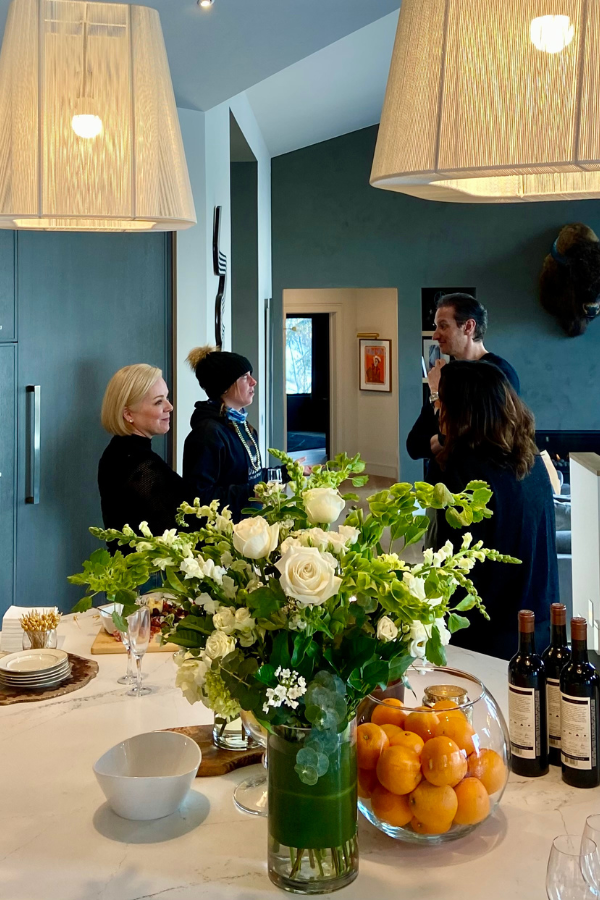
Most social conversations won’t result in immediate referrals. That’s not their purpose. Everyone is there to have a good time, not to sign a contract. What these interactions can do is create familiarity.
People hire designers they feel comfortable with. They hire designers who are confident, realistic, and passionate. Your job, as Laura puts it, is to…
“Do great work and tell everyone about it!”
In social situations, this means waiting until someone asks: about your work week, about your latest project, about “what you do.” It doesn’t mean launching into an oral history of your firm over cocktails or presenting your elevator pitch while waiting in line at the movies. Telling people doesn’t mean broadcasting. It means not hiding. It means answering honestly when asked. It means allowing your work to be part of who you are, not something you awkwardly tiptoe around or allow to subsume your entire personality.
Be proud of yourself. Be open and honest. Your talent and success will be visible to others that way.
Related Posts

The Psychological Dangers of Commodifying All Your Creative Hobbies
Opting to commodify our hobbies has multifaceted and often unexpected
Design Firm Friday: Explaining the Invisible Costs Clients Don’t See
Clients see fees and furniture, but hidden costs like freight, storage
What Do I Do If a Couple Can’t Agree On a Design Direction?
Learn how interior design firm owners can navigate client disagreement

Women at the Helm: Code-Switching in a Leadership Context
Authenticity in leadership and code-switching are not diametrically op
The CEO’s Listening List: Best Business Podcasts For Women
From Women at Work by Harvard Business Review to The Unmistakable Crea

POST COMMENT
You must be logged in to post a comment.