Which Intellectual Property Protections Do Interior Designers Actually Have?

 0
0
 0
0Summary
Interior designers create original work every single day, but not every creative idea receives the same legal protection. This article explores which aspects of an interior design project can be protected through copyright, trademark, patent, and contract law, where those protections become less certain, and practical steps designers can take to safeguard their work before disputes arise.
Reflection Questions
Which parts of your work do you currently consider your intellectual property?
Have you ever discovered your designs, photography, or written content being used without your permission?
Does your client agreement clearly explain who owns drawings, renderings, photography, and other project materials?
Which parts of your creative process would be most difficult to recreate if they were copied by someone else?
Beyond legal protections, what business practices help establish and reinforce authorship?
Journal Prompt
Think about the creative work your firm produces during a typical project, from sketches and floor plans to renderings, specifications, photography, and marketing materials. Which of those assets are currently protected, and where might your business be more vulnerable than you realized?
We know our design work has value. Less obvious is how that work is actually protected once it leaves our brains. An interior design project might be defined by the finalized space, but throughout the design process, firms create drawings, floor plans, renderings, specifications, custom details, photographs, written presentations, websites, social media content, and, in some cases, original homeware products. Clients receive presentations. Contractors receive construction documents. Photographers capture completed installations. Marketing teams publish finished projects online. Every one of those materials represents creative effort, but they aren’t all protected in the same way.
We often talk about “protecting our intellectual property” as though it were governed by a single body of law. In reality, different parts of a design project fall under different legal frameworks. Copyright, trademark, patent law, contracts, and licensing agreements each serve a different purpose, and understanding where one ends and another begins is a lot more complicated than you might think.
Most firms will never find themselves involved in intellectual property litigation. Even so, questions surrounding ownership arise all the time, especially with social media and AI occupying so much online space. Can a client take your drawings and hire someone else to complete the project? Who owns the professional photographs after an installation? Can another designer recreate your mood board? Does registering a copyright actually matter if your work is copied? The answers depend on what, exactly, you’re trying to protect. Let’s discuss.
Interior Design Isn’t Protected by One Law
Interior design is a multidisciplinary profession, so it makes sense that the legal protections surrounding our work are equally multifaceted. A single project might produce original drawings, branded presentations, custom furniture, written specifications, photography, product designs, and digital marketing materials. While all of those assets represent intellectual property in the broad sense, they aren’t necessarily protected by the same legal framework.
Instead, different forms of intellectual property law protect different kinds of creative work. Copyright generally applies to original creative expression that has been fixed in a tangible form, such as drawings, renderings, written content, and certain decorative designs. Trademarks protect the names, logos, and other identifiers that distinguish one business or product from another. Patents apply much more narrowly, as they protect qualifying inventions or ornamental product designs that satisfy specific legal requirements. Contracts, meanwhile, help establish who owns particular materials, how they’re permitted to be used, and what rights clients receive once a project is complete.
Copyright, Trademarks, Patents, and Contracts Often Work Together
These protections aren’t mutually exclusive. A single project may involve several of them at once. An interior designer might copyright original drawings, trademark a product collection or business name, seek patent protection for a custom furniture design, and use client agreements to clarify ownership of project documents and photography. Each serves a different purpose, which is one reason intellectual property questions rarely have simple, one-size-fits-all answers.
Understanding which protections apply to which parts of your work makes it much easier to know when additional steps (e.g., registering a copyright, negotiating licensing terms, or consulting an attorney) might actually be worthwhile. Rather than trying to protect “the project” as a whole, designers are usually protecting individual pieces of creative work, each under its own set of rules.

Copyright Protects More Than You Might Think!
One of the biggest misconceptions surrounding copyright is that creative work isn’t protected until it’s registered. In reality, copyright generally exists the moment an original work is created and fixed in a tangible form. A hand sketch, digital rendering, construction drawing, written proposal, or original textile pattern might all qualify for copyright protection as soon as they’re created.
That doesn’t necessarily mean registration is unnecessary. While creators typically own the copyright from the moment an eligible work is created, registration provides important legal advantages if someone later infringes upon that work. In other words, ownership and enforcement are closely related, but they aren’t exactly the same thing. David Adler, an intellectual property attorney interviewed by Business of Home, explained this a few years ago.
![“The law doesn't say you have to register your copyright to own [it], but a Supreme Court decision requires that you have a copyright registration certificate in hand when you file a copyright infringement lawsuit. So the de facto rule is, you really have to register.”](https://designdash.com/wp-content/uploads/2026/07/image-20-1024x563.png)
That doesn’t mean registering every floor plan, presentation, or furniture specification you produce. It does mean understanding that particularly valuable creative assets like original product designs, proprietary patterns, signature renderings, photography, or collections intended for broader commercial use, might need additional protection. Registration gives designers more options should enforcement ever become necessary.
What Interior Designers Can Copyright
Copyright protects original creative expression, not simply the fact that a design project exists. That distinction matters because an interior design project contains many different kinds of work, some of which qualify for copyright protection more readily than others.
Depending on the project, copyright could apply to original design drawings, renderings, floor plans, custom wallpaper and textile designs, decorative artwork, written specifications, presentation materials, photography, website copy, and other original creative content. Erica Canas, an intellectual property attorney interviewed by Elite Design Assistants, also notes that original ornamental aspects of furniture designs and other custom decorative elements might qualify for copyright protection under the appropriate circumstances.
Not every creative asset requires formal registration, but designers should figure out which parts of their work have value past a single project. A custom fabric developed for a licensing collection, an original wallpaper pattern, or proprietary photography could continue generating business opportunities long after installation and reveal. Those assets might deserve a different level of protection than routine project documentation.
Copyright Doesn’t Protect Every Idea
![“You can't copyright the idea of a sofa or a chair, but maybe there are design elements to it [that you can].“](https://designdash.com/wp-content/uploads/2026/07/image-25-1024x563.png)
Copyright law also has limits. It protects the original expression of an idea but not the idea itself. This is why designers can draw inspiration from historical furniture, architectural traditions, or familiar motifs without automatically infringing on someone else’s work. As Adler explains, common furniture types, by themselves, aren’t eligible for copyright protection simply because someone uses them in a design. Licensing consultant Kate Verner made a similar observation when discussing common forms that have existed throughout design history.
That doesn’t mean people can copy your designs with impunity, but it does mean that intellectual property disputes are a lot more nuanced than simply deciding whether two rooms, products, or pieces of furniture look similar. Original expression, historical precedent, functional requirements, and the degree of creative authorship all influence whether a particular work qualifies for protection. As with many legal questions surrounding design, the answer depends on the specific work itself rather than the project as a whole.
This is also why designers can specify existing furniture, lighting, textiles, and other products while still producing an original design. Although individual products belong to their respective manufacturers and designers, the overall composition, selection, arrangement, and original materials created for the project remain separate creative works.
Fuel your creative fire & be a part of a supportive community that values how you love to live.
subscribe to our newsletter
*please check your Spam folder for the latest DesignDash Magazine issue immediately after subscription

Trademarks Protect Your Business But Not Your Designs
Copyright protects original creative work. Trademarks are entirely different. Rather than protecting the design itself, trademark law protects the names, symbols, and other identifiers that distinguish one business, product, or service from another in the marketplace.
That means your firm’s name, logo, tagline, product collection names, or other branding elements may qualify for trademark protection if they meet the appropriate legal requirements. A trademark helps prevent consumer confusion by distinguishing your business from another, not by preventing someone from designing a room that looks similar to one of yours.
Your Brand Is One of Your Firm’s Most Valuable Assets
As designers, we spend years building a reputation. Clients begin associating our name with a particular level of service, aesthetic, or design philosophy. Over time, that recognition becomes one of the firm’s most valuable business assets, which is exactly what trademark law is designed to protect.
Unlike copyright, trademark rights often grow alongside the reputation attached to the mark itself (your brand). Firms that publish books, license products, launch home collections, or expand into multiple markets should focus just as much on protecting the brand as protecting the creative work it produces.
Registration isn’t necessary for every firm, nor is every name eligible for trademark protection. Choosing a distinctive business name, using it consistently, and consulting an intellectual property attorney when appropriate can help designers determine whether federal trademark registration makes sense for their business.
Patent Protection is Pretty Narrow
Copyright and trademark law apply to most interior designers at some point during their careers. Patents are different. While they’re often mentioned alongside other forms of intellectual property, patent protection applies only under specific circumstances and usually involves original products or inventions rather than an interior design project as a whole.
For designers who create furniture, lighting, hardware, decorative accessories, or other products intended for manufacturing, patents may become part of the conversation. Depending on the design, a product might qualify for either a utility patent, which protects how something works, or a design patent, which protects its ornamental appearance. Both require a formal application process and review by the United States Patent and Trademark Office.
Most Interior Designers Will Never Need a Patent
That doesn’t diminish the importance of patent law. Residential and commercial design projects typically involve specifying existing products, developing construction documents, selecting finishes, and creating original design concepts rather than inventing entirely new products.
Designers who license furniture collections, developing proprietary lighting, or manufacturing custom hardware may eventually find that patent protection makes sense. At that stage, consulting an intellectual property attorney early in the development process is so much more valuable than waiting until a product has already entered the marketplace.
Patents also require public disclosure, filing deadlines, and ongoing legal considerations that differ significantly from copyright and trademark law. For that reason, they tend to play a much smaller role in day-to-day interior design practice, even though they are still an important tool for designers whose work extends into product development.

Photography Introduces Another Layer of Ownership
By the time a project is complete, most designers are thinking about publication, portfolio updates, award submissions, and social media rather than intellectual property law. Yet project photography raises one of the most common ownership questions designers encounter.
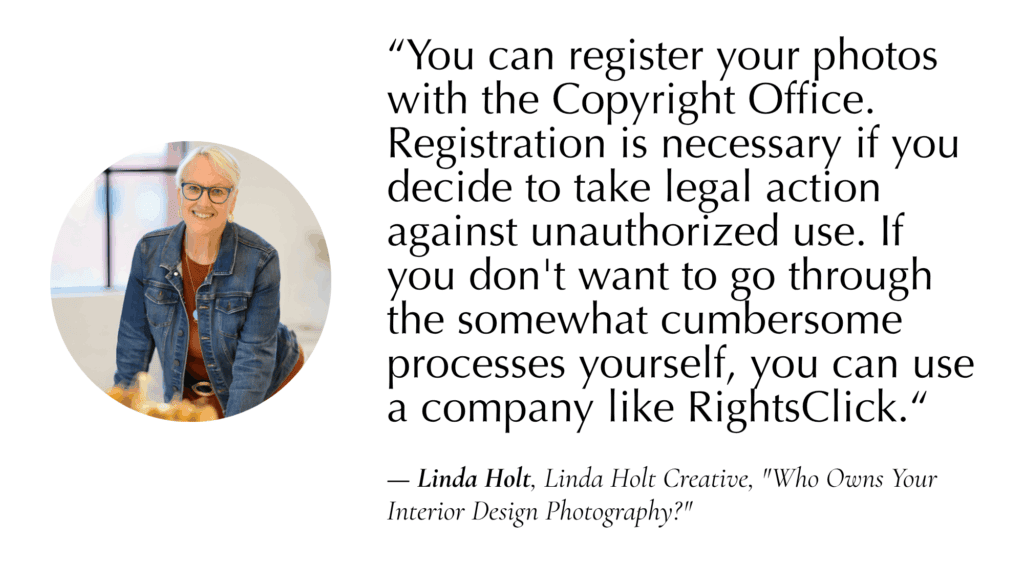
Many people assume that paying for a professional photo shoot automatically means they own the resulting images. In most cases, that’s not actually how copyright works. Unless a contract says otherwise, the photographer generally owns the copyright to the photographs they create, even when the designer pays for the session.
A Photography Agreement Protects Everyone
This doesn’t mean designers have no rights to use their project photography. Those rights should be clearly established before the camera comes out. A photography agreement can define how images may be used by the designer, photographer, client, manufacturers, vendors, publications, and other parties who may eventually request access.
Usage rights are especially important once photographs start appearing in magazines, on social media, in advertisements, or across multiple websites. Without a written agreement, assumptions about who can publish, edit, license, or distribute those images can quickly create unnecessary disputes.
Credit Matters, Too
Ownership and attribution aren’t the same thing. Designers invest months or even years developing a project before it’s photographed. Photographers contribute their own creative expertise through composition, lighting, editing, and post-production. Giving proper credit acknowledges both contributions while making it easier for future clients, editors, and collaborators to identify the professionals behind the finished work.
As projects continue to circulate online, clear attribution also helps establish authorship, strengthen professional relationships, and reduce confusion about who created what.
Put Your Faith in Contracts First
Intellectual property law establishes certain legal rights automatically, but contracts determine how those rights are shared throughout a project. Way before questions of infringement ever arise, designers make decisions about who receives drawings, who may reproduce them, how project photography can be used, and whether original creative work may be transferred to someone else. Those decisions are often addressed through contract language rather than copyright law alone.
This is especially important because interior design projects involve many different participants. Clients receive presentations and construction documents. Contractors rely on drawings to build the project. Consultants contribute their own work. Photographers create new copyrighted material. Vendors request images for marketing. Without clearly defining those relationships, assumptions about ownership will cause problems.
Ownership and Permission Are Different Things
One of the most important distinctions a contract can make is the difference between ownership and permission. A client may receive permission to use drawings for the completion of a project without actually receiving ownership of the underlying intellectual property. Likewise, a photographer may license images for a designer’s website and portfolio while still retaining the copyright to the photographs themselves.
![“A designer can... preserve their work to the best of their ability [by] carefully reading the fine print before sharing images with any website and creating detailed contracts when working with third-party retailers or design communities to ensure correct attribution.” — Maury Riad, “Interior design has an intellectual property problem” for Business of Home, May 2019](https://designdash.com/wp-content/uploads/2026/07/image-17-1024x563.png)
Contracts Should Evolve Alongside Your Business
As firms grow, so do the types of intellectual property they create. A residential practice may eventually develop a licensed furniture collection. A commercial firm might publish research, educational resources, or proprietary design standards. Others begin producing books, digital courses, or original product lines. Each new offering introduces additional questions surrounding ownership, licensing, attribution, and permitted use.
Rather than relying on the same agreement for every project, designers should periodically review their contracts with qualified legal counsel to ensure they reflect the firm’s current services and the creative assets it now produces. A contract written when a firm consisted primarily of residential decorating services may no longer address photography rights, licensed products, or digital content created years later.
Written by the DesignDash Editorial Team
Our contributors include experienced designers, firm owners, design writers, and other industry professionals. If you’re interested in submitting your work or collaborating, please reach out to our Editor-in-Chief at editor@designdash.com.
Related Posts

What is Urban Sprawl and How Does it Impact Working Women?
Let's consider the many side effects of urban sprawl, including their

Top Interior Design Certifications for Advancing Your Career
LIKE 0 LEAVE COMMENT 0 10 min read Summary Professional certifications

Work-Life IntegrationIntegration Tips for CreativeCreative Entrepreneurs
From involving your kids to rethinking your office's layout, here are

Beyond the Space Needle: Celebrating the Seattle Skyline
An intriguing mix of the past and present makes Seattle architecture u

How Transparent Should Interior Designers Be With Clients?
Laura Umansky shares how she balances clear communication, client trus

How to Let Go and Delegate Without Losing Creative Control
As an interior design business owner, it can be difficult to let go an