
What is an Indemnity Clause, and Do You Need It in Interior Design Contracts?

 0
0
 0
0Summary
An indemnity clause helps explain who is financially responsible when a legal claim, vendor issue, contractor mistake, installation problem, or third-party dispute happens during an interior design project. For firm owners, this clause is part of managing risk before the project gets messy.
Reflection Questions
Which parts of your current client agreement explain responsibility for vendor, contractor, receiver, installer, or subcontractor errors?
Are your indemnity provisions tied to the way your firm actually works, or are they copied from a general contract template?
Have you reviewed your indemnity language with an attorney in your state?
Journal Prompt
Write down the last project issue that involved a vendor, contractor, installer, receiver, or client-approved selection. Who did the client expect to fix it? Who actually caused the problem? What would your contract have said if the issue had become a legal dispute?
Welcome back to our series exploring a few clauses interior designers should consider including in client contracts to protect themselves and their firms. Today, we will discuss indemnity clauses, which can help explain who is financially responsible if a client, vendor, contractor, installer, or other party makes a legal claim during a project. As always, we recommend meeting with a licensed attorney before making major changes to any legal documents, including client contracts. This article is not legal advice, and it is not a substitute for professional advice.

What Is an Indemnity Clause?
An indemnity clause is a section of a contract that explains who becomes financially responsible if a legal claim, loss, or dispute happens during a project. According to this resource from Thomson Reuters, indemnity is “an agreement that safeguards one party against the financial impacts of specific actions or events.” In interior design contracts, this clause usually addresses situations where a third party gets involved and one side argues that the other side should cover the resulting costs, damages, or attorney fees.

Interior design firm owners should have a clause like this in any contract where they are expected to deliver a certain result. Here’s an example: a designer specifies a custom banquette, the fabric arrives damaged, the installer blames the fabricator, the client blames the designer, and suddenly multiple parties are arguing over who approved what and when. Another example: a contractor installs lighting incorrectly after receiving revised plans from the electrician instead of the designer’s final drawings. Yet another: a vendor provides incorrect dimensions and the cabinetry doesn’t properly fit the wall it was fabricated for. These situations can spiral into payment disputes or legal disputes very quickly, especially on larger renovations with several vendors, trades, consultants, and procurement orders at one time.
An indemnification clause tries to sort out some of that responsibility before anything bad happens. The language in these clauses typically states that one party agrees to compensate or defend the other party under certain circumstances. Some clauses are narrow and tied specifically to negligence. Others are written much more aggressively and try to shift broad categories of liability from one side to another. However, both sides should know that courts do not enforce every indemnity provision the same way, especially when the language is overly broad or conflicts with state law.
Interior design contracts typically pair indemnification language with limitation-of-liability provisions, contractor responsibility clauses, purchasing terms, and language explaining that the designer is not responsible for errors made by third-party vendors or trades. DesignFiles, for example, lists “liability and indemnification” alongside damages, warranties, contractor coordination, and site safety within its own contract structure for interior designers.
This also explains why indemnity clauses should be placed inside the main client agreement rather than floating around in isolated proposal documents or email approvals. If the agreement already explains who handles procurement, who verifies field measurements, who hires subcontractors, and who approves shop drawings, the indemnity provision has much more context supporting it if a dispute is ever made.
What is Mutual Indemnity?
Some contracts use mutual indemnity language instead of making only one side responsible for claims and damages. In a mutual indemnity clause, both parties agree to protect the other side under certain circumstances. The exact language varies a lot from contract to contract, which is one reason interior designers should have an attorney review these provisions carefully before dropping template language into their agreements.
Think about it this way: a client might agree to indemnify the designer if the client supplies inaccurate site information, conceals construction issues, or hires vendors who create damages or delays that later trigger claims against the designer. Meanwhile, the designer might agree to indemnify the client if the designer’s own negligence, contract breach, or misconduct causes financial harm during the project.

This structure feels more balanced than a one-sided indemnity clause because both parties accept responsibility for their own actions. Still, it might not be the right fit for you and your client base. Some mutual indemnity clauses still shift far more risk onto one side depending on how broadly the language defines negligence, damages, attorney fees, subcontractors, third-party claims, or project oversight responsibilities.
Firm owners should pay close attention to this if they coordinate procurement, communicate directly with contractors, review shop drawings, manage installations, or supervise project execution in any capacity. When several vendors and trades get involved, disputes can become very messy very fast. Clients tend to assume the designer should absorb responsibility for every issue connected to the project, even when the designer didn’t fabricate, install, transport, or physically construct the item causing the problem.
Why Is an Indemnity Clause Included?
An indemnity clause is included because interior design projects involve a lot of people who are not under the designer’s direct control. The client may hire the general contractor. The contractor may bring in subcontractors. A workroom may fabricate window treatments from approved measurements. A receiver may store and deliver furniture. A vendor may ship the wrong item or send a damaged piece. Any one of those decisions can create legal claims, unpaid costs, legal fees, or related claims that still pull the designer into the argument.
The primary benefit of such a clause is risk management. It ensures your contract has the language to define who accepts financial responsibility when certain events happen. If a client hires a contractor who damages finished flooring during installation, the designer shouldn’t automatically absorb the financial burden just because the designer introduced the client to a finish, fixture, vendor, or trade. If a designer makes a mistake that creates damages arising from the designer’s own negligence, that’s a different issue entirely. Indemnity language should help separate those situations before everyone is angry, invoices are unpaid, and the project has turned into a pile of emails nobody wants to read.
Because the words “indemnify,” “defend,” “indemnified party,” and “hold harmless” all have complex legal definitions, we do recommend working with an attorney on this contractual provision. Some indemnification provisions require one party to reimburse the other party after a claim. Some require a legal defense from the beginning. Some include attorney fees, court costs, settlements, direct damages, and expenses arising from a third party lawsuit. Morgan Lewis notes that “indemnify, defend, and hold harmless” can create different obligations depending on the wording and applicable law.
Not including this clause will affect the business relationship if a specific event triggers indemnification. It may also affect commercial insurance contracts held by your firm because not every indemnification agreement is insurable in the same way. A designer can have strong contract language and still need professional liability coverage, general liability coverage, and insurance requirements for contractors, vendors, receivers, installers, and other project participants.
Fuel your creative fire & be a part of a supportive community that values how you love to live.
subscribe to our newsletter
*please check your Spam folder for the latest DesignDash Magazine issue immediately after subscription

Which Contract Does It Belong In?
The indemnification clause usually belongs in the main client agreement, which you will already know is the document that defines the contractual relationship between the firm and the client. This is where the parties agree on services, payment, approvals, procurement, construction administration, third-party vendors, contractor coordination, and limitations on liability.
Some designers may also need indemnity provisions in vendor agreements, trade agreements, receiving agreements, purchasing terms, or procurement documents. This depends entirely on how your firm operates. A studio that only recommends vendors may need different language than a studio that purchases product directly, takes trade discounts, manages freight, handles receiving, and bills the client for furnishings.
This is why we don’t recommend relying on template language you find on the internet. A bare indemnity clause copied from a commercial contract may not account for site measurements, client-approved selections, contractor errors, vendor substitutions, freight damage, discontinued products, backorders, or installation problems. Interior design contracts need indemnity language tied to the way your firm actually operates. Otherwise, the clause might sound serious but barely be enforceable.

Do Certain States Have Different Rules?
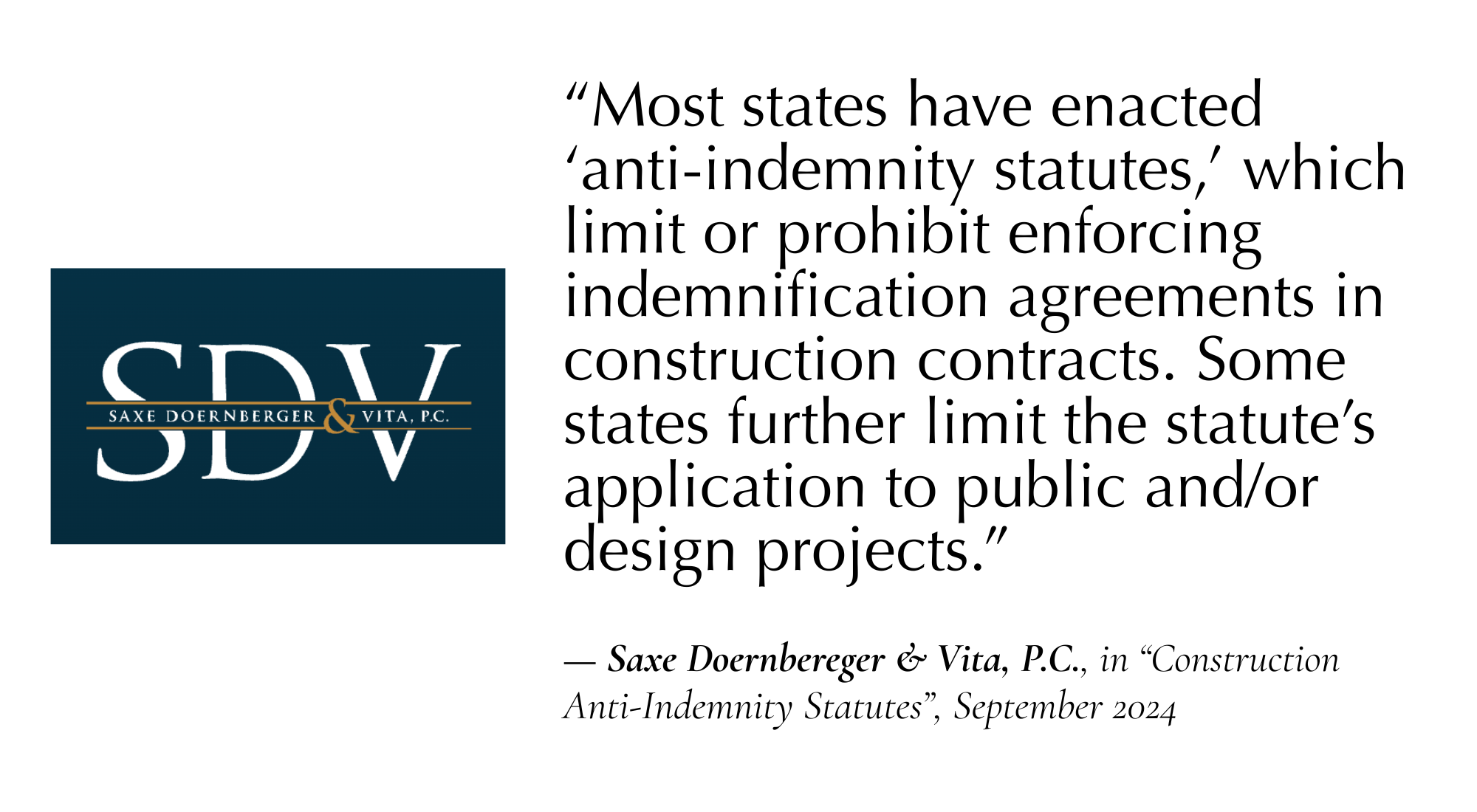
Yes! State laws can change how indemnity agreements are enforced, especially in construction contracts. Many states have anti-indemnity statutes that limit how much risk one contracting party can shift onto another. SDV Law’s construction anti-indemnity survey states that most states have enacted statutes limiting or prohibiting certain indemnification agreements in construction contracts.
That point is important for interior designers because many projects touch construction, even when the designer is not acting as the general contractor. A full-service renovation may involve drawings, specifications, contractor coordination, site visits, procurement, installation, and client approvals. If the contract language tries to make one party responsible for another party’s own gross negligence, willful misconduct, or broad construction-related liability, applicable law may limit or reject that language.
State rules vary widely depending on the type of contract, the parties involved, the level of fault, and the category of damages. Some states treat construction contracts differently from ordinary commercial contracts. Some rules focus on sole negligence. Some address gross negligence or willful misconduct. Some affect whether attorney fees, legal defense, punitive damages, personal injury claims, product liability, or third party claims can be shifted from one party to another.
This is yet another reason why a licensed attorney really does need to review the clause. The enforceability of indemnification obligations depends on the actual wording of your clause, the state law governing the contract, and the facts around the event you’ve predicted. A clause that works in one state might very well need revisions in another. A clause that works for procurement may not work the same way for injuries occurring on a construction site.
Written by the DesignDash Editorial Team
Our contributors include experienced designers, firm owners, design writers, and other industry professionals. If you’re interested in submitting your work or collaborating, please reach out to our Editor-in-Chief at editor@designdash.com.
Related Posts

Key Takeaways from “Billing Methods For Interior Designers” on the DesignDash Podcast
Learn about different interior design billing methods—from hourly an

10 Tips for Growing Your Online Presence in a Crowded Creative Market
Learn to define your niche, optimize your website, leverage social med

Career Guide: How to Become an Architect in the U.S.
The path to becoming a licensed architect in the U.S. is rigorous and

Sustainable Practices in Interior Design Businesses
LIKE 0 LEAVE COMMENT 0 8 min read Summary Reflection Questions Journal