
What Should Design Firms Do When Products Are Backordered or Discontinued?

 0
0
 0
0Summary
Backorders, discontinued products, damaged deliveries, and vendor closures have become an unavoidable part of the design industry. While no firm can prevent supply chain disruptions, thoughtful contracts, clear communication, and well-defined billing policies can determine whether those challenges become manageable inconveniences or expensive business problems. This article explores how experienced firms prepare clients for procurement realities, when replacement selections should be billed, and what to do when products simply aren’t available anymore.
Reflection Questions
How does your firm currently handle discontinued products after selections have already been approved?
Does your client agreement explain who pays for replacement selections, additional procurement time, or project delays?
How often do you communicate lead times and vendor updates throughout a project?
If one of your primary vendors unexpectedly closed tomorrow, how prepared would your firm be?
Does your billing structure support the realities of procurement, or does it encourage your team to absorb additional work?
Journal Prompt
Think about the last time a product became unavailable after you had already specified it. How did your team respond? Looking back, did your firm’s billing policies and client communication make that situation easier to manage, or did they create unnecessary stress for everyone involved?
A client approves the furniture plan, and pretty soon, fabric is selected for upholstery, quotes are finalized for custom pieces, and your procurement team starts placing orders for off-the-shelf items. The project continues moving along until an email arrives from the vendor explaining that the sofa has been discontinued, the finish is no longer available, or the manufacturer has pushed production back several months. The selections now have to be revisited even though you’re pretty far along in the project.
Situations like these aren’t exactly uncommon. Supply chain disruptions receive most of the news coverage, but they’re not the whole story. Manufacturers discontinue products. Mills stop producing fabrics. Vendors close their doors. Collections change. Lead times that seemed perfectly reasonable might be much longer by the time a client approves an order.
Replacing those products takes time. After you do find the right piece, pricing, lead times, installation schedules, and overall design intent probably all need another round of review. Every replacement introduces another series of professional decisions. DesignDash Co-Founder and Founder and CEO of Laura U Design Collective Laura Umansky believes designers should recognize this work for what it is.
Questions about discontinued products eventually evolve into questions about business operations. Who absorbs the additional design hours? How should clients be prepared for delays that nobody in your firm caused? What should be in the firm’s contract before procurement starts?
Procurement Doesn’t End After Selections Are Approved
Approving selections is an important milestone, but it isn’t the end of procurement. Furniture orders still need to be placed, vendors will (or won’t) confirm availability, production schedules might change, and freight timelines could be extended. Sometimes a manufacturer retires an entire collection between specification and ordering. None of those developments change the design intent, yet every one of them needs a person to evaluate what comes next.
Even though your team is well aware of it, clients don’t always see that effort because much of it happens behind the scenes. Procurement teams communicate with vendors, compare replacement options, request updated pricing, confirm dimensions, verify finishes, and coordinate revised delivery schedules before presenting a new option. A discontinued product might look like a single email in the client’s inbox, but your firm might spend hours of additional work on coordination before the project’s ready to move forward again.

Replacement Selections Still Need Your Team’s Professional Judgment
Clients might think that finding another product is simply a matter of opening a catalog and choosing the next closest option. But that’s really not true. Every replacement has to work within decisions that have already been made. Scale, proportions, finish, performance, lead time, pricing, installation requirements, and the overall design concept all need another review before a recommendation is made to the client. Every decision relies on another in a design project.
Laura Umansky believes this is where designers sometimes underestimate their own work. Clients may only see the final recommendation, but they don’t necessarily see the investigative work that happened beforehand.

Replacement selections require your team to be forward-thinking, which is yet another element to this process and why it’s not so straightforward. A substitute shouldn’t simply solve today’s availability problem if it creates another issue later in the project; you have to preserve the project’s integrity.
Preserving the overall concept might mean evaluating products from entirely different manufacturers, revisiting earlier design decisions, or adjusting other specifications to maintain a cohesive result. The client ultimately receives a new recommendation, but considerable professional judgment typically precedes that conversation.
Your Billing Structure Determines Who Absorbs that Time
Time is money. Someone is paying for the extra hours spent on this part of your project, but is it your firm or the client? The answer depends largely on how a firm structures its fees. Some firms charge a flat design fee, which establishes a fixed price for a defined scope of work. Others charge by the hour, billing clients only for the time actually spent on their project. Both models are common in our industry, but they handle unexpected situations very differently.
When a project follows its original path with no interruptions or alterations, those differences might not be especially noticeable. But if your team handles procurement, that completely smooth road is the road less traveled. Bumps are common! Manufacturers discontinue products. Vendors extend lead times. Clients change their minds. Shipments reach you damaged.
Every one of those situations means additional professional time, regardless of who caused the disruption. Laura Umansky believes hourly billing empowers firms to respond to those changes without turning every unexpected situation into a negotiation.

Hourly billing also gives designers the flexibility to pursue the best solution instead of the fastest one. When additional research, sourcing, vendor conversations, or client meetings are needed, those hours become part of the design process rather than work the firm feels pressured to absorb. Clients benefit because the design team is focused on solving the problem instead of deciding whether the solution still fits within a fixed fee. Laura believes this creates healthier relationships for both the client and the design team.
That doesn’t mean firms working under flat fees can’t navigate procurement successfully, as some do. However, they often have to decide whether replacement selections fall within the original scope of work or whether additional services should be billed separately. Hourly billing largely eliminates that question because the project simply continues moving forward. This means that the team can continue being responsive while clients pay only for the professional time their project actually needs.

Set Expectations Right Away
Product delays won’t damage client relationships on their own. Procurement is one of the few parts of an interior design project that depends almost entirely on outside manufacturers, freight companies, fabric mills, and suppliers. Designers and their teams can manage those relationships, but they can’t control every production schedule or inventory decision.
Rather than waiting until a favorite sofa disappears from a manufacturer’s catalog or a custom finish suddenly becomes unavailable, it’s important that you explain this part of the process from the outset. Clients don’t need every possible scenario spelled out in advance, but they do benefit from understanding that design projects are dynamic and that adjustments are sometimes necessary.
Fuel your creative fire & be a part of a supportive community that values how you love to live.
subscribe to our newsletter
*please check your Spam folder for the latest DesignDash Magazine issue immediately after subscription

Discuss Delays Before They Become Delays
Preparing clients for procurement realities doesn’t mean that you need to start every consultation with worst-case scenarios. Clients are excited about their future homes, and they deserve to enjoy that excitement. At the same time, setting realistic expectations early makes later conversations much easier because neither party feels blindsided when circumstances change.

Natasha Bishop, owner and principal architect of Bishop Design, introduces those conversations during the consultation and discovery phase rather than after procurement is already underway. Interior designer Antoinette Fargo follows a similar approach by introducing supply chain realities from the very beginning of the relationship.
You’re trying to establish realistic expectations. Clients who understand that procurement depends on manufacturers, freight schedules, and inventory decisions will be better prepared to evaluate replacement options thoughtfully instead of reacting emotionally when something changes.
Give Clients Options Instead of False Certainty
Expectation setting doesn’t stop once the contract is signed. Procurement is an ongoing process, and clients appreciate understanding the decisions they’re being asked to make along the way. Sometimes the right answer is waiting several months for the perfect custom piece. Other times, selecting an in-stock alternative allows construction or installation to continue without interruption. Neither approach is universally correct because every project has different priorities.
Several designers interviewed by Houzz recommend identifying alternative products before they’re actually needed. Maintaining a “Plan B” allows firms to respond quickly when inventory changes unexpectedly without sacrificing the overall design concept. Clients remain part of the decision-making process, but they aren’t forced to begin the selection process from scratch.
Architectural Digest reaches a similar conclusion when discussing long lead times. Interior designer Josh Greene recommends building conservative schedules from the outset rather than promising timelines that leave no room for unexpected delays.
That same conversation also creates an opportunity to explain why some products deserve additional patience. Custom furnishings frequently need longer lead times than readily available pieces, but they’re often selected because they solve design challenges that mass-produced alternatives simply can’t. Interior designer Kirill Istomin encourages designers to help clients understand that relationship between craftsmanship and time.

Whether the solution involves waiting for the original selection or identifying an appropriate replacement, clients are generally better equipped to make those decisions when they understand why you’re making the recommendation that you are.

Your Contract Should Explain Your Role in Procurement
Every procurement process involves some amount of risk. Products arrive damaged. Manufacturers discontinue collections. Freight companies lose shipments. Vendors unexpectedly close their doors. None of those situations are unusual, but they do raise an important question. Who is responsible for solving the problem?
The answer depends partly on your contract and partly on how your firm defines its role. Many interior designers coordinate purchasing, oversee deliveries, communicate with vendors, and manage replacements when problems arise. Those responsibilities are substantial, but they don’t necessarily mean the designer guarantees that every product will arrive exactly as ordered or that every manufacturer will fulfill its obligations without interruption. Business coach Sean Low believes many firms unintentionally create confusion by failing to distinguish between acting as a retailer and acting as a procurement agent.
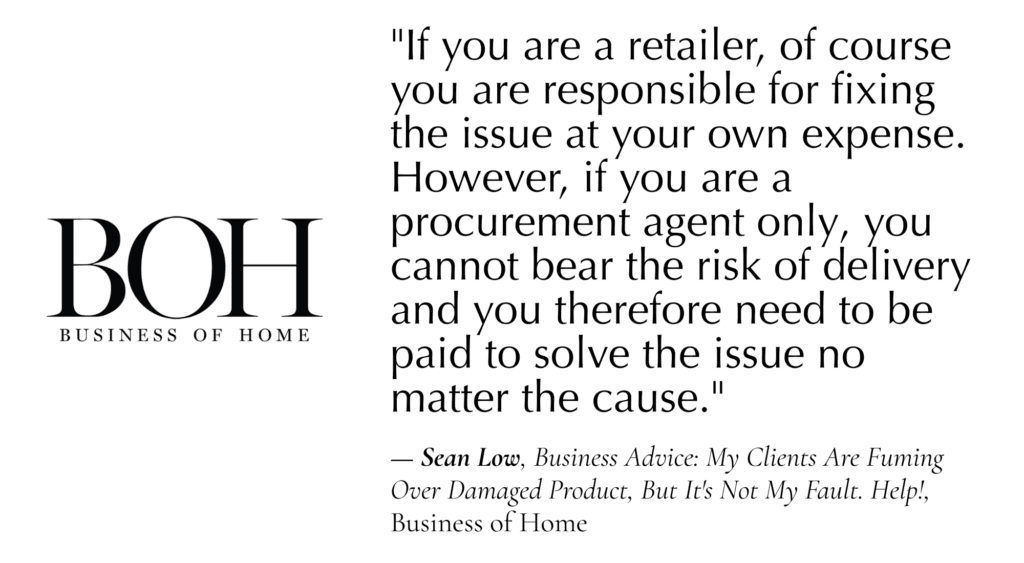
That also shapes how your firm responds when manufacturers discontinue products, vendors change finishes without notice, or freight delays push installation back several weeks. If clients understand your role from the beginning of the relationship, those conversations are much easier to have because everyone shares the same expectations about who is responsible for what.
Some Problems Are the Firm’s Responsibility
Not every procurement issue belongs in the same category. A manufacturer discontinuing a product presents one set of circumstances. An incorrect specification, ordering mistake, or oversight by the design team presents another. Laura believes that distinction matters internally, even if it doesn’t change the firm’s commitment to helping the client reach a successful outcome.
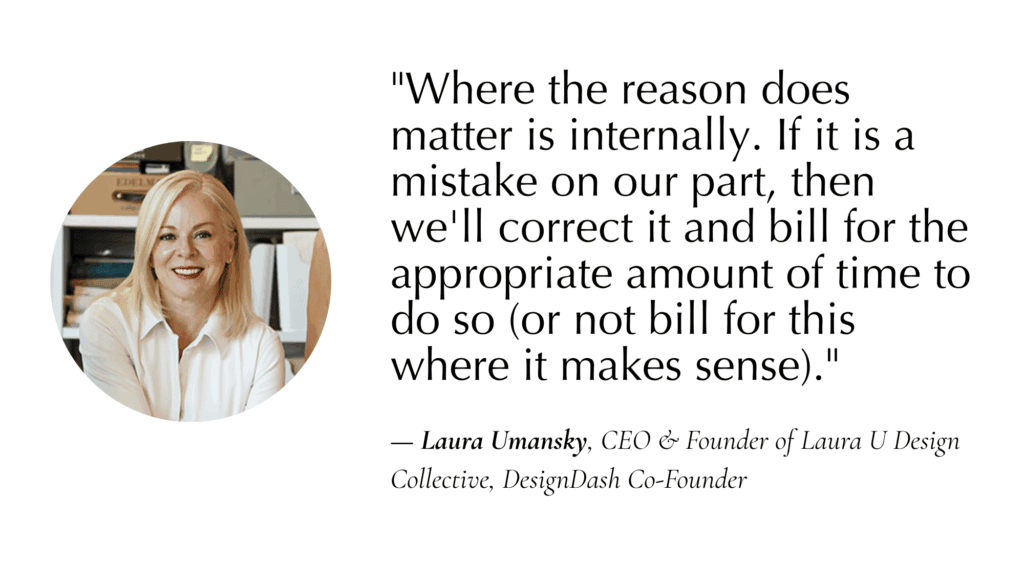
Every firm should decide how it wants to handle those situations before they occur. A written policy promotes consistency across projects and gives the design team a framework for making decisions when procurement doesn’t go according to plan. Clients are also more likely to trust a process that reflects accountability for genuine mistakes while recognizing that many disruptions originate well outside the designer’s control.
Written by the DesignDash Editorial Team
Our contributors include experienced designers, firm owners, design writers, and other industry professionals. If you’re interested in submitting your work or collaborating, please reach out to our Editor-in-Chief at editor@designdash.com.
Related Posts

Five Vladimir Kagan Designs That Still Shape Modern Interiors
Learn more about 5 iconic designs that reveal why Kagan's timeless app

How to Become an Art Therapist
Curious about how to become an art therapist and combine your love of

How to Time Block for a More Satisfying, Efficient Workflow
Time-blocking can help you reclaim your schedule, boost your focus, an

Suzanne Valadon and the Société Nationale des Beaux-Arts
Suzanne Valadon was a remarkable 19th-century artist, distinguished by

Mid-Career Switch: How to Become an Event Planner With No Experience
If you've ever dreamed of orchestrating unforgettable experiences, a m

How to Let Go and Delegate Without Losing Creative Control
As an interior design business owner, it can be difficult to let go an