Takeaways from Our Interview with Storied Interiors’ Anne Golliher

 0
0
 0
0Summary
Anne Golliher built Storied Interiors around her ability to decide which existing pieces should stay, which should go, and where new investment will complete the house. Because that approach can reduce product sales, much of the firm’s profitability comes through service fees and clearly defined Short Story Sessions. Her current rebrand aims to separate clients who want a few hours of advice from full-service clients who value their history and have the budget to finish the project.
Reflection Questions
- When a client wants to keep most of what they own, does your fee structure account for the time required to edit, rearrange, restore, and supplement those pieces?
- Does your current messaging distinguish between clients who want a consultation and clients who want full-service design?
- Which final details are usually removed from your projects when the client is satisfied before the original design is complete?
Journal Prompt
Think about a recent client who came to you with furniture, art, or inherited pieces they wanted to keep. Write down what stayed, what left, and which new purchases were required to complete the design. Then review whether your fees and product revenue properly accounted for the work involved.
Can an interior designer build a profitable firm around furniture a client already owns? Anne Golliher, Founder and Principal Designer of Storied Interiors, has spent about 13 years answering that question. Her clients often come to her with inherited furniture, art purchased in their 20s, objects collected while traveling, and rooms that have accumulated pieces over several stages of family life. Anne decides what still belongs, what needs a bit of investment, and what should go.
That approach differs from a business built mainly around new furnishings or large construction projects. The financial problem is a significant one. If Anne reuses 50% of what a client owns, she says she may lose 50% of the product profit attached to that project. Storied Interiors therefore earns much of its profit through services, while new rugs, wallpaper, custom pieces, vintage finds, and other purchases contribute on the product side.
In Episode 101 of the DesignDash Podcast, Anne joins hosts Laura Umansky and Melissa Grove to discuss the discernment behind her work, the Short Story Sessions she created for smaller projects, and the difficulty of reaching full-service clients who value their existing pieces and understand what professional interior design costs.
Three Takeaways from Episode 101 of the DesignDash Podcast: How to Build Beautiful Spaces From Existing Pieces with Anne Golliher
Discernment Determines What Belongs in the Next Version of a Home
Anne says she works more effectively and efficiently when she can look at what’s already within a home and make sense of it. One piece needs to go, another needs a different location… The room might also need custom furniture, new upholstery, wallpaper, or art before the existing pieces work together.
She compares the process to a puzzle. Her clients have often built a life through travel, family, inheritance, and years of buying what they love. Some have lived in the same house for 25 years. Others have recently finished the baby stage or watched their children graduate. They’re ready to look at the furniture and objects they have collected and decide what belongs in the house now.
A college sofa may have served the family well for years, but its time might be over. A grandmother’s armoire could work beautifully in another room after a new finish or a change in context. Another inherited piece may have personal meaning but no practical place in the house. Anne also helps clients give themselves permission to let those pieces go.
But first, Anne wants to know why her client kept a piece, who owned it before them, and which memories are attached to it. Sometimes an old idea returns to the home elsewhere, perhaps through a color, material, or object rather than through the original furniture.
New purchases are still part of most projects Anne spearheads. She might specify custom furniture, vintage lighting, rugs, wallpaper, art, and decorative objects that work well with what the client already owns. As she tells Laura and Melissa, she wants the space to embody the client’s history and personality without being limited solely by the client’s current collection.
Melissa also points to the amount of waste associated with luxury residential design. Anne has noticed greater interest in vintage pieces and in homes that embrace their character. That interest has also made certain pieces, including vintage lighting, harder for her to find.

Reusing More Furniture Refactors the Firm’s Profit Engine
Anne doesn’t hedge about the financial tradeoff she accepts in doing this kind of work. Buying new furniture can produce meaningful product profit for an interior design firm. Boutique and vintage purchases can do the same. If Storied Interiors uses half of what a client already owns, Anne estimates that she has cut that portion of the potential profit in half.
She still wants to grow the firm, support her current employee, and hire additional staff in the future. To do that, the business has to earn money somewhere. Anne estimates that services account for roughly 50 to 60% of her annual profitability. Full-service projects also include new custom pieces, wallpaper, rugs, and other finishing details that produce revenue on the product side.
Anne has created a separate service for clients who want her eye but do not need a full-service project. She calls these appointments Short Story Sessions. During the three-hour session, Anne works with what the client owns. She rearranges furniture, hangs pictures that may have rested against a wall for five years, selects paint colors, and gives the client a plan to complete independently.
She doesn’t purchase furniture or manage any work after the session. The client takes over from there. Because the scope is clearly defined, Anne can charge an hourly rate that accounts for her experience without confusing that service with a larger project.
But this business model has been a long time coming. Anne once described her work with the phrase “use what you have.” Someone pointed out that potential clients could interpret that as “let’s not spend any money.” That message doesn’t support the full-service side of Storied Interiors.
A client can keep a grandmother’s armoire and still spend thousands on wallpaper, a new rug, art, custom upholstery, and installation. Anne knows she needs to explain those numbers earlier and with greater confidence. She gives the example of telling a client that the wallpaper they want may cost $5,000 by the time it’s installed. The existing pieces define the starting point, but they don’t determine the full project budget.
Fuel your creative fire & be a part of a supportive community that values how you love to live.
subscribe to our newsletter
*please check your Spam folder for the latest DesignDash Magazine issue immediately after subscription

Clearer Messaging Separates DIY Help From Full-Service Design
Anne has spent about six months rebranding Storied Interiors. She has worked on the firm’s visual identity, language, services, and client-facing materials. During that process, she has had to examine whom her current messaging attracts and whether those people match the clients she wants for larger projects.
The phrase “use what you have” can attract someone who wants a few hours of advice and plans to complete the room alone. Short Story Sessions give that client a defined place inside the firm. Anne also wants whole-home projects where she can select new pieces, manage the full design, and develop her ideas across every room.
Her ideal full-service client is quite specific. Anne describes a couple in their mid-30s who may have recently finished the baby stage. Their sofa has survived children, pets, and several years of family life. They may have purchased art or furniture in their 20s, then paused after realizing that finishing their home takes a lot of mental and emotional investment.
These clients care about design, but they also have careers and families. They have spent weekends searching Facebook Marketplace, Pinterest, and estate sales. Some purchases worked while others didn’t make as much sense upon delivery and installation. They now want someone to shorten that process and make the house complete.

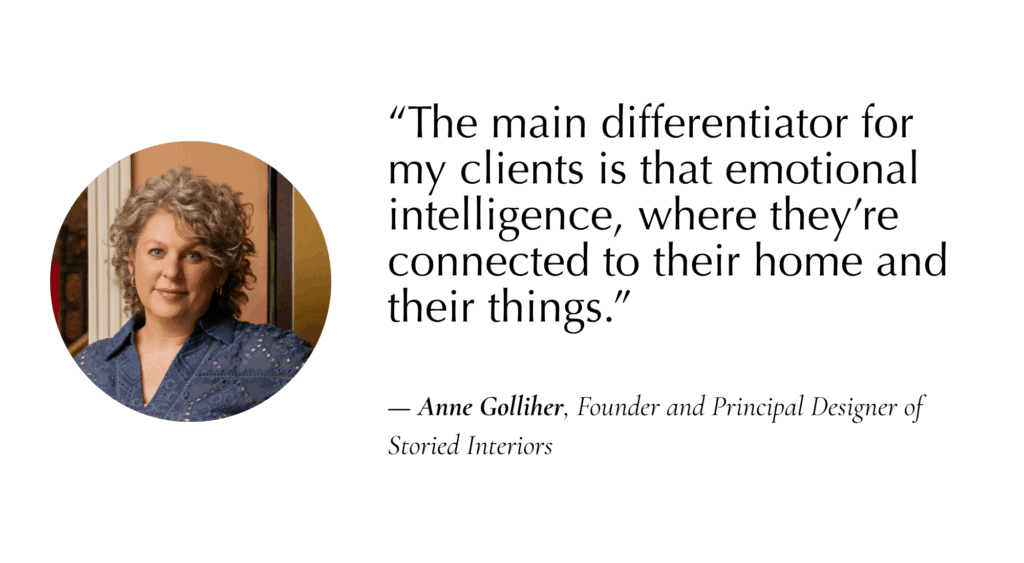
Anne describes emotional intelligence as the main distinction between her clients and other potential clients. They are truly connected to their homes and possessions. They want a designer who will listen to the stories behind those pieces rather than replace everything or impose the same signature “look” on every room.
They also have to understand the investment. Anne can preserve an important object, reinterpret a memory, and design around a family’s history. She still needs a budget for custom furniture, labor, wallpaper, rugs, vintage pieces, and professional services.
Laura and Melissa point out that Anne’s audience might be larger than she realizes. Many homeowners care about sustainability, own pieces they don’t want to discard, and worry that a designer will take control of the house without listening to them. Those clients might simply have no idea that firms like Storied Interiors exist.
Anne sometimes imagines the one project or client who could propel the firm into its next stage. But Laura disagrees with this premise. Anne isn’t sitting there, passively waiting for a benefactor. With every project, she’s revising her brand, defining her ideal client, building services, and changing the business when one part of the model isn’t working anymore.
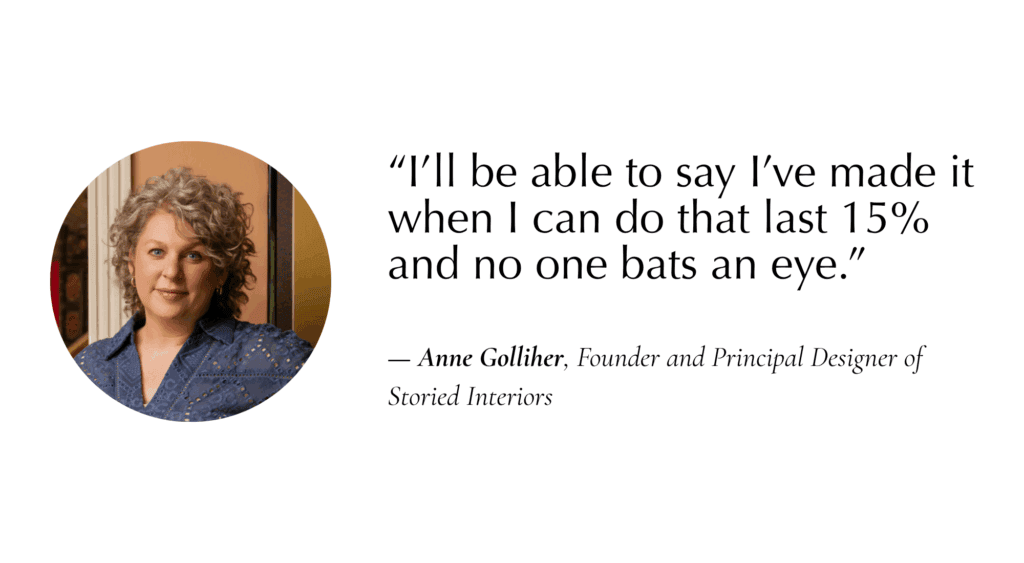
Anne has a specific benchmark in mind. She has completed whole homes over time, but some projects stop at about 85% completion because the client is already happy. Anne still sees the final pieces she would add and yearns to do so.
Listen to the Full DesignDash Podcast Episode
By the end of the episode, Anne has separated two groups of clients who would both connect with her work. One wants three hours of direct advice and plans to finish the house independently. The other wants a full-service designer who will respect the pieces they own, make difficult decisions, source what’s missing, and complete the project.
Listen to Episode 101 of the DesignDash Podcast for Anne’s full conversation with Laura and Melissa about inherited furniture, Short Story Sessions, service profitability, ideal clients, and the final 15% of a whole-home project.
Written by the DesignDash Editorial Team
Our contributors include experienced designers, firm owners, design writers, and other industry professionals. If you’re interested in submitting your work or collaborating, please reach out to our Editor-in-Chief at editor@designdash.com.
Related Posts
How Do I Stop Spending So Much Time On Low-Value Tasks as a Firm Owner?
Firm owners get stuck on low-value tasks, but delegation, hiring, and
All About Hudson Valley Lighting: What Designers Should Know
Loving their designer-forward approach, we have worked with HVLG for y

Women, In Their Own Words: Bre Hance
From creative rituals to leadership lessons, Bre Hance shares insights

Day 3: DesignDash Focus & Flex Challenge
It's Day 3 of the Focus & Flex Challenge! How do you address self-doub

Don’t Miss These June 2026 Design, Art, and Architecture Events
We've rounded up six June 2026 design, art, and architecture events, i

Day 7: DesignDash Focus & Flex Challenge
It's the LAST day of our Focus and Flex Challenge! How did the Pomodor