13 Charming Curtain Tiebacks to Make Your Drapery More Whimsical

 0
0
 0
0Summary
Curtain tiebacks have a much longer and stranger history than the standard tassel-and-cord version suggests. This article traces that history through passementerie, metal holdbacks, glass and porcelain examples, and then rounds up thirteen tiebacks that range from Victorian hands and Empire birds to brass bows, lemons, mirrored holdbacks, and contemporary tassels.
Reflection Questions
When I choose window treatments, do I usually stop at fabric and hardware, or do I think about the tieback as part of the decorative composition too?
Which tieback types fit most naturally with the rooms I’m drawn to: tassels and cords, sculptural metal holdbacks, botanical forms, or more eccentric figural pieces?
Where in my own work could a tieback add more shape, ornament, or historical reference without tipping the room too far into costume?
Journal Prompt
Write about a window treatment you love, either from one of your own projects, a historic interior, or a room you have saved for years. Focus only on the tieback, or on the fact that there isn’t one. What material would make the most sense there: silk cord, tassel, brass, bronze, glass, porcelain, or something more unusual? Describe the curtain fabric, the scale of the folds, the wall beside the window, and the kind of tieback that would suit it best. Then write about whether you’d want the tieback to blend in, match the trim, or pull the eye on purpose.
In our recent article on passementerie, we defined the broader decorative category that includes fringe, tassels, braid, cord, galloon, gimp, rosettes, and tiebacks. Tiebacks were only one small part of that glossary, but they deserve a much closer look. They’re one of the few window treatment details that are both practical and unabashedly decorative. A tieback can be a tassel, a cord, a band of fabric, a brass hook, a cast metal figure, or something far stranger.
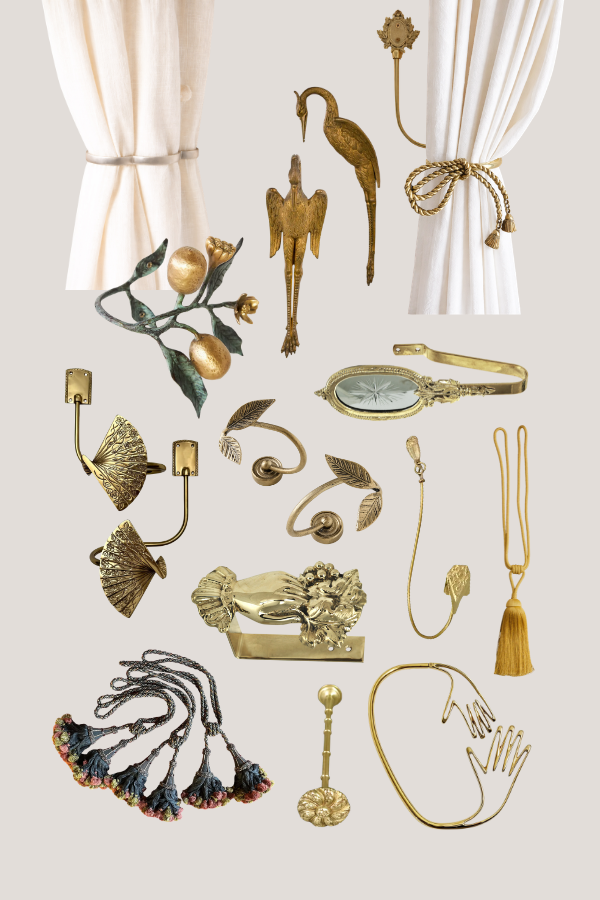
You can probably picture the basic version: drapery pulled to one side with rope or a tassel. But tiebacks have a longer and more varied history than that somewhat boring image suggests. Some are formal and historical. Some are playful. Some are sculptural. This article starts with a short history of curtain tiebacks, then looks at thirteen examples that will charm your guests and delight you everyday.
A Brief History of Curtain Tiebacks
Curtain tiebacks developed alongside the heavier and more elaborate window treatments of early modern Europe. By the 17th and 18th centuries, curtains were often layered, lined, and trimmed, especially in formal French and English interiors. Tiebacks helped keep side drapery off the glass and controlled the shape of the folds. They also gave decorators another place to add ornament. In many rooms, that meant cords, tassels, fringe, knots, rosettes, and other passementerie details made in silk, cotton, metal thread, or wool.
The textile versions are probably best known. Silk cords with large tassels were common in 18th- and 19th-century interiors, especially in French and English rooms with full-length drapery, valances, and elaborate trimmings. Some were braided or wrapped by hand. Some included wood forms underneath the threadwork. Some were trimmed further with knots, skirted heads, or bead-like ornaments. The tieback could match the curtain trim exactly, or it could introduce another color and texture.

Metal holdbacks were common too, and they could be much more rigid and architectural. Bronze, brass, and ormolu versions turn up in Empire, Regency, Victorian, and later revival interiors. Scrolls, rosettes, leaves, birds, hands, and neoclassical motifs were all used. Some were cast in one piece and mounted directly to the wall. Others combined a metal hook with a textile cord or tassel. The French Empire bronze bird tiebacks found later in this article are a good example. So are the Hollywood Regency brass versions, which make the tieback seem more like decorative hardware than soft trim.
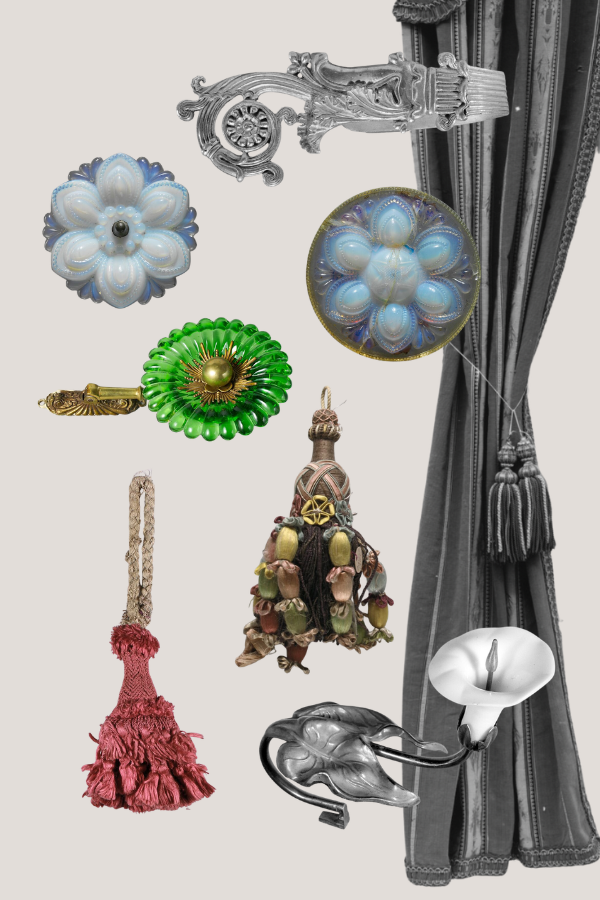
Glass and porcelain tiebacks were another popular style in the 19th century. Milk glass, opaline glass, and ceramic floral forms gave the wall a brighter, more jewel-like point near the curtain edge. The flower-shaped examples from the Met’s collection show how ornate even a small holdback could be.
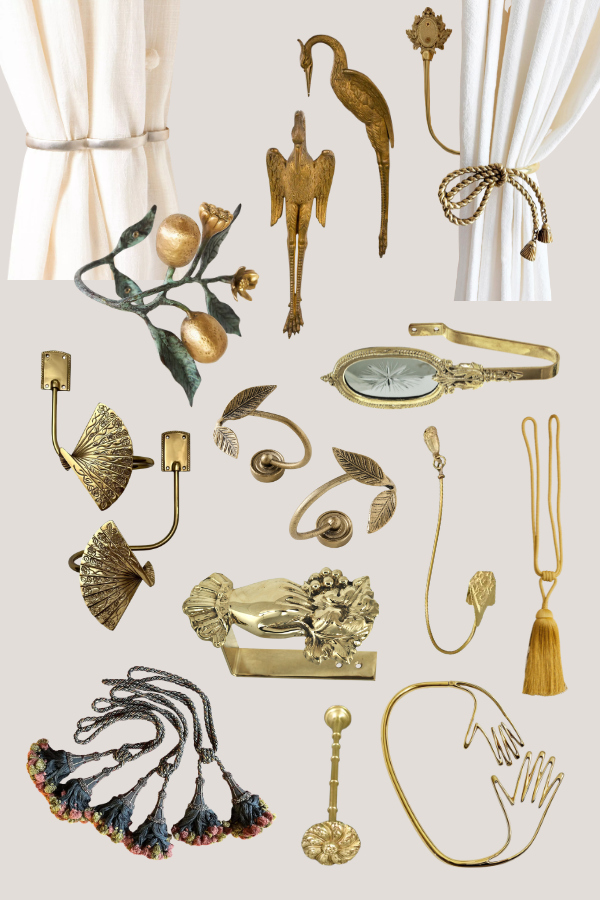
13 Whimsical Tiebacks for Your Next Custom Drapery Project
The Constance Tieback in Grey from Anthropologie
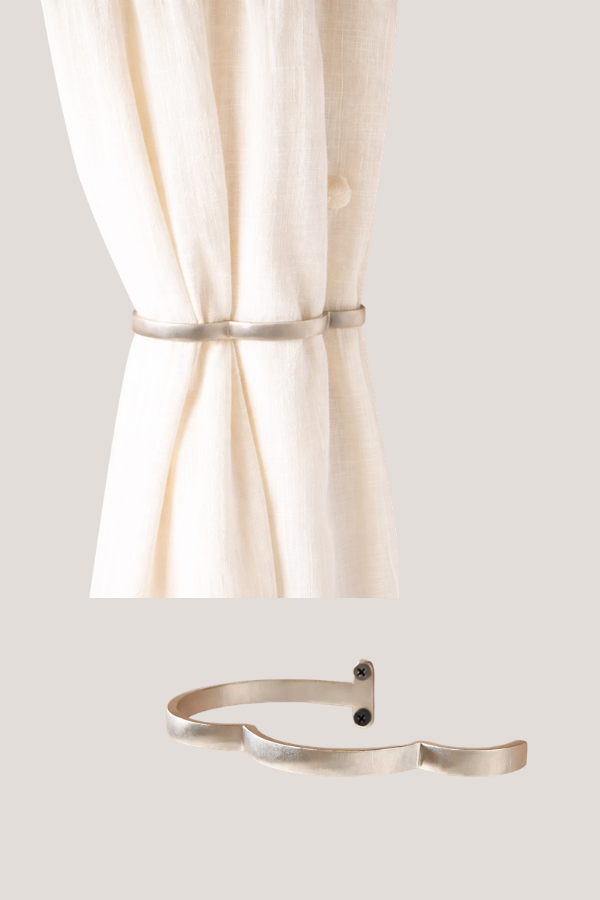
Anthropologie’s Constance Tieback is a cast iron holdback with a flattened loop and a waved front edge. It mounts directly to the wall with two visible screws and is sold individually. The shape is spare, but the slight bends prevents it from looking completely utilitarian.
There’s a little bit of Art Nouveau or midcentury metalwork in the line. Around a sheer or loosely woven curtain, it keeps the drapery close to the wall and gives the fabric a narrow gathered middle.
A Pair of Vintage Hollywood Regency Solid Brass Curtain Tiebacks from Chairish
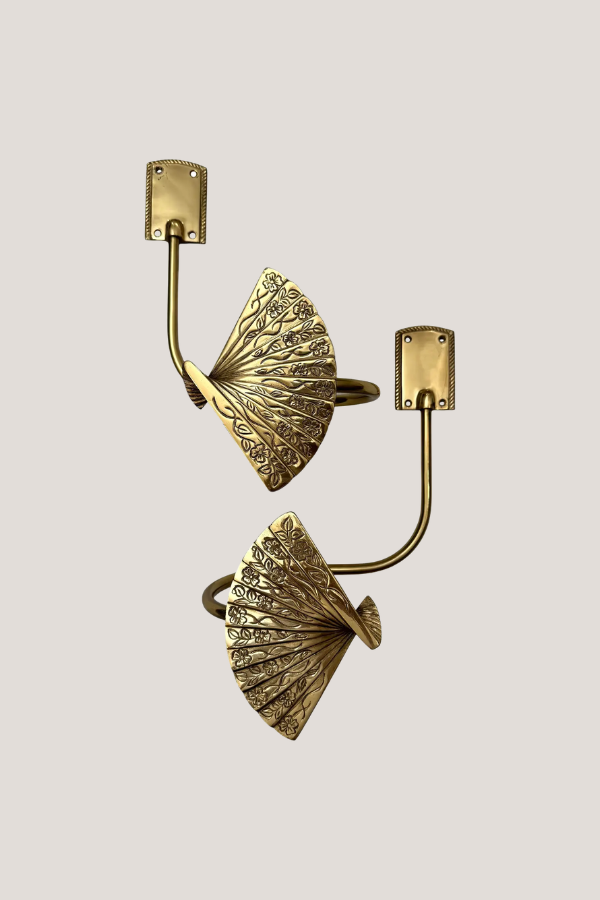
This pair of vintage solid brass tiebacks has a curved arm and a rectangular backplate with a rope-edged border and visible screw holes. The front is shaped like an open fan, with etched floral detailing across each rib and a scalloped outer edge. They project fairly far from the wall, so they would work best with fuller drapery rather than a very slim panel.
The fan form gives them a little bit of chinoiserie, and the polished brass puts them squarely in the Hollywood Regency camp. They’re decorative in a very obvious way, which is part of the appeal. These would make the most sense with drapery that already has some body and formality to it.
Pair of French Empire Bronze Bird Tiebacks from 1stDibs
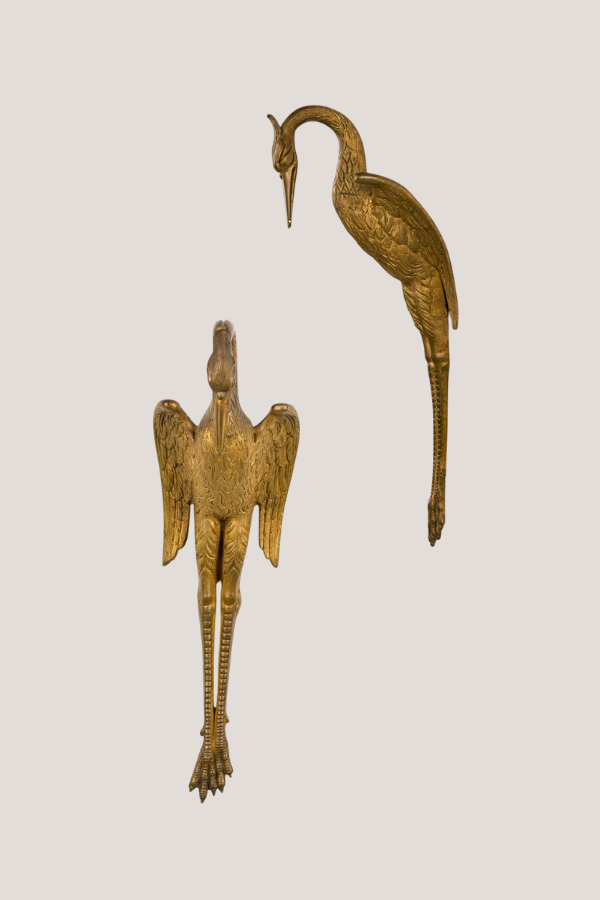
These French Empire tiebacks are cast in bronze and shaped as long-legged birds with lowered wings and pointed beaks. The bodies are textured with engraved feather detail, and the birds are mounted flat against the wall so the heads project outward to catch the drapery. At sixteen inches high, they are much larger than a standard hook, which gives them a more commanding air.
The bird form fits the Empire label, especially with the symmetry, the stylized anatomy, and the bronze finish. They look closer to wall ornament than ordinary drapery hardware. On full curtains, they would be very hard to miss.
This Butterfly Knot Brass Curtain Tieback from FabricSpaceDesign on Etsy
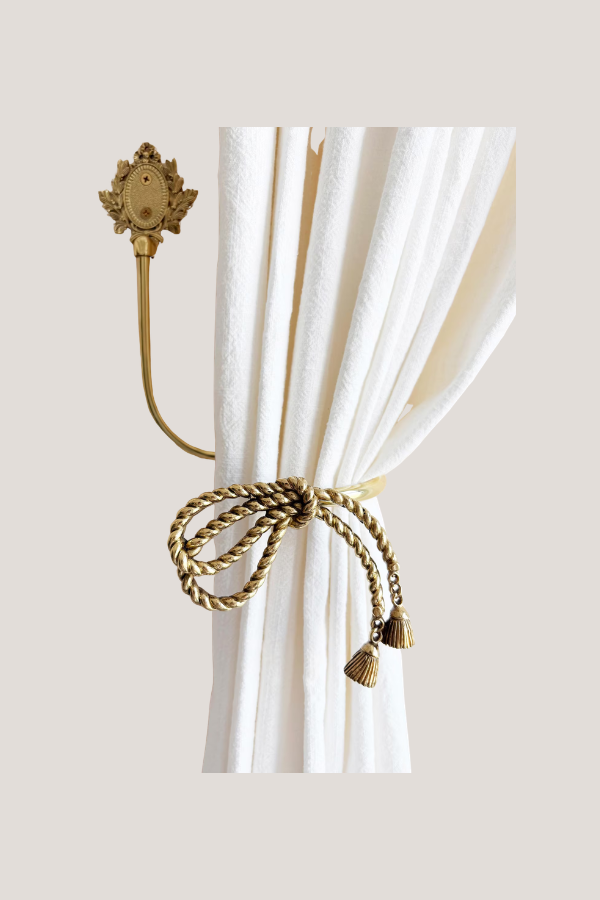
This brass tieback wraps around the drapery like a twisted rope tied into a loose bow. Two small tassel-shaped drops hang from one side, and the wall mount has an oval backplate with leaf detailing at the top. The metal is shiny and heavily worked, which suits the knot design.
There’s a little bit of Victorian and French revival hardware in it, especially in the backplate and the tassel ends. The bow shape keeps it decorative, but it still works like a rigid holdback rather than a soft tie.
These Handmade Abstract Hand Tiebacks from AureaArbor on Etsy
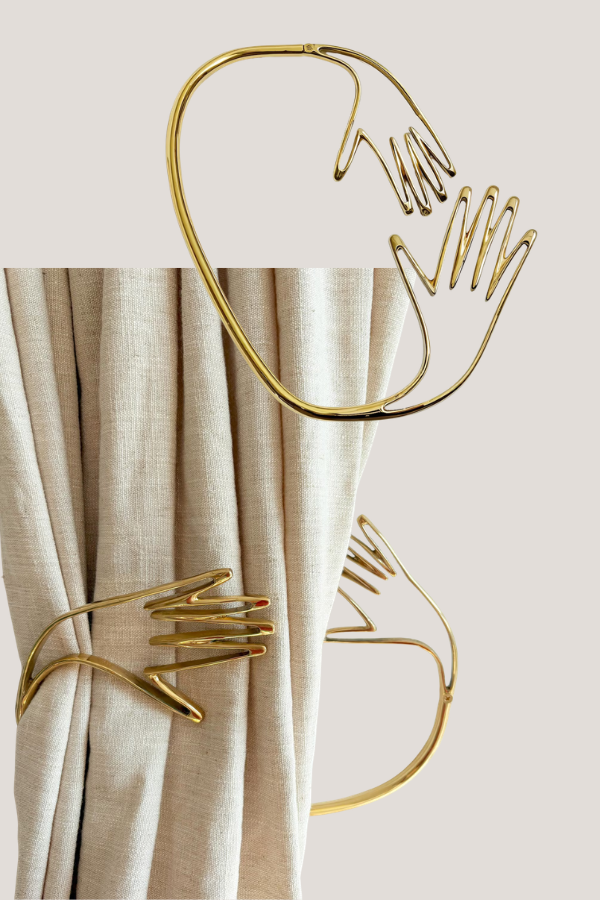
These brass tiebacks are shaped like two stylized hands reaching toward each other around the curtain. The fingers are long and simplified, and the whole piece is made from one continuous curved line. In use, the curtain sits right in the middle, so the holdback looks almost like a bracelet or cuff around the fabric.
There’s a little bit of Surrealism in the hand motif, and a little bit of modernist jewelry too. The form is much cleaner than a Victorian hand tieback, but the body-part reference gives it the same odd yet enticing charm.
Limoncello Tieback from Anthropologie
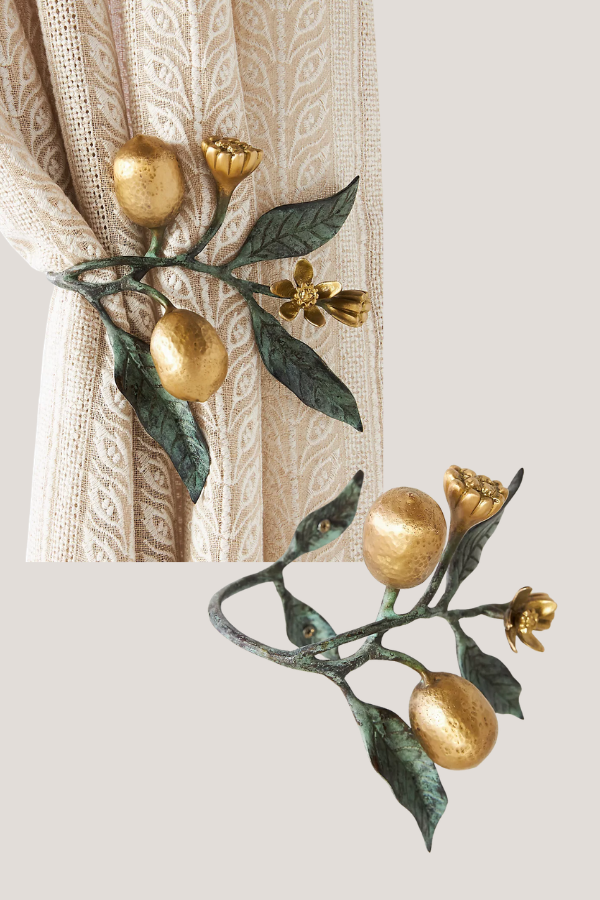
Anthropologie’s Limoncello Tieback is a brass holdback shaped like a lemon branch, with two gold-toned lemons, dark green leaves, and small flowers extending across the arm. The branch loops back to the wall, so the curtain sits inside a more natural, irregular shape than it would with a plain hook. Because the finish varies from piece to piece, the metal and patina look a little less uniform and a little more old-world.
There’s some Italianate and garden-room charm in it, which suits the lemon motif. It’s decorative in a very literal way, but the branch form keeps it from looking too novelty-heavy.
This Oval Mirror Curtain Tieback from Vintage Hardware
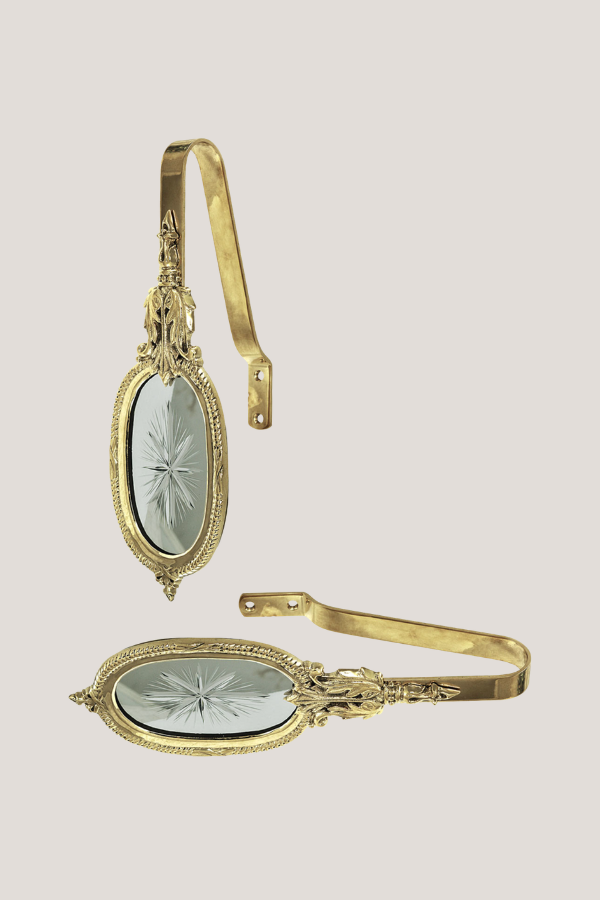
This oval mirror tieback is an antique reproduction in a bright polished finish with a lost-wax cast frame and strap. The oval head has a cut glass starburst in the center, and the border around it is heavily detailed, with a pointed finial at one end and a more elaborate mount where the strap begins. It does sort of look like a watch face, especially with the oval shape, the glass center, and the narrow metal strap extending from it.
The design is very Victorian, which makes sense given the reproduction source. Vintage Hardware notes that mirror tiebacks were used in front parlors and dining rooms, where the glass would catch and reflect gaslight. This one is especially decorative, and the depth of the strap gives it room for fuller curtains.
These Botanical Forged Iron Holdbacks from Pottery Barn
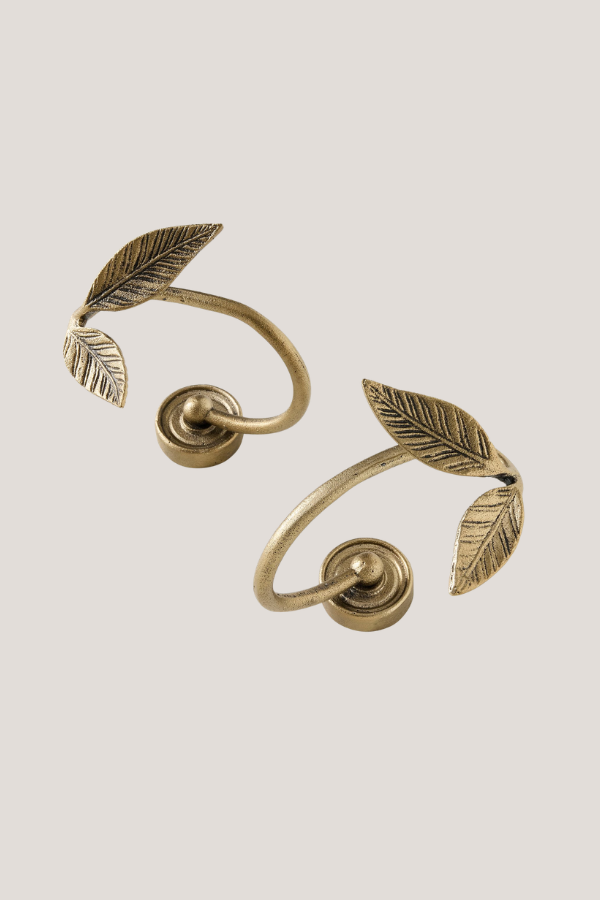
Pottery Barn’s Botanical Forged Iron Holdbacks are a much simpler leaf motif. Each one has a circular wall mount, a rounded arm, and two textured leaves at the front where the holdback closes around the curtain. The antique brass finish and darkened grooves bring out the veins in the leaves without making the piece too ornate.
Fuel your creative fire & be a part of a supportive community that values how you love to live.
subscribe to our newsletter
*please check your Spam folder for the latest DesignDash Magazine issue immediately after subscription

There’s a little bit of Arts and Crafts or Art Nouveau plant styling here, though the overall shape is much plainer than either of those periods usually are. These are good for someone who wants a botanical tieback without flowers, fruit, tassels, or a lot of extra decoration.
This Victorian Hand Motif Curtain Tieback from Vintage Hardware
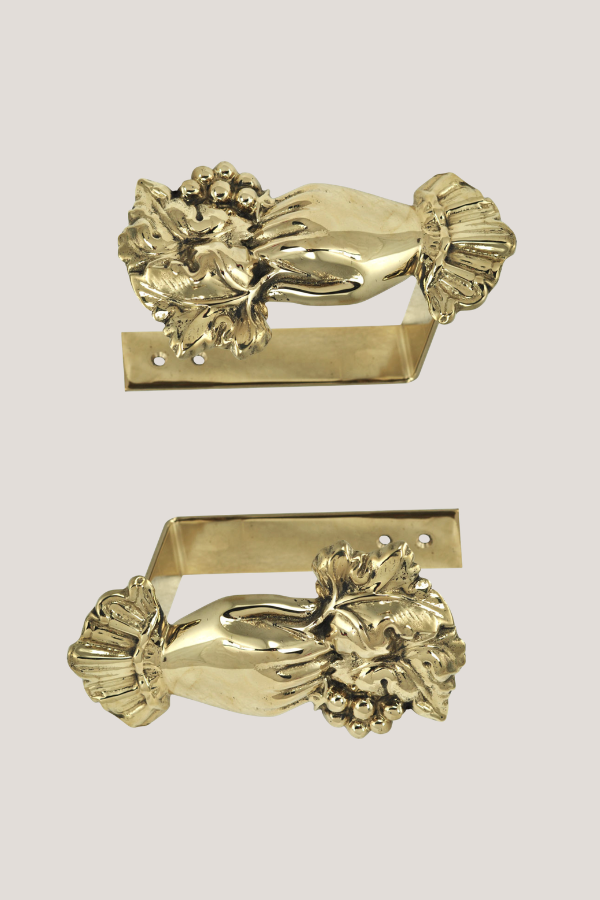
This antique reproduction tieback is shaped like a hand holding a cluster of leaves and grapes. The hand projects outward from a flat metal strap, so the curtain wraps behind the wrist and forearm rather than around a plain hook. In polished brass, the whole piece looks bright and a little theatrical.
There’s a strong Victorian note here, especially with the hand motif and the fruit-and-leaf cluster. It’s also part of a much older decorative tradition of hand-shaped hardware and ornament, but this version is clearly dressed up for 19th-century drapery.
These Belle Epoque French Silk Tassel Tiebacks from South Street Antiques
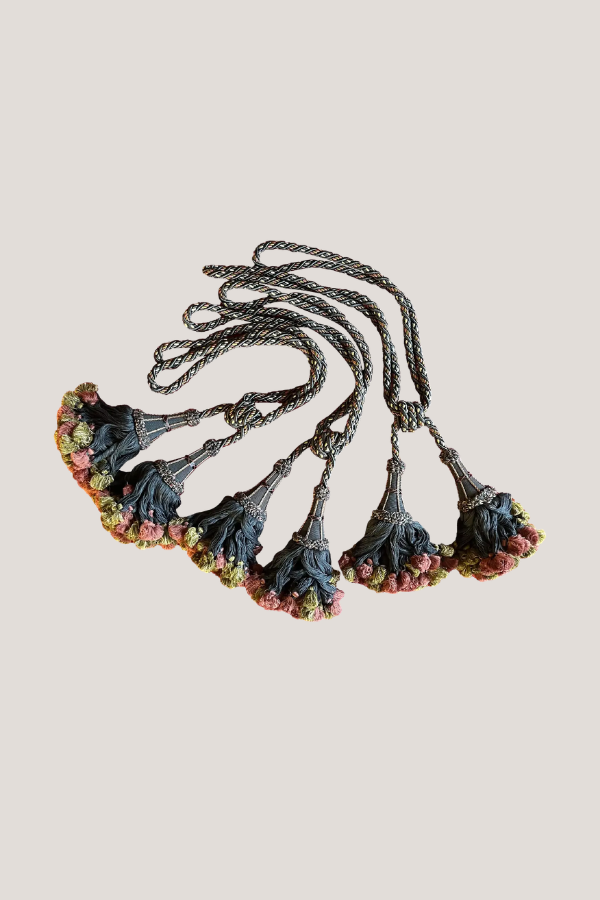
These French tiebacks are long braided cords finished with large tassels in dark blue silk and cotton. Each tassel has a structured top, a full skirt of thread, and a border of smaller pink and olive tassels around the bottom edge. The braid mixes several colors together, so the cord has more depth than a single-color rope would.
There’s a Belle Époque richness to them, and a little bit of Louis XVI formality in the symmetry and finish. These are much softer and fuller than the metal holdbacks in this list, and they look meant for heavier drapery with trim, lining, and a lot of volume.
This Pair of 1930s French Art Deco Bronze Tiebacks from SSDS
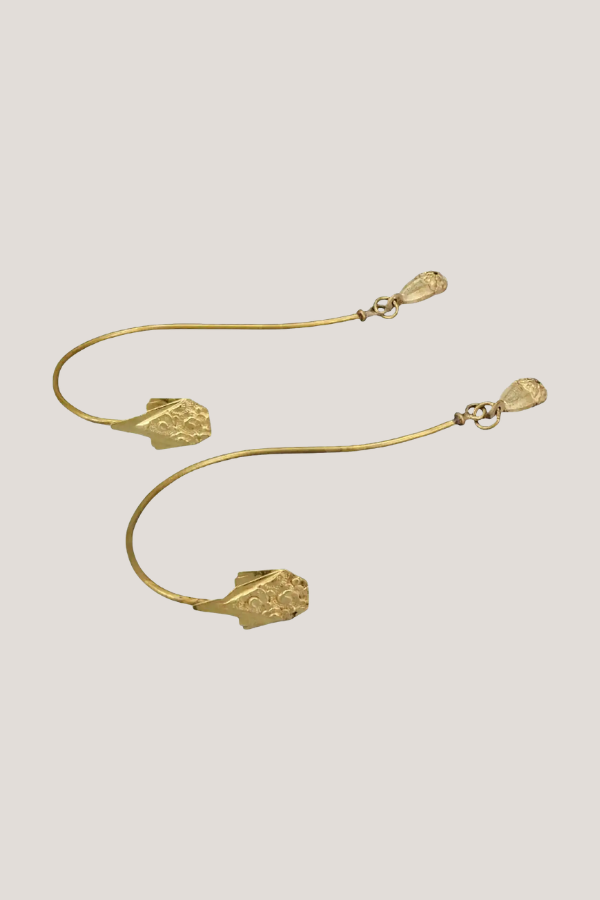
These 1930s French tiebacks are much slimmer than most of the others here. Each one has a long curved metal arm with a stylized flower form at the front and a smaller bud-like detail at the wall end. The line is narrow and controlled, with just a little bit of ornament pressed into the floral head.

There’s a clear Art Deco influence in the form restraint and the elongated shape. They don’t have the fullness of tassel tiebacks or the sculptural bulk of Empire birds, but that’s part of their appeal. They would work especially well with drapery that has a cleaner line and not too much extra trim.
This Cottage Collection Curtain Holdback Tassel in Mustard from Gotain
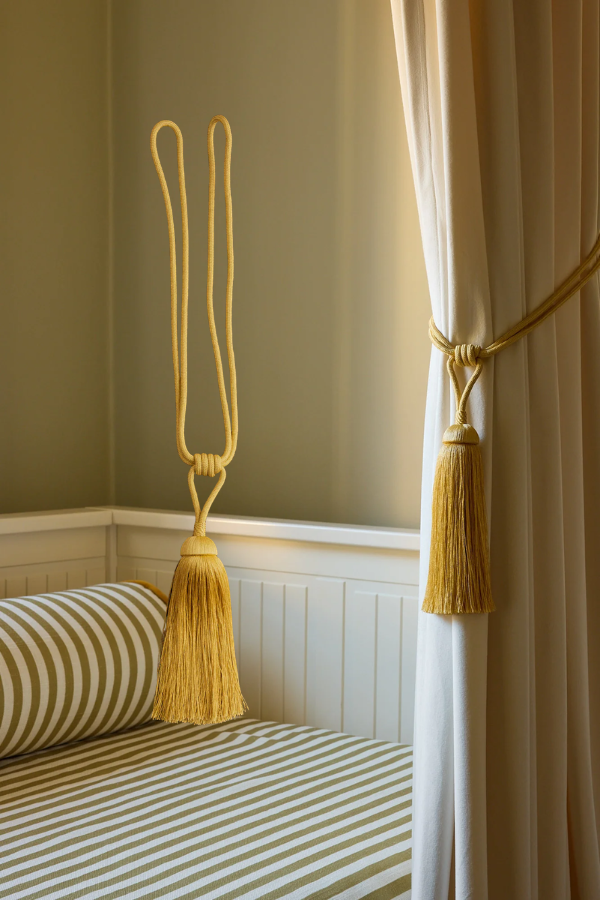
This tieback is a twisted mustard cord finished with a single long tassel. The knot at the center is small and neat, and the tassel head is simple, without extra trim or beading. Compared with the more elaborate French examples, this one is much plainer.
There’s still a little bit of classical and passementerie history in it, since tassel tiebacks have been used on drapery for centuries. But this version is stripped back and softer, with the focus mostly on the color and the clean line of the cord. We love that it was inspired by chunky jewelry!
These Huge Empire Revival Tiebacks from Chairish
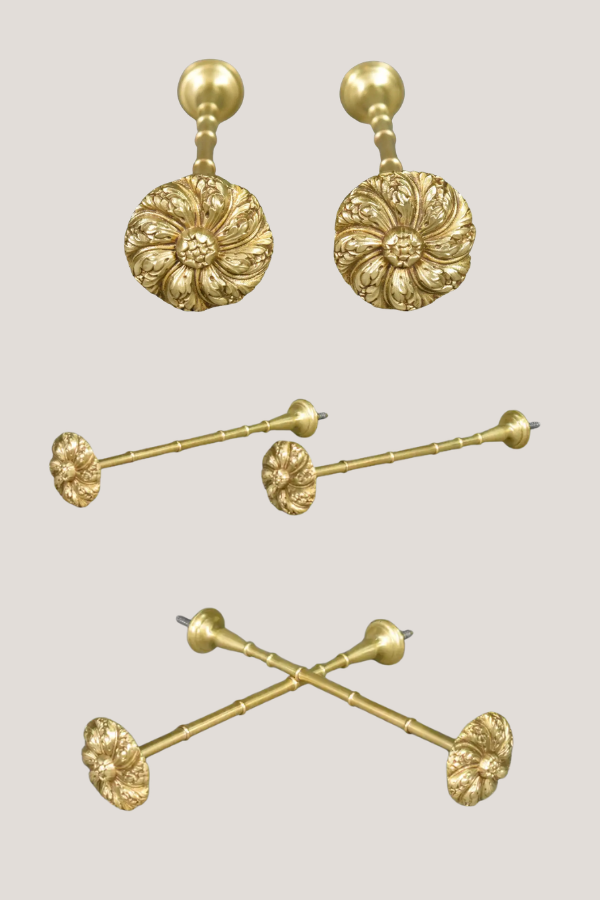
These large French tiebacks have long brass stems, rounded wall mounts, and circular fronts cast with swirling acanthus leaves and a central rosette. The stems are turned in sections, which gives the tiebacks a little more length and formality than a plain rod would. They project far enough from the wall to easily handle fuller drapery, and the polished brass makes all that leaf detailing much easier to see.
There’s a strong Second Empire and Empire Revival influence in the acanthus motif, the rosette center, and the overall symmetry. Compared with some of the more playful tiebacks in this list, these are stricter and more architectural.
The Onyx Tassel Tieback from Houlès Paris
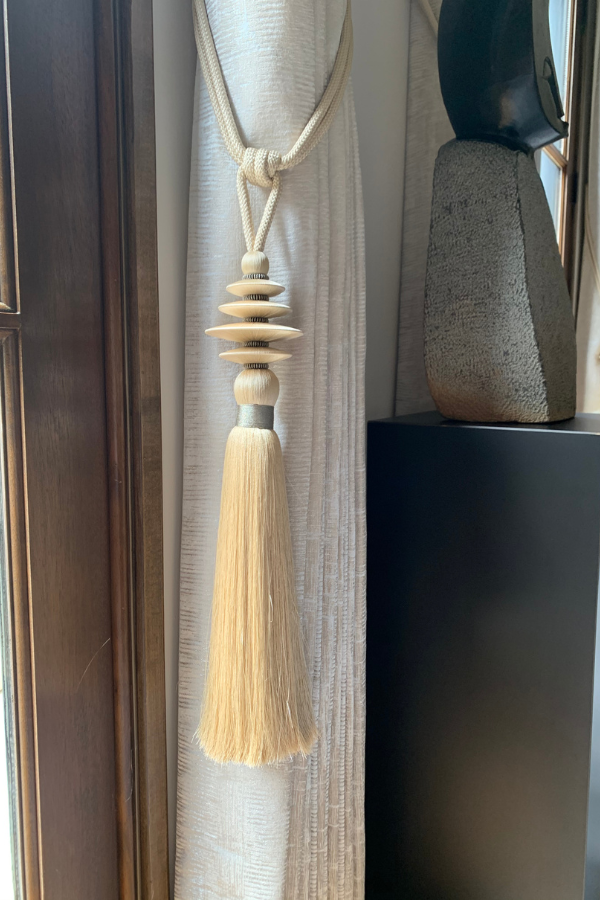
Houlès Paris’s Onyx Tassel Tieback has a long silk-like tassel suspended from a braided cord and a stacked centerpiece made from satin-covered discs, a rounded bead, and small metal spacers. In the ivory colorway, it looks almost architectural, especially with the disc shapes lined up above the tassel. In the brighter colors, that same form looks like jewelry.
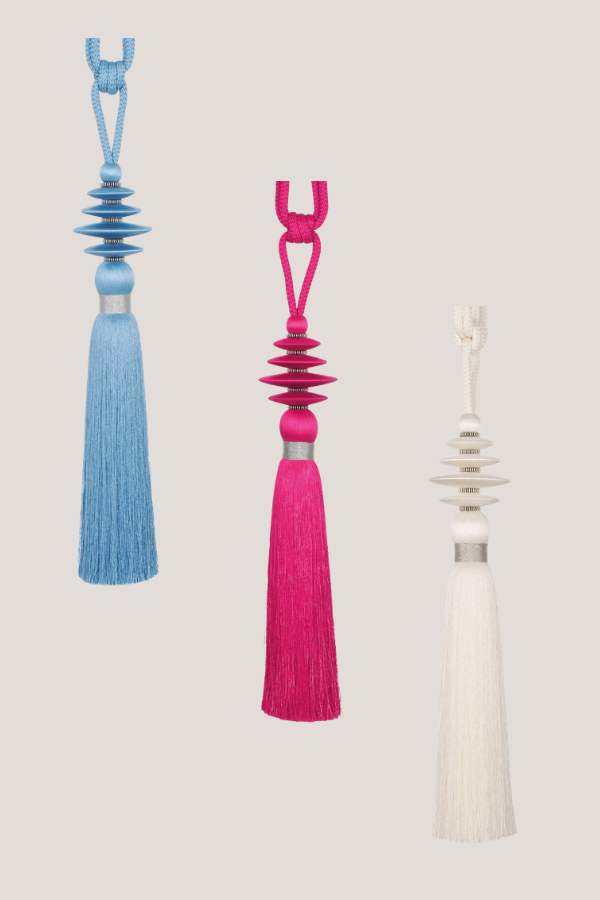
There’s a little bit of Art Deco in the stacked geometry, but the tassel keeps it tied to older passementerie traditions. Seen in Laura U Design Collective’s Circle Drive project, the neutral version works beautifully against a sheer curtain and dark wood window trim. The collection is broad, so you could use it in a pale room without much fuss or push it much harder in fuchsia, lemon, or blue.
Written by the DesignDash Editorial Team
Our contributors include experienced designers, firm owners, design writers, and other industry professionals. If you’re interested in submitting your work or collaborating, please reach out to our Editor-in-Chief at editor@designdash.com.
Related Posts
Trailblazing Female Interior Designers Who Made Space for Us To Shine Today
From Elsie de Wolfe and Dorothy Draper to Patricia Urquiola, these are

Kongjian Yu: 2023 Recipient of the Oberlander Prize for Landscape Architecture
Kongjian Yu—the distinguished landscape architect renowned for his e
Becoming an Interior Design Influencer
LIKE 0 LEAVE COMMENT 0 16 min read Summary Reflection Questions Journa
Summer Design Interns: What You Can Expect & What You Owe
Laura Umansky and Melissa Grove share how design firms can structure s

Stockholm Furniture Fair 2026 Cancellation Announced
Stockholm Furniture Fair and Stockholm Design Week are canceled for 20