
5 Podcast Episodes About Keeping a Design Project On Track

 0
0
 0
0Summary
These five podcast episodes bring hosts Laura Umansky and Melissa Grove together with a variety of guests to discuss the issues that produce project delays. They also discuss solutions like better focus, cleaner communication, tighter process, and better team alignment.
Reflection Questions
Where in your current projects are decisions sitting too long because too many things still feel urgent at once?
Which part of your process is most likely to create client doubt later: pricing accuracy, discovery notes, budget alignment, or team communication?
When a project starts tightening up, does your team have a clear way to solve the issue together before it spills onto the client?
Journal Prompt
Choose one active project that feels heavier than it should right now. Write one paragraph on where the drag is actually coming from. Be specific. Is it late decision-making, weak documentation, unclear pricing, client hesitation, or a gap between the builder and design team? Then write a second paragraph on what would need to change this week to steady the project before the problem grows more expensive.
Interior design projects don’t usually go off track because of one giant mistake. Instead, they fall apart because of miscommunications, misallocation of time or attention, and leaving a bunch of smaller decisions unresolved for too long. By the time a project actually screeches to a halt, the problems have been building up for weeks.
That’s what connects these five DesignDash Podcast episodes. Alongside hosts Laura and Melissa, all of our guests are talking about different contributors to the same issue, whether it’s focus, accuracy, client psychology, or organization. Each of these is just one small piece in the puzzle of a perfectly executed project, but together, they decide whether that project moves forward with clarity or starts circling itself due to confusion.
The episodes explore that from several different directions, but as a collection, they make a pretty good case that keeping a project on track has a lot less to do with “grand plans” and a lot more to do with sequence, communication, and structure.

5 Podcast Episodes About Keeping an Interior Design Project On Track
Episode 54: How to Focus When Everything Feels Important
In this fifty-fourth episode of the DesignDash Podcast, Laura Umansky and Melissa Grove talk about focus, but they spend less time on productivity hacks and more time on mindset. What they’re really doing in this episode is sorting through sequence.
In a design firm, too many tasks claim urgency at the same time, but once that happens, the day organizes itself for you without your input. The inbox pulls you one way. The calendar pulls you another. A team question is waiting. A client reply is waiting. Meanwhile, the principal is trying to move from admin work into creative review, or from one business into another, and that context switching costs way too much time. After a week like that, a project might look like it’s chugging along from the outside, but the decisions that keep it moving have entered a bottleneck.
Melissa talks about moving meetings when she knows she won’t be present enough for that time to count, and Laura references tools that force a rank order: Pomodoro blocks, the urgent-versus-important matrix, and clarity breaks. This is where the episode connects to our overarching article theme: keeping a design project on track.
Fuel your creative fire & be a part of a supportive community that values how you love to live.
subscribe to our newsletter
*please check your Spam folder for the latest DesignDash Magazine issue immediately after subscription

Laura says, “If you have a team, the first thing you do is get them lined out because then they’re moving forward. They’re not stalled out.” Projects stay on target when the studio protects decision time, answers questions in sequence, and stops treating every interruption like it deserves the same attention. Not all questions should go to leadership, and not all tasks should take up a principal’s time.
Episode 53: The Business of Interior Design w Rainey & Casey
In this fifty-third episode of the DesignDash Podcast, Laura Umansky and Melissa Grove bring in Casey Brand and Rainey Richardson for a conversation about business. Casey and Rainey spend a lot of time on the back-office parts of a project that clients don’t always see.
Someone has to catch the pricing mistake before an order goes out. Someone has to sort through revised vendor invoices and decide when a firm should push back. Someone has to build enough structure in the back office that a bad proposal, a missed line item, or a sloppy billing process doesn’t turn into client distrust three months later.
Rainey even talks through a large plumbing package where the vendor kept revising invoices after the client had already paid. That’s part of keeping a project on track too: almost every project can survive a surprise, but it’s a lot harder to recover if the client starts wondering whether anybody has a handle on the numbers.
The other reason this episode belongs in this article is that Casey and Rainey don’t separate project management from client psychology. Rainey talks about missing one major cue in an early presentation for a large remodel. She didn’t realize the client was uncomfortable with change until the plans were in front of her and she saw her eyes glaze over.
Casey points to identifying dynamics as key to project success. That may sound less important than budgets and billing, but it affects the project’s trajectory just as much (if not more). If a firm misses a client’s resistance early, they’ll pay for it later in redraws, hesitation, and approval delays. If the designer catches it in the room and addresses it tactfully, the client and design firm can both move through the process with a lot less friction.
Episode 49: Behind the Scenes of High-End Interior Design with Shannon Smith
In this forty-ninth episode of the DesignDash Podcast, Laura Umansky talks with Shannon Smith about high-end interior design, and Shannon keeps bringing the conversation back to process. She talks about busy clients who want someone to take charge, guide decisions, and move a project from discovery through installation without constant backtracking. That fits this article pretty well.
Furnishings projects can lose time just as fast as renovations can. A client changes direction late. A team member misses a note from discovery. A presentation goes in with one detail off, and now the room, the timeline, and the client conversation all need another round.
She then talks about keeping notes from discovery and pulling them back out during later reviews so the team doesn’t forget something the client made very clear at the beginning. Her example in the podcast is a client who hates cream-colored bouclé. That sounds minor until somebody forgets and presents it anyway; then, it’s disregard for the client’s taste and an inability to truly listen.
Laura also talks about momentum in this portion of the conversation. Once a team has to redo, re-present, or re-explain decisions that should’ve been settled earlier, the project starts burning time and money in all the wrong places. A disciplined process protects the creative side of design because it cuts down on avoidable repetition.
Episode 47: Navigating High-End Home Projects: Expert Advice from Erin Stetzer
In this forty-seventh episode of the DesignDash Podcast, Laura Umansky and Melissa Grove talk with builder Erin Stetzer about high-end home projects, and Erin spends a lot of time on the months before a client ever sees a finished house. She keeps going back to the phone calls behind the scenes, the trade evaluations, the mockups, and the long stretch of coordination that has to happen before a decision hardens into a price, a schedule, or a construction detail.
A high-end home project can absorb uncertainty but not much confusion. If the architect, builder, and design team are pricing different versions of the same house, the project starts moving in circles. Erin talks about hardware as one example, but it could be any detail that is assumed too early and clarified too late. The project isn’t falling apart because someone lacks taste but because communication is horrifically unclear and the cost of fixing issues that arise from miscommunications keeps climbing.
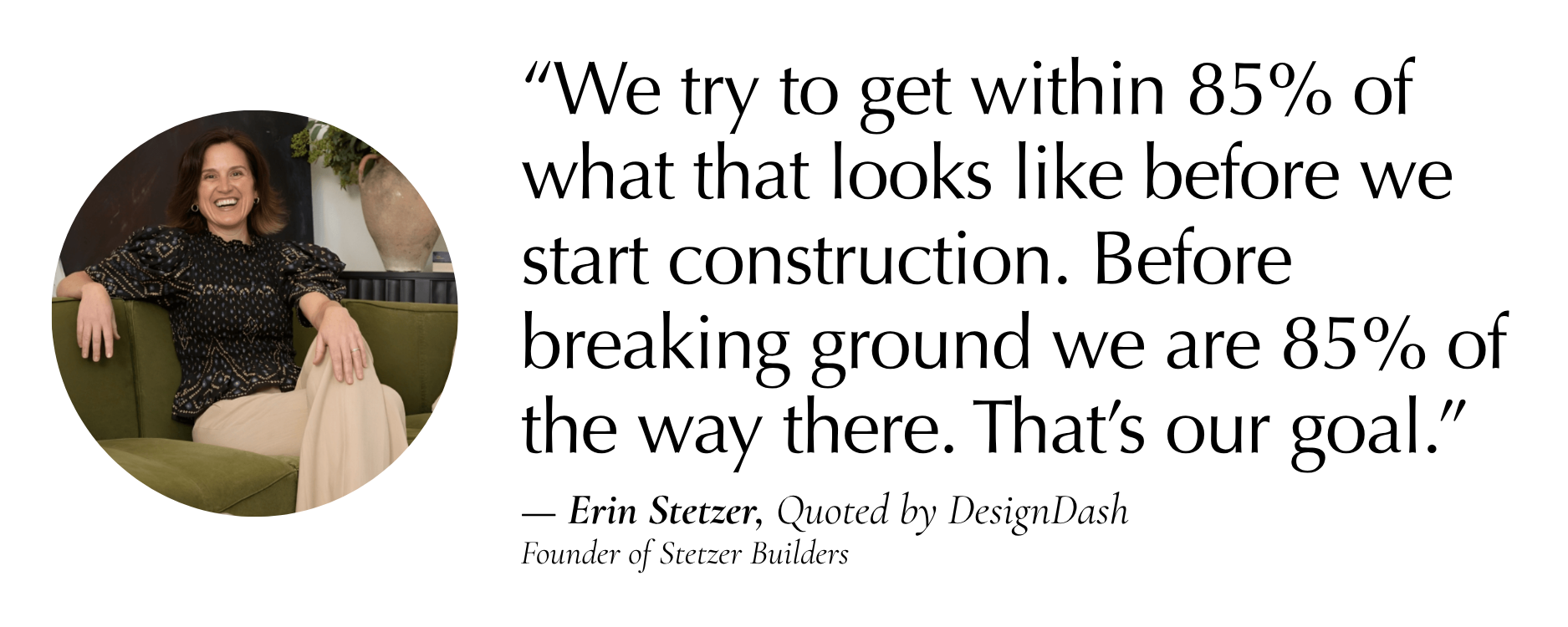
Erin also says she wants a project about eighty-five percent resolved before breaking ground. Not every detail will be ready that early, but she still wants a real baseline in place before money and schedule attach themselves to every choice. She talks about discussing the bar, the stone, and the brass while the slab is still being poured, not months later when everyone is already under pressure. That sequencing cuts down on repricing, rescheduling, and constant backtracking.
Episode 45: Designer’s Role in Keeping A Project Together w/ Megan Strasberg
In this forty-fifth episode of the DesignDash Podcast, Laura Umansky and Melissa Grove bring in Megan Strasberg for a conversation about renovation stress, budget fatigue, and the designer’s role in keeping a project on track. Megan talks about contractor schedules, client anxiety, and how tensions can rise when a renovation starts and there’s a surprise waiting behind the walls. Mold is one example she gives. Pressure on the timeline is another. Once a project has fallen behind, everyone starts to look for a reason, for someone to blame.
That shift in tone is a big part of keeping a project on track. A renovation can survive bad news, but it won’t survive a room full of people blaming one another while the client is still waiting for a plan. Megan talks about getting everyone on site together, resetting expectations, and course-correcting before frustration spreads any further. That triage sounds simple, but it has the power to change the whole direction of the project.
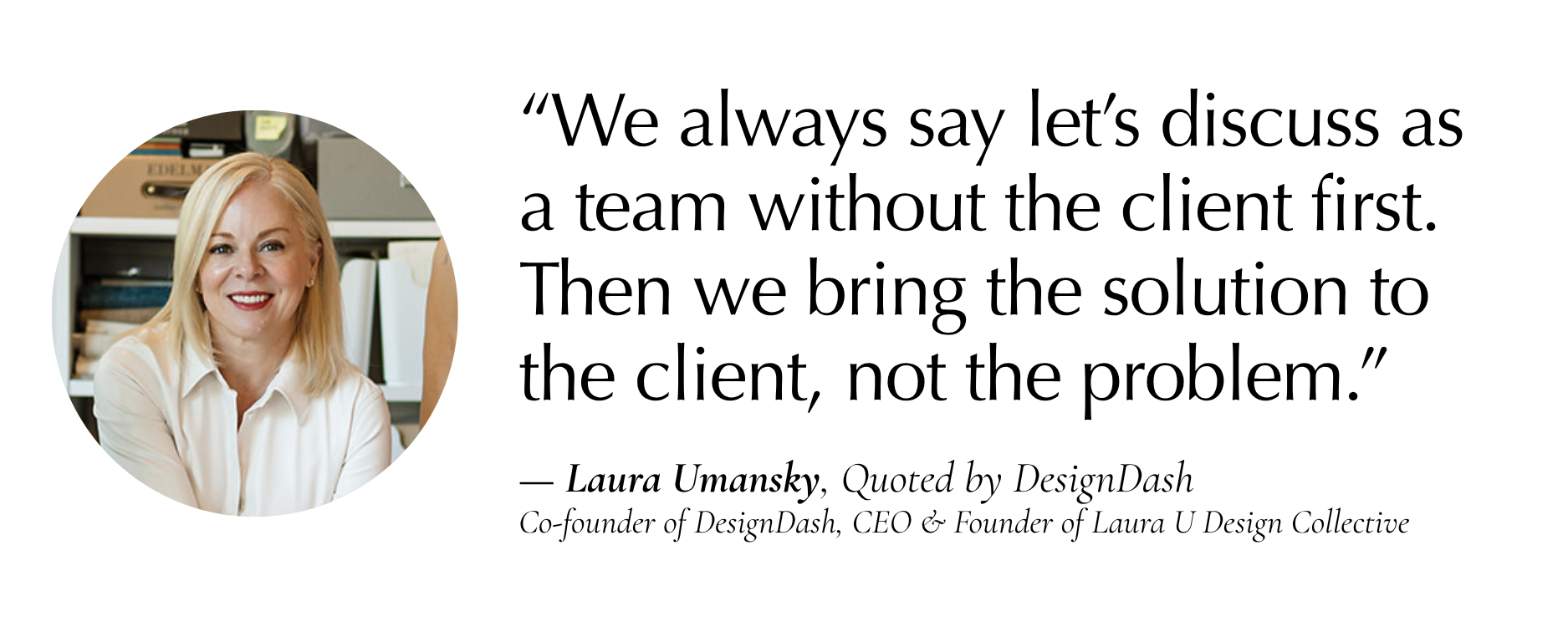
Megan also talks about bringing builders into the first phases of design so budget conversations start early, before anyone is too deep into the process to adjust expectations. In this way, she’s on the same page as Erin Stetzer. By the time construction starts, she wants pricing decisions on the table and the team generally working from the same assumptions. Clients can handle bumps in the road when the builder and designer look aligned. What wears them down is repeated scrambling.
Final Thoughts

Many firm owners are trying to solve process problems, pricing problems, team problems, and client communication problems in private, then paying for that isolation. DesignDash Growth Studio is built around People, Profit, Promotion, Process, and Purpose, and the community gives those conversations somewhere to keep going after the program ends. If you want more clarity on issues like these, join the Growth Studio waitlist.
Written by the DesignDash Editorial Team
Our contributors include experienced designers, firm owners, design writers, and other industry professionals. If you’re interested in submitting your work or collaborating, please reach out to our Editor-in-Chief at editor@designdash.com.
Related Posts

10 Kinetic Artists Who Aren’t Alexander Calder
From Naum Gabo to Jesús Rafael Soto, these artists have created kinet

Here’s How to Get Comfortable with Uncertainty as a Firm Owner
Learn how to handle uncertainty around hiring, payroll, marketing, cas
Are Clients Pushing My Rates Down, Or Am I Priced Too High?
LIKE 0 LEAVE COMMENT 0 5 min read Summary Designers often mistake clie

Can Foreigners Buy Property in Canada? What Americans Should Know.
Given the country's high quality of life, stable economy, and breathta

February 2026 Interior Design Events You Simply Can’t Miss
From material research and construction insight to architectural histo

Green Planning of Public Spaces: Integrating Nature in Urban Environments
Let's consider the transformative impact of green cities, examining th