Does Leading a Firm Mean Stepping Back from Design?

 2
2
 0
0Summary
As a design firm grows, the owner’s role starts to change. The work no longer consists only of concepts, sourcing, presentations, and client meetings. Leadership enters the picture too, and with it come delegation, trust, oversight, hiring decisions, and the responsibility of guiding a team. This article examines that shift through Laura Umansky and Melissa Grove’s perspective on creative direction, team leadership, delegation, and the fear many owners have that stepping into leadership means losing the part of the job they love most.
Reflection Questions
At what point would leadership in my firm stop being a side responsibility and start becoming a real part of my job?
Do I want to stay closely involved in design execution, or would I rather guide the vision and let a team carry more of the work forward?
Where am I still holding on too tightly because I do not trust someone else to do the job well?
Have I hired for the kind of support I actually need, or have I hired around the edges of the real problem?
If my team shadowed me for a week, would they come away with a clear understanding of my standards, approach, and decision-making process?
Journal Prompt
Write about your current role inside your firm as honestly as you can. How much of your week is spent on design work, and how much is spent on leadership, delegation, review, and decision-making for other people? Then write about what you want that balance to look like a year from now.
As you reflect, ask yourself whether you are resisting leadership because you truly want a more design-centered role or because you have not yet built enough trust in your team. Also ask whether the version of your business you want can actually exist without a change in how you lead, delegate, and stay involved in the work.
Designers often picture growth for their firms in terms of bigger projects, better clients, and more creative opportunities. What they don’t always picture as clearly is how much their own job will change once that firm starts to expand. More people enter the picture. More decisions need direction. More work moves through other hands before it reaches the client.
That shift towards leadership can create uncomfortable tension for a founder who still loves the design work most of all. On one hand, the firm needs that leadership, not just talent. On the other, the owner may have started the business because she wanted to design, not because she wanted to manage people all day. That discomfort underpins a lot of conversations about growth, which is why it’s vital that you ask yourself whether running a firm and being a designer are actually compatible with each other.
In this Q&A, we asked Laura Umansky and Melissa Grove of Laura U Design Collective what leadership actually asks of a firm owner, how that role changes as a team grows, and whether stepping up as a firm owner means stepping back from design.

Will Leadership Expectations Shift My Day-to-Day Away from Design and Towards Management?
As a firm grows, the owner is expected to do so much more than design. She has to delegate, build trust, make hiring decisions, set standards, mentor the team, and support the business as a whole. That doesn’t automatically mean giving up design work, but it usually does mean slimming down in that department. Instead of executing every detail, the owner often moves toward creative direction, concept leadership, and design oversight with the support of her team.
What is a firm owner expected to do as a leader?
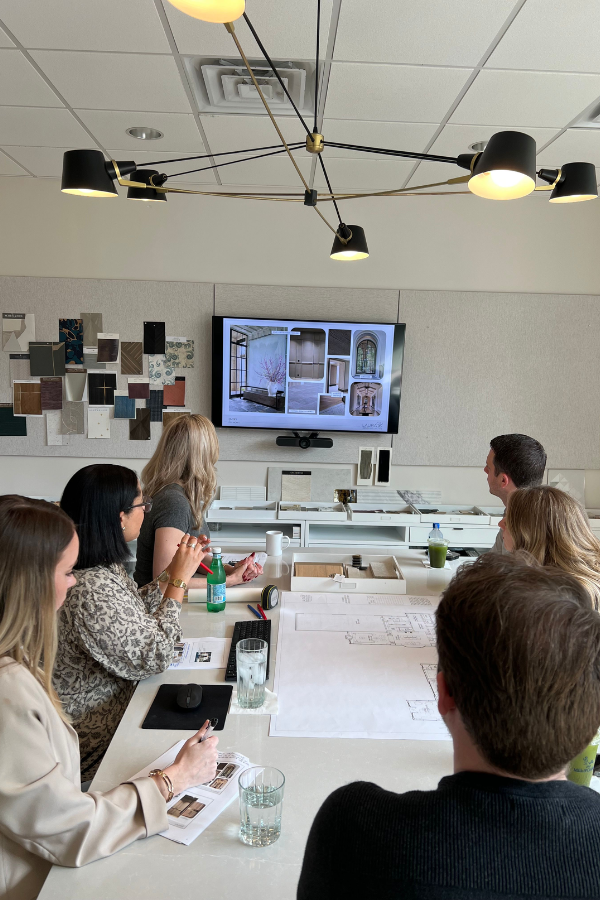
Once a firm has enough projects and enough people involved in them, the owner’s job expands. She is no longer only responsible for her own design work. She has to direct other people’s work too. That means deciding who handles which part of a project, reviewing work before it reaches the client, setting standards for the team, and catching confusion early enough that it does not spread across multiple jobs.
That change usually catches owners in the middle of still doing plenty of design themselves. The projects are multiplying, the team is growing, and the owner is still heavily involved, but now the business also needs structure, oversight, and clearer direction. A founder who once spent most of her time producing now has to protect time for review, delegation, and bigger decisions about how the firm runs.
A large part of leadership comes down to whether the owner can let other people take real responsibility. If every selection, drawing, vendor question, or client update still depends on her direct involvement, then the firm may have more staff, but the role at the top has not really changed. The owner’s job changes when she shifts from doing the work herself to directing that work.
Delegation is one of the first real leadership tests

Nothing makes the role change feel more real than delegating. It’s one thing to say the team can take on more responsibility. It’s another to let a designer run with a scheme, let a project manager handle communication, or let someone else make a consequential decision without stepping in halfway through. This is where owners find out whether they’ve actually built a team or whether they still have support staff orbiting around their own output.
This is also where a lot of internal friction starts; that internal friction can quickly erode company culture if the owner doesn’t have a handle on it. An owner may know she needs help and still keep too much work in her own hands because the work reflects her taste, her standards, and her name. The team may technically have responsibilities, but those responsibilities will stay very narrow if every important decision still has to come back around for approval. That slows projects down, creates hesitation inside the team, and keeps the owner locked into a role that looks more like senior designer than leader.
We understand the fear of letting go. Firm owners often assume that delegating means giving up control of both day-to-day operations and brand identity. However, effective delegation is actually vital to creating, maintaining and growing a successful business. But effective delegation can’t happen without trust.
The owner has to trust that someone else can carry part of the work forward and still meet the standard of the firm. Without that trust, she keeps reviewing too much, correcting too much, and staying involved in parts of the process that should already belong to someone else. Over time, she has developed a lot of very expensive redundancy instead of much-needed support.

Why Some Owners Struggle to Meet Leadership Expectations
A lot of owners struggle here because the pressure point in the business isn’t always the one they think it is. They know they need help, so they hire. Then a few months later, they’re still reviewing too much, correcting too much, and carrying too much. That usually traces back to one of two issues. Either they hired the wrong person for the wrong reason, or they still don’t trust someone else to do the job at the level they want.
Melissa sees this all the time in both her role as COO and her involvement in the DesignDash Community. Some owners hire an assistant when what they really needed was a more experienced designer. That mismatch creates a whole host of problems. The owner still has to make too many design decisions herself, but now she also has to manage someone who can’t truly relieve the part of the business that’s under strain. This turns into micromanagement, frustration, and a team structure that looks substantial on paper but is paper thin in reality.
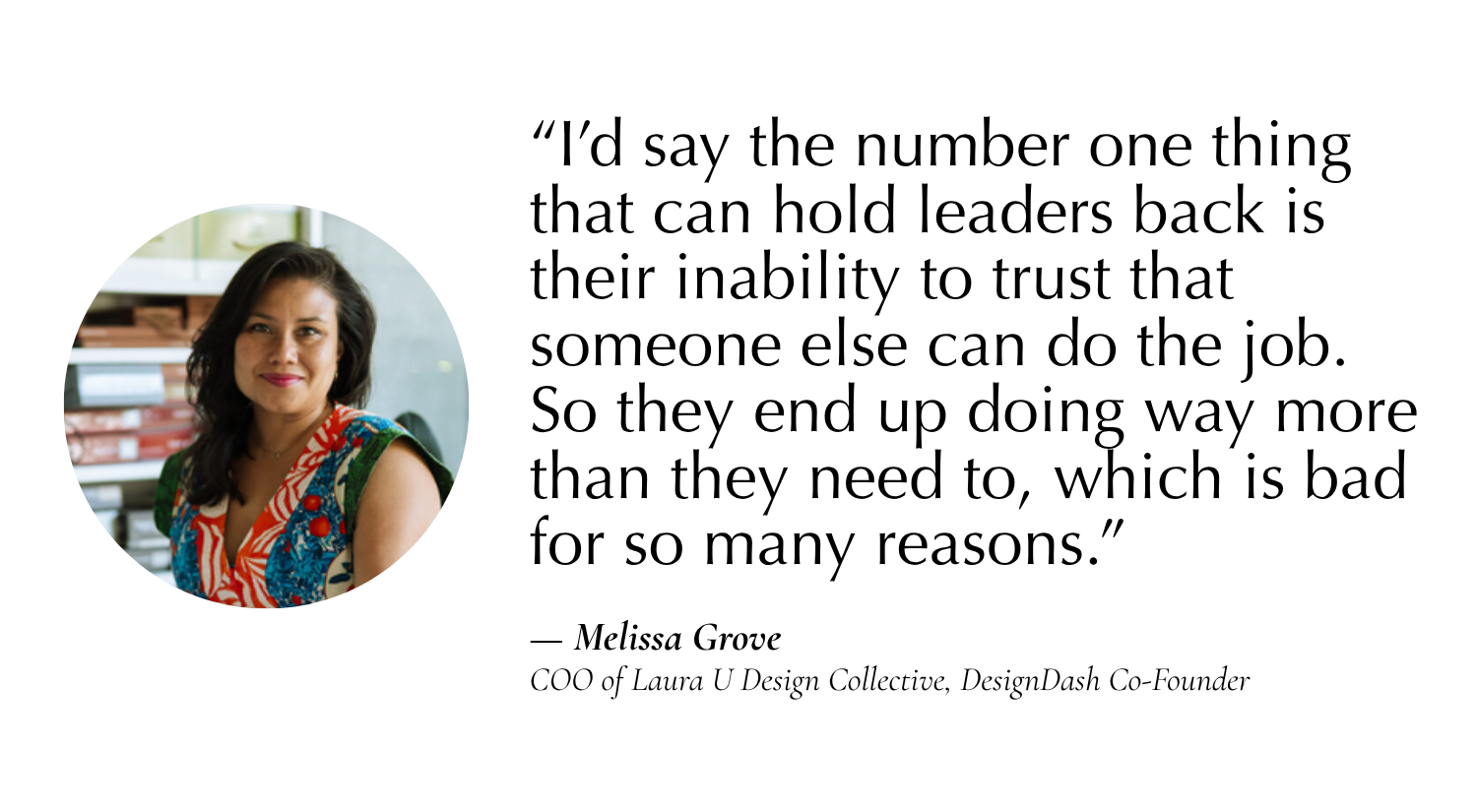
Trust is the other major issue. An owner may say she wants support and still keep all the meaningful decisions for herself. At that point, the problem isn’t staffing alone. She hasn’t created enough room for someone else to take real ownership of the work. That creates a standstill or a bottleneck, whichever term you prefer. The team can’t fully grow into their roles, and the owner can’t fully move into hers.
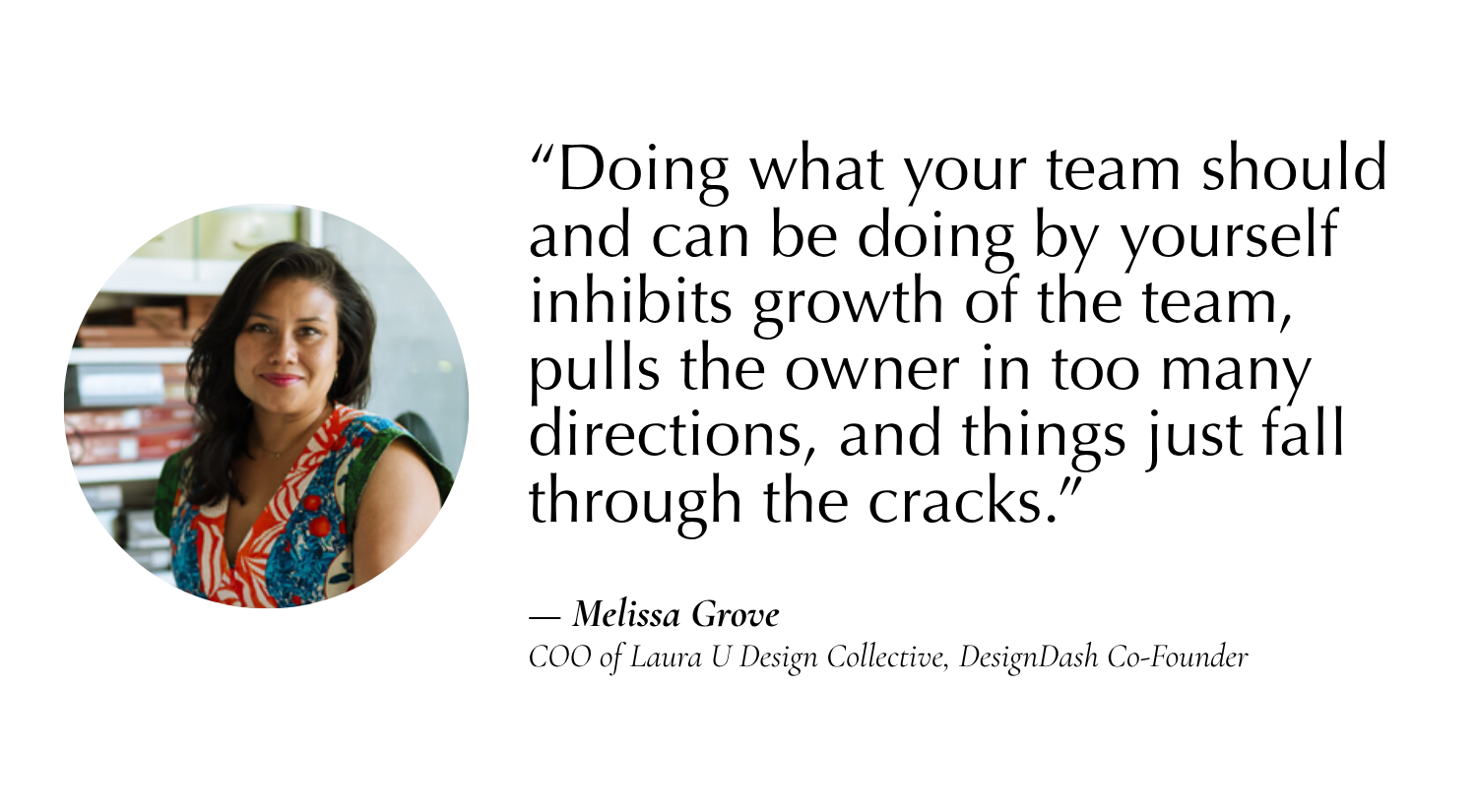
Does leadership mean giving up design work? Not necessarily.
This is the meat of our article and the question that gives most firm owners pause. Growth sounds appealing until we start picturing what it might take away. More people usually means less direct involvement. More responsibility usually means less time. It’s reasonable to wonder whether building a firm eventually pulls you out of the work that made you start it in the first place.
What actually changes is how the owner participates. Early on, everything runs through her. She’s sourcing, drawing, presenting, solving problems in real time. As the firm grows, that level of involvement becomes harder and harder to maintain across multiple projects and multiple people. Design doesn’t disappear, but it does move. Other people take on execution. The owner starts working at a different level inside the same projects.
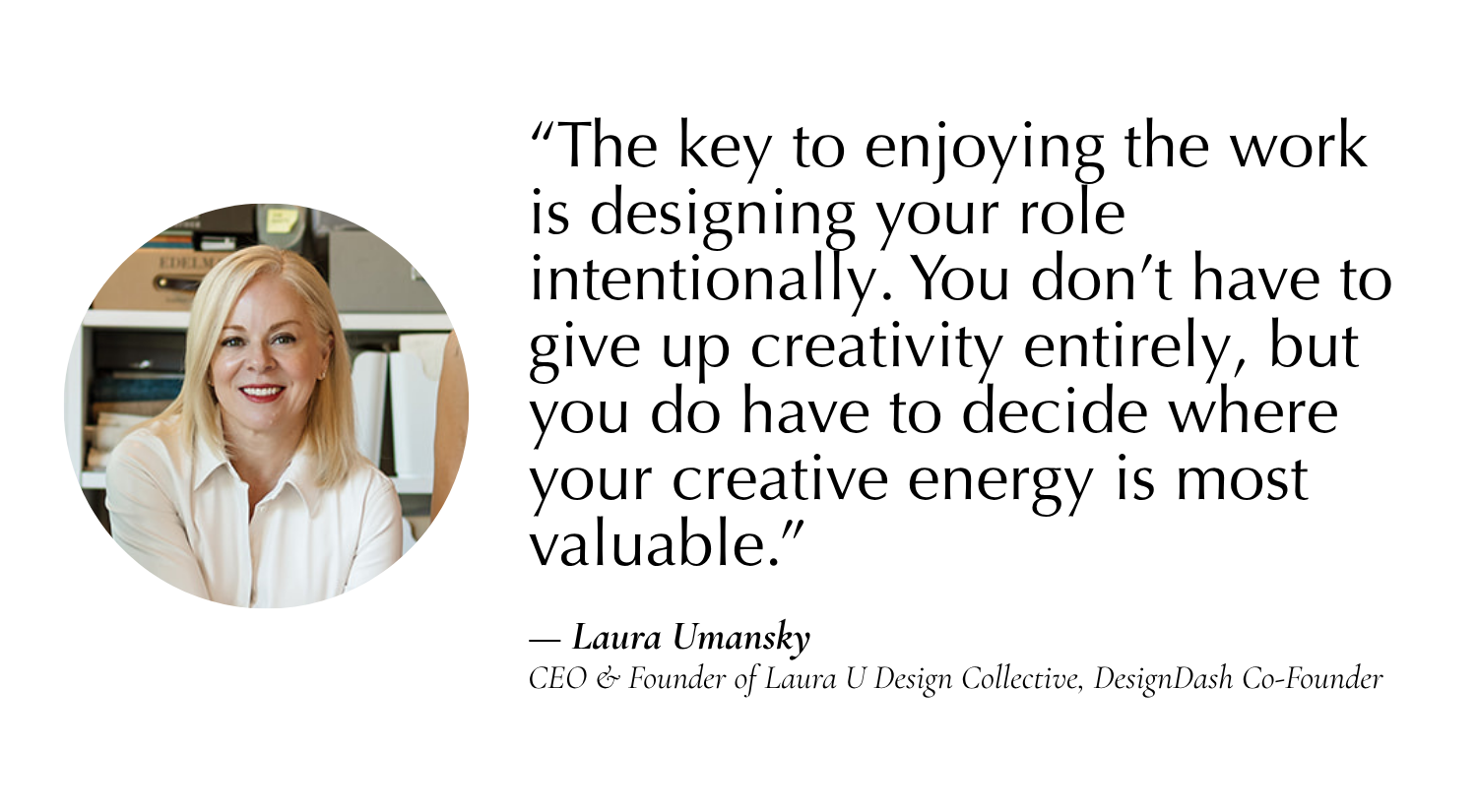
That shift requires a series of important decisions on your part. If the owner keeps trying to stay involved in everything, her time gets stretched thin and the team never fully steps in. If she pulls back without defining her role, the design itself will suffer. You have to shape your new role with purpose and vision.
Fuel your creative fire & be a part of a supportive community that values how you love to live.
subscribe to our newsletter
*please check your Spam folder for the latest DesignDash Magazine issue immediately after subscription

What design work can still look like at the leadership level
At the leadership level, design usually narrows in scope and widens in influence. The owner may no longer be sourcing every piece, answering every vendor question, or building every presentation herself, but she’s still the primary driver. She is setting the concept, establishing the visual direction, and deciding whether what’s coming back from the team is aligned or off course.
That level of involvement can be harder to define because it’s less task-driven than it used to be. The owner may spend less time producing and more time reviewing, redirecting, and protecting the integrity of the work. That can feel like distance from design at first, especially for someone who built her business around being deeply involved in every layer of a project.
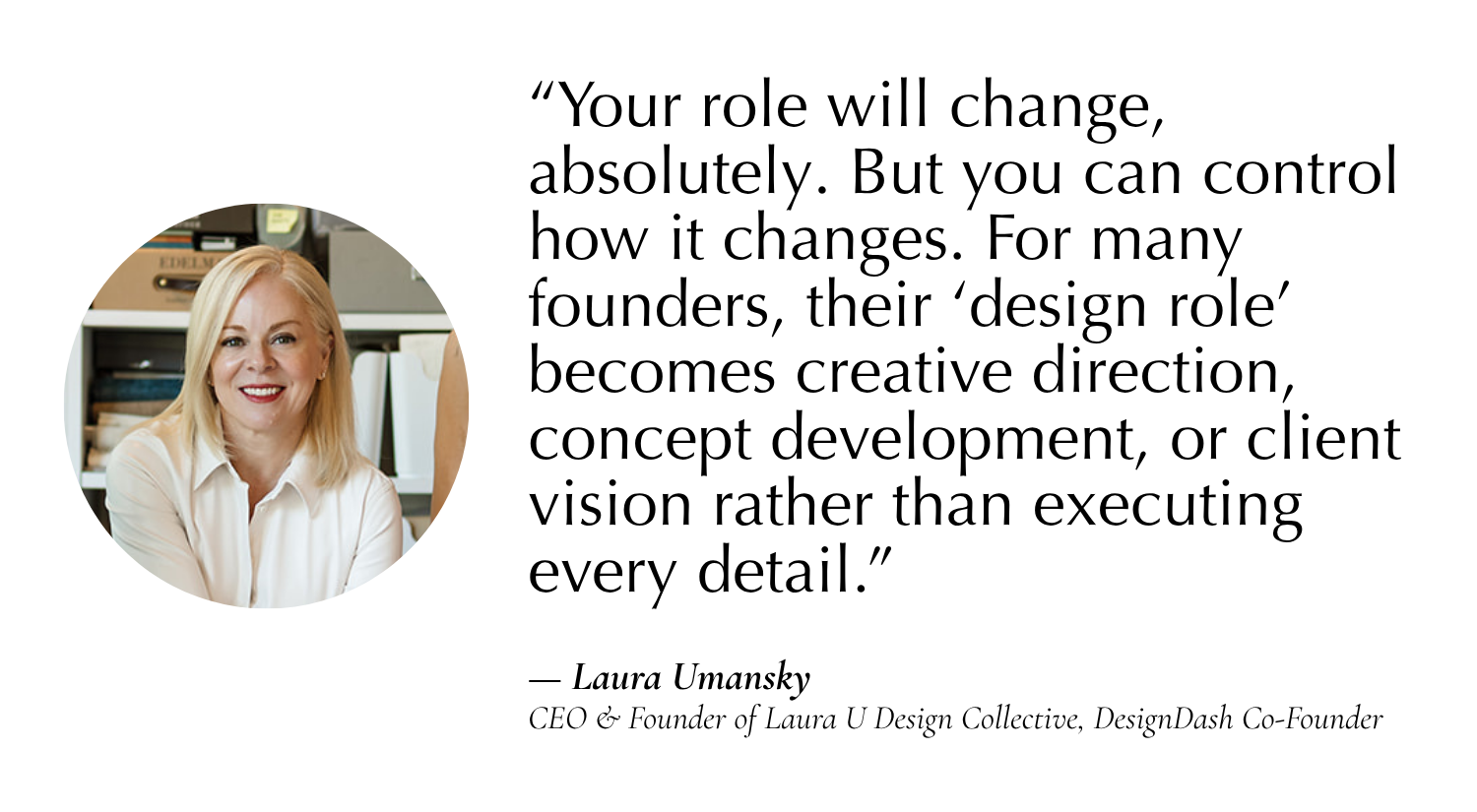
The challenge is that maintaining this role takes a lot of discipline. A founder has to know when to step in, when to redirect, and when to let the team solve something without her. Too much involvement clogs the process. Too little creates inconsistency. The owner has to figure out where her eye is most needed and where someone else can make design decisions.
What good design leadership looks like inside a team
A team does far better work when the principal’s standards are clear. Designers know what level of refinement is expected. They know what fits the firm’s aesthetic and what misses it. Project managers know how external communication should sound and when a decision needs to go back up the chain. That clarity cuts down on second-guessing, repeated corrections, and the bottlenecking that happens when too many decisions go unanswered because everyone is too scared to answer without owner input.
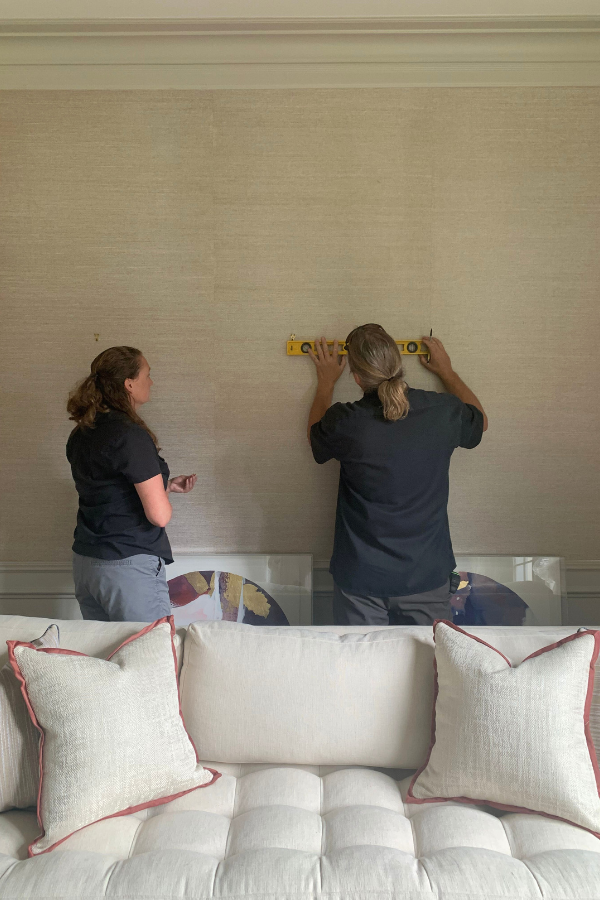
Mentorship has a lot to do with whether this process is successful or not. Younger designers develop better judgment by watching how a principal works, both with clients and with the team. In watching you, they’re learning standards, sequence, restraint, and how to protect a concept when revisions and competing opinions crowd around it. Developing “taste” is only a small part of it.
Join DesignDash Growth Studio for Clarity, Direction, and Community
If this article brought up bigger questions about delegation, team leadership, hiring, trust, or how your own role needs to change as your firm grows, DesignDash Growth Studio was built for that stage of your business. Growth Studio is our 6-month pathway for interior designers who want a more profitable, stable, and scalable firm built around five core pillars: People, Profit, Promotion, Process, and Purpose.

Enrollment for the next Growth Studio cohort, running July through December 2026, opens in April. If you want clearer structure, stronger leadership habits, better systems, and a business that does not depend on you at every single step, join the waitlist now. After Growth Studio, you’ll also have the option to continue inside our private alumni DesignDash Community for ongoing support, accountability, and conversation with other firm owners at many different stages of business.
Written by the DesignDash Editorial Team
Our contributors include experienced designers, firm owners, design writers, and other industry professionals. If you’re interested in submitting your work or collaborating, please reach out to our Editor-in-Chief at editor@designdash.com.
Related Posts

Interior Design Trend: Beaded Lamps & String Light Fixtures
To honor another interesting HPMKT interior design trend, we've rounde

Finding a New 9 to 5: How to Put Freelance Work on a Resume
From listing relevant skills to explaining your employment gap, here's

How to Cut Flowers for Lovely, Long-Lasting Arrangements
Whether you're a gardening enthusiast or simply enjoy having fresh flo

What is a Capsule Wardrobe, and How Can I Build My Own?
The term "capsule wardrobe" was first coined in the 1970s by Susie Fau
Sustainable Interior Design: Celebrating Eco-Conscious Designers
Prioritizing human health, the natural world, and careful allocation o