


What Is Passementerie? The Decorative Trim Term Every Designer Should Know

 0
0
 0
0Summary
Passementerie is the umbrella term for decorative trim, including fringe, tassels, braid, cord, galloon, gimp, rosettes, tiebacks, brush fringe, and bullion fringe. This article explains what the word means, where it came from, how it entered interiors through clothing and ceremonial textiles, and how these individual trimmings still shape furniture, drapery, and soft furnishings now.
Reflection Questions
Which passementerie terms do I already use with confidence, and which ones have I been describing more loosely as just trim or fringe?
When I look at a room with a lot of textile detail, do I notice where ornament sits at the edge, seam, hem, or border, or do I mostly register the fabric itself?
Which of these trimmings still feels current to me, and which ones still read as too historical, formal, or specialized?
Journal Prompt
Write about a room, object, or historic interior where decorative trim changed the whole reading of the space. It could be a skirted chair, a set of drapery panels, a bed canopy, a lampshade, or even a small object like a tassel tieback or braided pillow edge. Describe the trim as specifically as you can. Name the material, the placement, the color, and the type of passementerie if you know it. Then write about why that detail stayed with you and whether you would use it differently now.
In our recent article on fringed light fixtures, we spent a fair amount of time looking at fringe as an object-level detail: leather tassels around a chandelier, cotton-linen trim beneath a glass shade, jute wrapping that pushed a lamp into fringe territory without fully crossing over. In that article, we used the term “passementerie,” which we realized not all designers will know. Passementerie is the name for the broader decorative category that also includes tassels, braid, cord, galloon, and other ornamental trims that have been used on furniture, drapery, and upholstery for centuries.
You can probably identify a bullion fringe on a chair skirt, a braided edge on a pillow, or a tassel tieback at a window, but if you don’t, this article will clear up all those vocabulary words for you. Passementerie can sound antique, overly academic, or a little fussy at first, but it’s an essential umbrella term for designers (both interior and fashion). Read on to learn all about it!
What Is Passementerie?
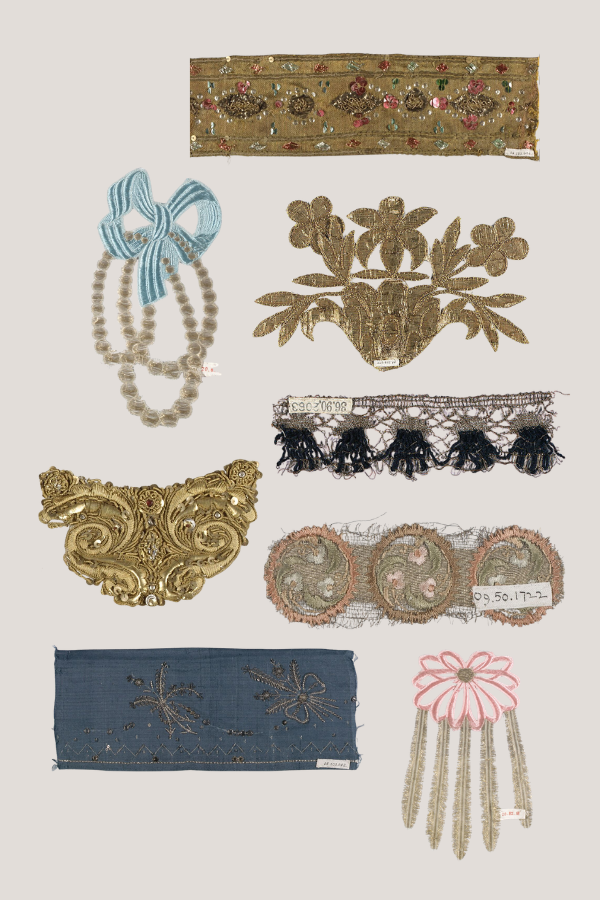
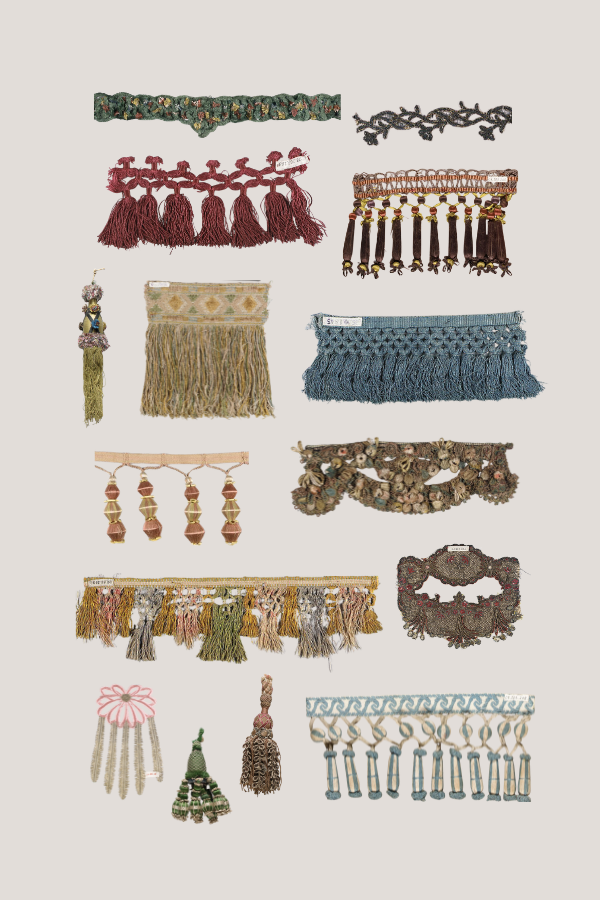
Passementerie is the decorative category that includes fringe, tassels, braid, ornamental cords, galloon, gimp, rosettes, and tiebacks. Put simply, it refers to ornamental trimming applied to textiles, furniture, and soft furnishings. Some have beads, embroidery, metal threading, linear ornaments, and embellishments while others are simpler. If you have ever looked at a skirted chair with bullion fringe at the base, a pillow with braided edging, or drapery finished with tassel tiebacks, you have already seen passementerie.
The term is broader than fringe, which is only one part of it. It refers to the larger family of decorative trims used across upholstery, drapery, and other textile surfaces in a room. As this resource from New York’s Fashion Institute of Technology describes, between the 16th and 17th centuries passementerie was considered “Ornamental braids and other trimmings of gold and silver, silk or cotton threads.” However, by the 1800s, it had evolved to include “colourful braids and fringes decorated with beads, silk and metallic threads.”
Passementerie can be found in garb and interior decor from ancient Egypt, the Middle East, and classical cultures like Rome and Greece. It can also be found in more recent European traditions throughout the 16th to 20th centuries. Of course, passementerie is not solely relegated to interiors of history; it is still used in modern and contemporary interiors.

What Does the Word Mean?
Of course, the word passementerie comes from an early French word, where it was used in connection with ornamental trimming and braid. It entered English through textile, fashion, and decorative arts vocabulary. Passementerie is usually pronounced pass-MEN-tree in English. Merriam-Webster gives it as pas-ˈmen-t(ə-)rē, while Dictionary.com gives both an anglicized pronunciation and a more French-influenced one.
Its immediate root is passement, the French term for ornamental braid or decorative trimming. Merriam-Webster traces passement to Middle French and connects it to passer plus the suffix -ment. Collins also gives the older French root and notes a link to passer in the sense of trimming or edging.
How Did Passementerie Get Its Start?
Passementerie started in clothing rather than interiors. Early passementerie referred to ornamental trimmings made for dress, ceremonial and liturgical garments, military uniforms, and church vestments. Braid, cord, tassels, and metal-thread trims were applied to sleeves, bodices, belts, cloaks, and uniforms, where they indicated rank, wealth, or office. Before the term had anything to do with drapery or upholstery, it was tied to the body and to garments.
The same trims that decorated clothing could also finish bed hangings, curtain borders, valances, chair skirts, and upholstered edges. Braid, fringe, tassels, and cord did much the same thing for furnishings and interior decor as they had already been doing on dress. They outlined shapes, added color and texture, and drew attention to seams, hems, and borders.
Passementerie in Historic Interiors
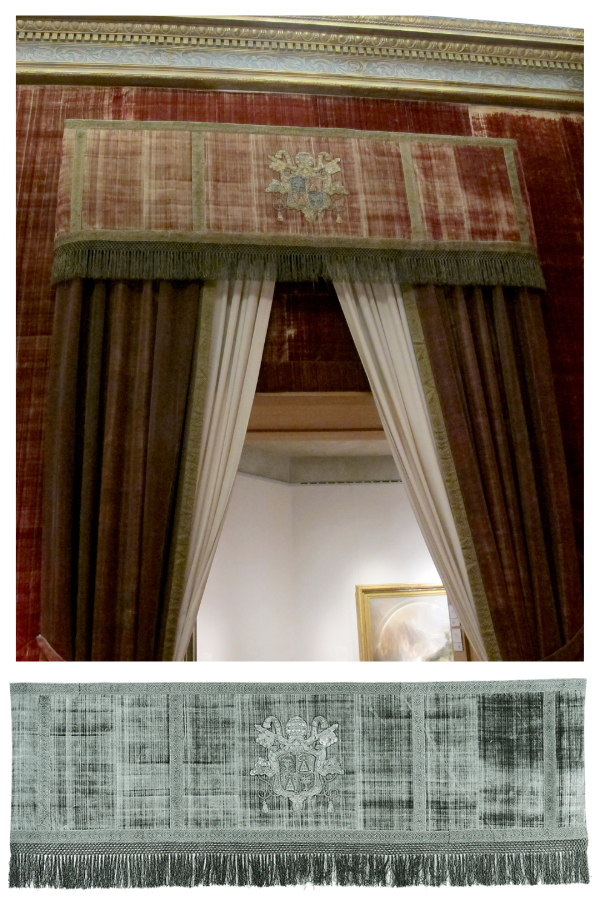
By the 17th and 18th centuries, passementerie was already part of interior decoration, especially on valances, bed hangings, and other textile furnishings. The Met’s mid-17th-century Italian Valance with Chigi coat of arms is made of red silk cut velvet appliqued with linen and silk rep weave, then outlined with couched gilt and cotton cording ending in tassels. The trim sits directly on the border of the textile, where cord and tassels pick out the edge and add another material.
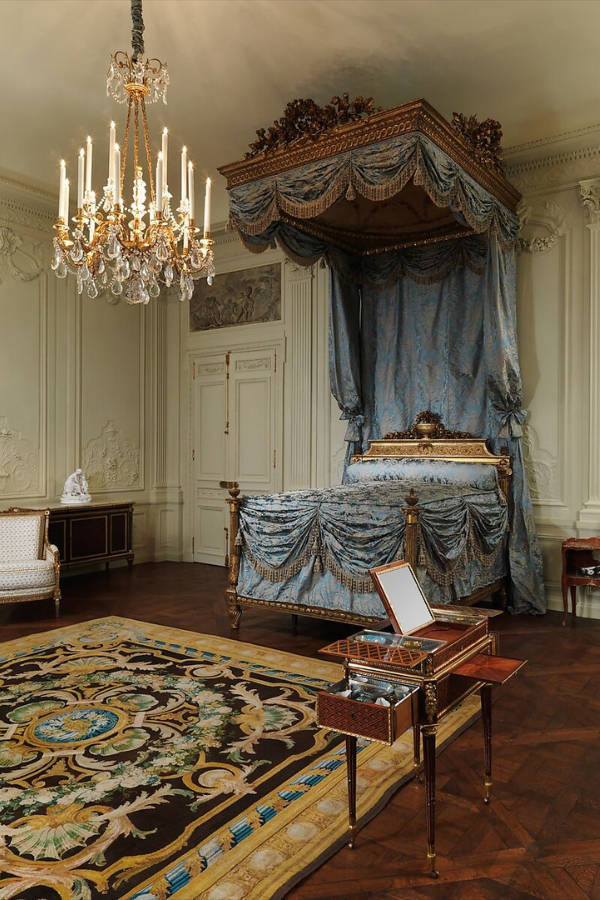
The Met’s Tester bed (lit à la duchesse en impériale), made in Paris around 1782–83, uses trim across a much larger piece of furniture. The bed has a ceiling-suspended canopy, blue silk damask hangings, gathered side drapery, and fringe at the lower edges of the valance and bedcover. In the museum’s earlier research on this bed type, side curtains are described as finished with short gold fringe all around, with cords and tassels in fake gold. In this kind of interior, passementerie can be found anywhere and everywhere fabric is bordered, tied back, gathered, or dropped in a swag.
Passementerie Terms Every Designer Should Know
Fringe
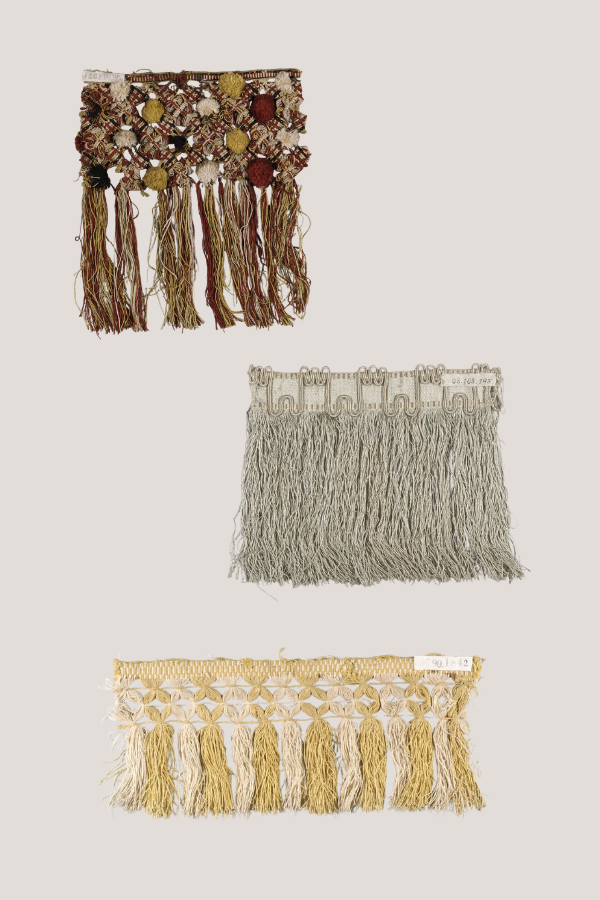
Fringe is a trim made from hanging threads, cords, or other fibers attached to a woven header. In interiors, it is often used at the edge of upholstery, lampshades, drapery, valances, and skirted furniture. The word itself dates to the 14th century in English, but applications of fringe can be seen far back in human history.
For example, the Met has a piece of limestone from the New Kingdom’s Amarna Period with shawl pleating and fringe carved into it. It is shown above in early 18th century Spanish fringe, American silk fringe trimming from between 1870 and 1900, and 19th century French silk fringe.
Tassel
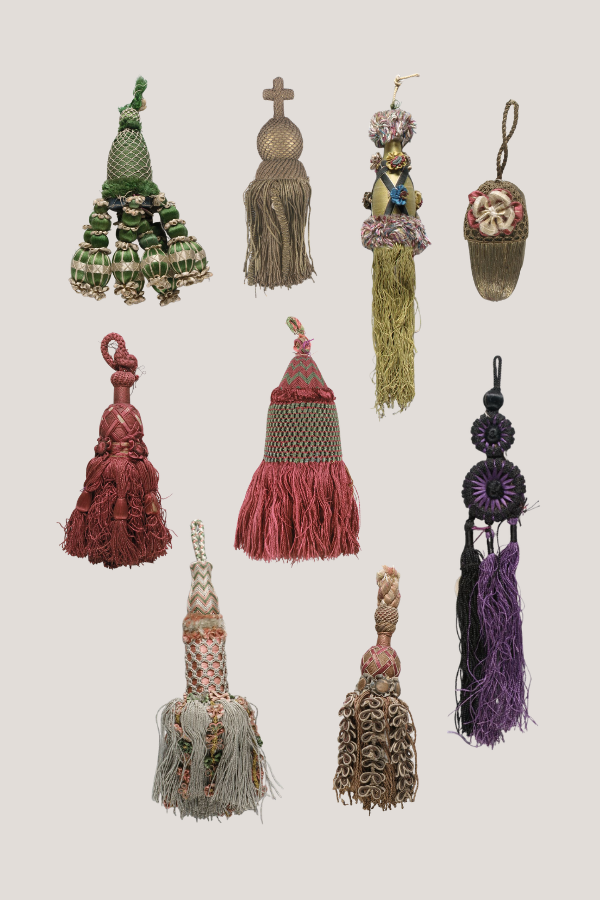
A tassel is a decorative bunch of threads or cords gathered at one end and left loose at the other. In interiors, tassels are used on tiebacks, lamp pulls, key trims, and the corners of cushions, though they also appear as a larger decorative element on lighting and furniture. The word dates to the 14th century in English. The Met has later examples in its collection, including a late 16th to early 17th-century French tassel in silk and cotton and a 17th-century Italian tassel in linen.
Fuel your creative fire & be a part of a supportive community that values how you love to live.
subscribe to our newsletter
*please check your Spam folder for the latest DesignDash Magazine issue immediately after subscription
Braid
Braid is a flat trim made by interlacing strands into a narrow band. In interiors, it is often used to edge pillows, outline upholstery, finish curtain panels, or cover seams where one fabric meets another. As a word, braid is very old in English: Merriam-Webster dates the verb to before the 12th century and the noun to 1530. The Met’s collection includes much earlier material evidence, including Textile Fragments and braid from 4th to 7th-century Byzantine Egypt, made in the Kharga Oasis.
Cord
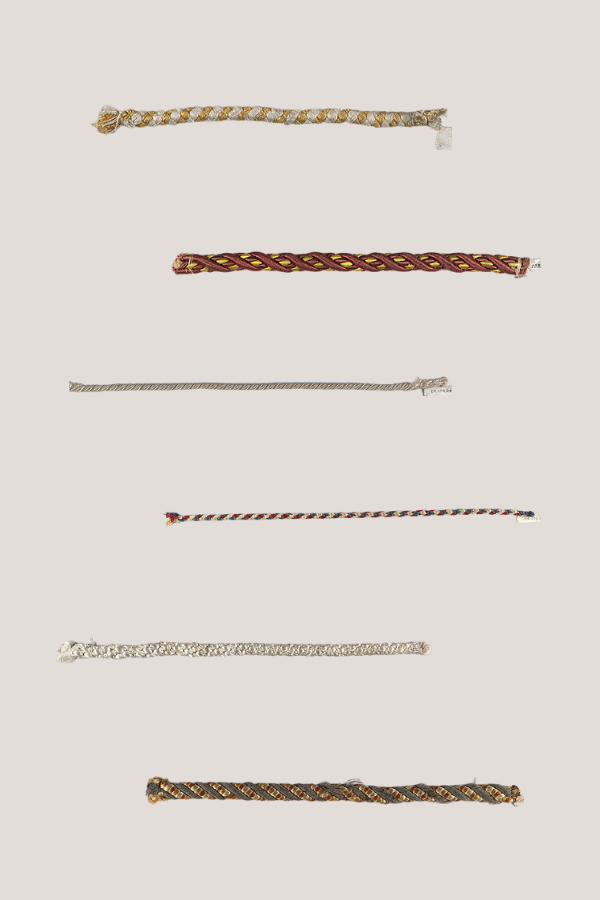
Cord is a thicker, rounded trim made from twisted strands. In interiors, it is used in welting, piping, tiebacks, and decorative edging, especially where a firmer line is needed than braid or fringe would provide. The word dates to the 14th century in English. The Met has several French silk and metal-thread cords from the late 18th and 19th centuries, along with a European silk cord dated to the 18th or 19th century.
Galloon
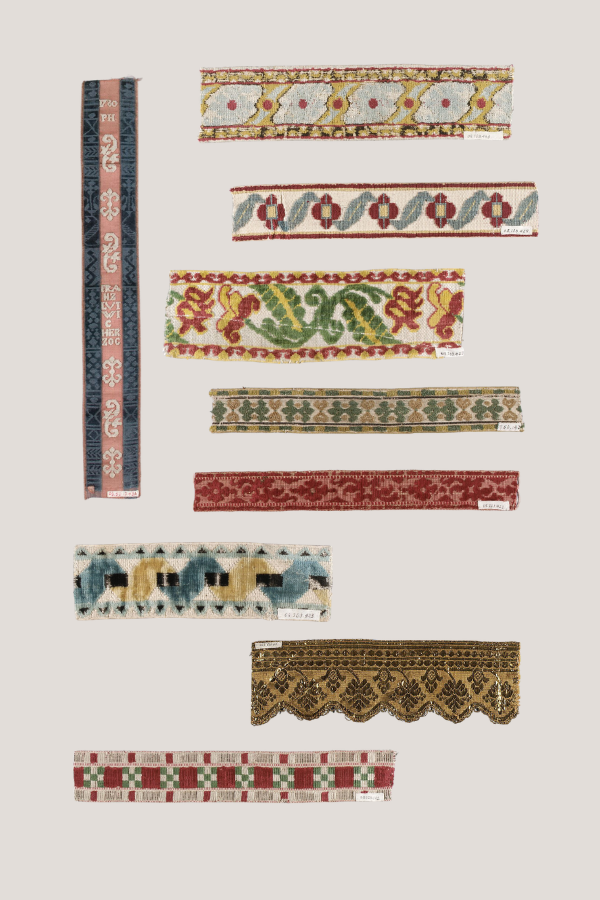
Galloon is a narrow woven trim, often flat, and often made with silk, cotton, or metal thread. In interiors, it is used to edge upholstery, finish curtain borders, and cover seams where a flatter, more graphic trim is needed than cord or fringe.
Merriam-Webster defines it as a narrow trimming, often lace or braid with metallic threads and scalloped edges. The Met has several examples in its collection, including a 17th-century French or Italian galloon in metal thread and an 18th-century French galloon in silk and cotton.
Gimp
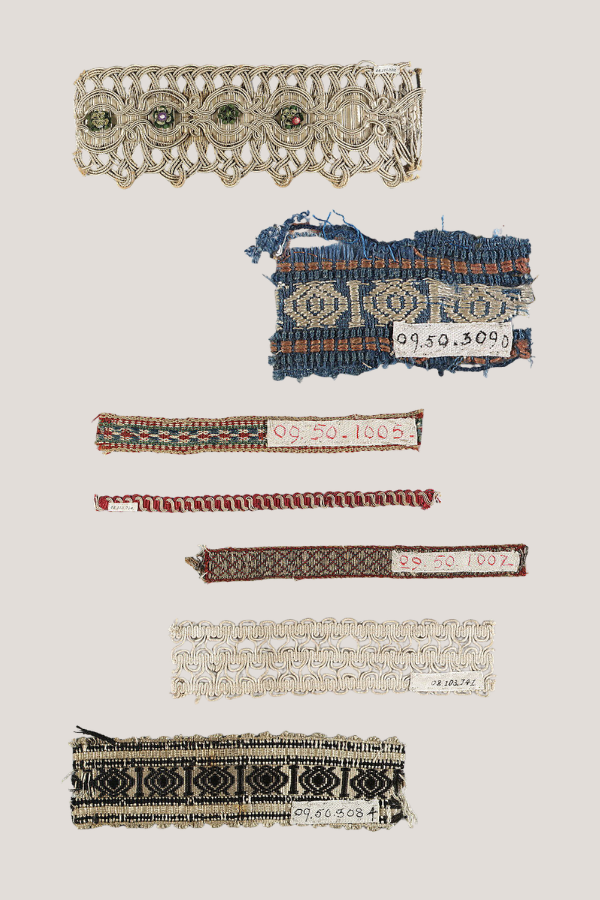
Gimp is an ornamental flat braid or round cord used as trim. In interiors, it is often applied along upholstery seams, around cushions, or at the edge of lampshades and drapery where the goal is to hide a join with something more decorative than plain braid.
Merriam-Webster dates the trim sense of gimp as an ornamental braid or cord, and the Met has examples that include a mid-19th-century French silk gimp and a 19th-century probably European silk gimp.
Rosette
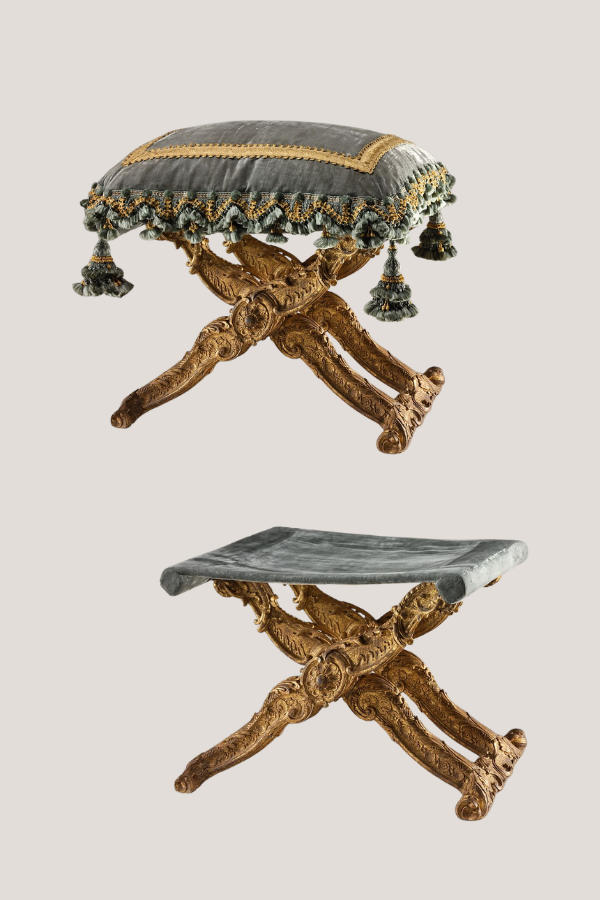
A rosette is an ornament gathered, pleated, or shaped to resemble a rose. In interiors, rosettes are used at curtain tiebacks, on upholstery, at the center of bows, and as applied trim where a flat braid or cord doesn’t quite cut it. They belong to a family of passementerie called “point ornaments.”

Merriam-Webster defines the word as an ornament usually made of material gathered or pleated so as to resemble a rose. In the Met’s collection, the rosette also appears as a much older decorative motif in other media, including a 5th–6th-century fragment from a molding with rosettes and acanthus clusters and a Tang-period dish with a rosette medallion. In furniture, it can be seen in the French folding stool (pliant) pictured above and created in the early 18th century. The cushion on this carved and gilded walnut stool is actually removable, but it’s not original to the object.
Tieback
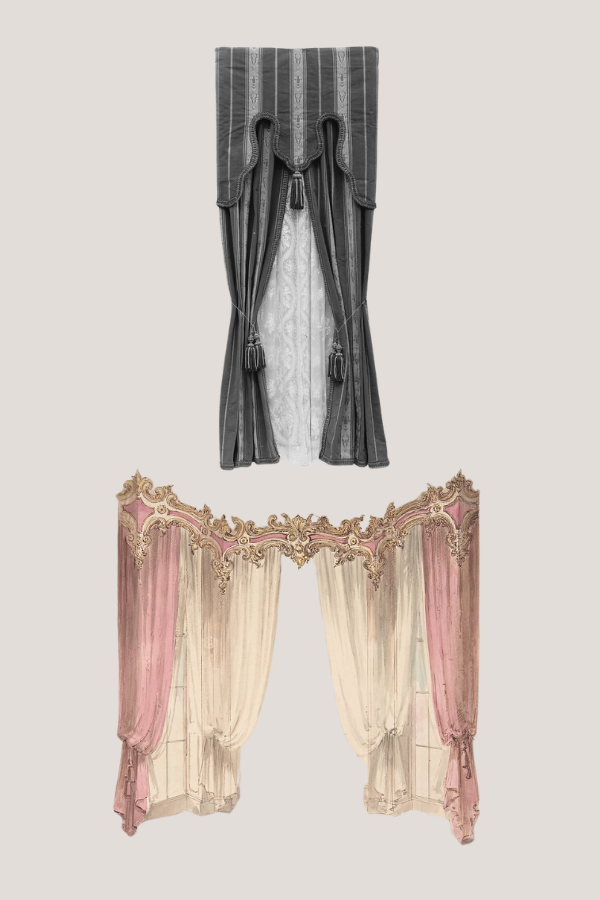
A tieback is a decorative band, cord, metal hook, or fastening device used to pull a curtain to the side. In interiors, tiebacks are often made of fabric, twisted cord, rope, or metal, and many include tassels or other passementerie details. It is not an edge trim in the same sense as fringe, braid, or gimp, but it belongs to the same decorative family. For example, the French or Swiss curtain set pictured above has a matching pair of two-tasseled tiebacks.
Brush Fringe
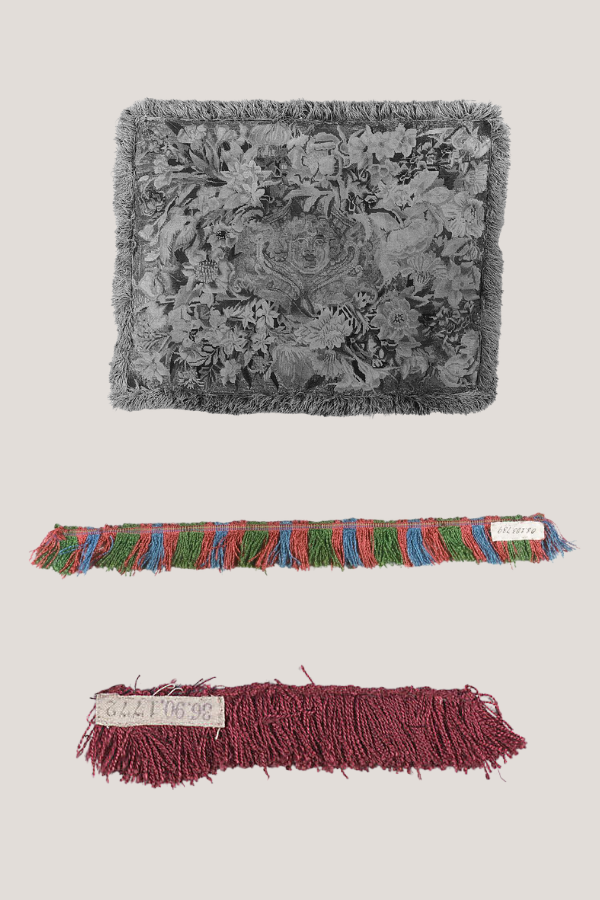
Brush fringe is a flat, dense fringe made from straight-cut threads attached to a ribbon or woven band. In interiors, it is used on the edges of pillows, lampshades, drapery, and upholstery where a softer edge is wanted without the heavier twist of bullion fringe. Trade glossaries describe it as a fringe with a brush-like surface, and that description is pretty literal.
The Met’s Design for Purple Curtains with Gold Fringes and a Gold and White Pediment shows fringe used on curtain borders in an early 19th-century interior scheme, which is the same general placement brush fringe still occupies now.
Bullion Fringe
Bullion fringe is a heavier fringe made from twisted yarns or cords that hang in rounded, rope-like lengths rather than straight strands. In interiors, it is common on chair skirts, ottomans, valances, cushions, and more formal drapery. The name comes from bullion, which Merriam-Webster defines in one sense as lace, braid, or fringe of gold or silver threads.
The Met’s Greek Revival Parlor includes silk brocade curtains with a large bullion-fringe valance copied from an 1833 design plate, which places the trim very clearly in a 19th-century interior context.
Written by the DesignDash Editorial Team
Our contributors include experienced designers, firm owners, design writers, and other industry professionals. If you’re interested in submitting your work or collaborating, please reach out to our Editor-in-Chief at editor@designdash.com.
Related Posts

15 Interior Architecture Schools to Consider for Your Degree
Let's compare 15 respected interior architecture schools that offer co
Are Those Vintage and Antique Light Fixtures Safe? Here’s How to Know
Learn about identifying outdated wiring, spotting hazards, and consult
Age of Opulence: French Rococo Interiors and Architecture
With ornate detailing, light colors, and playful themes, French Rococo
How to Choose a Studio Location as an Interior Design Firm
Choosing the right interior design studio location signals your intent

What is Interior Design? And Why Does It Matter?
LIKE 0 LEAVE COMMENT 0 11 min read Summary Interior design is the thou
Here’s What to Do About Textured Wallcoverings That Gather Dust
Textured wallcoverings can gather dust, but they're worth the extra e

POST COMMENT
You must be logged in to post a comment.