
5 Tasks You’re Doing Right Now That Should Be Someone Else’s Job

 0
0
 0
0Summary
Reflection Questions
Journal Prompt
If you own a design firm, take a look at all the jobs you picked up when your business was much smaller and you were the one responsible for EVERYTHING. You might still be sending invoices, tracking orders, scheduling deliveries, answering vendor emails, and managing the whole firm’s calendar because there was nobody else around to do those things at the time.
As your business grows, those early responsibilities can keep taking up your time unless you deliberately hand them off to someone else. You know how to do them, you can probably do them quickly, and training another person takes time. Delegation can be incredibly annoying (and hardly seem worth it) for exactly that reason.

But if you’re still personally responsible for every invoice, delivery update, schedule change, and routine client email, you’re spending a lot of your time on work another person could easily manage. We’ve interviewed DesignDash co-founder and Laura U Design Collective CEO Laura Umansky many times about what has bottlenecked progress at her firm, and she has repeatedly talked about how much admin help changed her business.
Laura says, “Operational support changed my business. Not having to manage accounting and bookkeeping freed my brain. For a lot of creatives, just the idea of having to do bookkeeping weighs on us. Having someone professional to support me gave me space to think, lead, and design at a higher level.”
Five Tasks Someone Else Should Own First
#1 Invoicing, Bookkeeping, and Routine Financial Admin
You absolutely need to understand your firm’s finances. And yet, you probably don’t need to personally send every invoice, reconcile every transaction, enter every expense, chase every overdue payment, and organize every receipt for your accountant.
Knowing your numbers and doing all the administrative work behind those numbers are two very different jobs.
If you’re spending hours preparing invoices, checking whether clients paid, entering expenses, or gathering paperwork, start there. A bookkeeper, administrator, or operations employee can manage the routine work while you review cash flow, profitability, receivables, and the financial information that actually requires your attention.
This is also one of the easier jobs to outsource before adding in another full-time salary. Laura and Melissa have both talked about bookkeeping as work that can go to an outside professional.
Your time is better spent understanding what the numbers are telling you than entering every number yourself.

#2 Order Tracking and Vendor Follow-Up
Procurement can swallow a shocking amount of time because every individual task seems tiny. You check a lead time, confirm a finish, follow up on shipping, ask about the backordered piece, update the receiver, email the vendor again, and half the afternoon is gone. Multiply that across an entire home and you can spend a ridiculous amount of time following orders around.
Routine procurement follow-up can go to somebody else.
A procurement manager, project coordinator, or another trained team member can track orders, check availability, update shipping information, and follow up with vendors. You’ll still be needed for certain procurement decisions.
Let somebody else chase down an errant shipment. And if an item was out of stock or discontinued, wait for your procurement team to bring you in when it’s actually time to replace that missing piece with a new item.
Fuel your creative fire & be a part of a supportive community that values how you love to live.
subscribe to our newsletter
*please check your Spam folder for the latest DesignDash Magazine issue immediately after subscription

#3 Scheduling, Deliveries, and Project Logistics
Keeping a calendar is time- and effort-intensive. Think about how much schedule-arranging goes into a finished project. There are just so many moving parts. In just one week, a client meeting changes, an installer needs access to the home, the photographer sends three possible dates, a delivery has to be coordinated with the receiver, samples need to make their way across town, and your builder wants to know when your team will be on site.
Each individual scheduling call or email might not seem like a big deal, but together they can really take over your schedule.
If you’re still coordinating routine appointments, deliveries, install logistics, site access, and internal calendars, assign that responsibility to somebody else. Give her the information she needs, explain which conflicts require your input, and let her make the normal decisions herself.
And if you see that date-change email first, ignore it. It’s not your job anymore.
#4 Routine Client and Vendor Communication
You probably shouldn’t delegate every client conversation, but you can delegate plenty of them.
A project manager can confirm meetings, send normal project updates, answer straightforward scheduling questions, request information from vendors, and tell a client when to expect the next presentation. You can step in for major design decisions, pricing, scope, sensitive problems, and conversations where your authority or relationship with the client is important.

Your employee needs to know how your firm communicates before you hand over those conversations. Melissa says Laura U Design Collective trains employees on this during their first week through its Guided Design Experience. Certain terms can mean very different things to different employees, so the firm spells out its expectations EXPLICITLY.
“We train to this in the very first week of employment with our Guided Design Experience. It’s a procedural reference document that demonstrates how we speak to clients, to subs, to each other. If a candidate is punctual, well-spoken, well-groomed that goes a long way, as does hospitality experience. Our clients expect a lot and I prefer new team members who have worked in kind of thankless service industries, like fine dining and upscale retail, who understand what it’s like to go above and beyond for a client relationship.”
Melissa Grove
Laura has a similar approach to deciding what clients need to hear from the team. Her team works through unfinished ideas, vendor problems, and internal conversations before communicating with the client. Major changes that affect what the client approved absolutely must be communicated.
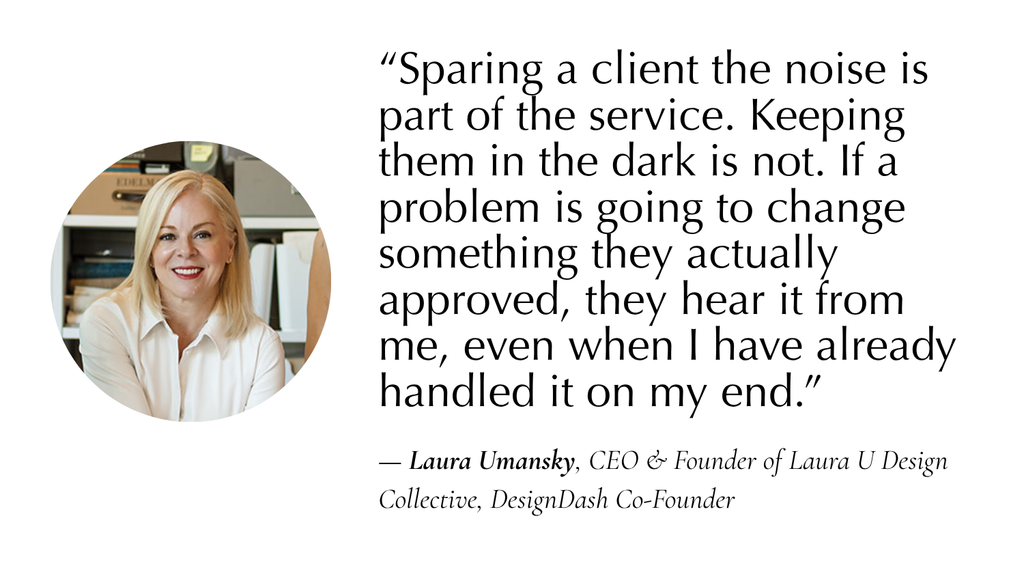
Laura doesn’t share what she calls “unfinished thinking” with clients. As she explains, her firm will discuss options internally. They’ll change their minds and “slog through the messy middle” of every design. According to Laura, a client does not need a seat at that table, because watching a decision get made is a completely different experience from being handed a confident recommendation. What makes it to the client? Laura says, “We work it out, land on a point of view, and bring that to them.”
But there’s a lot that will never be discussed between designer and homeowner.
“The operational grind stays with us, too. Vendor issues, the rep who has stopped returning calls, the delay we are quietly troubleshooting. The client sees the result of all that, but they do not need the play-by-play.
I will say I have learned to be careful with that one, because there is a line and I have crossed it. We also keep our internal team conversations internal. If someone is being coached or a role is shifting, that is ours to manage. The client hired the firm, not the individual team member.”
—Laura Umansky
Define what good communication means at your firm, train people to do it, and stop rewriting every email they send.
#5 First-Pass Project Work
You probably don’t need to source every option, pull every sample, prepare every presentation, draft every drawing, research every product, and assemble every schedule yourself. A junior designer or design assistant can take the first pass after she understands the direction, budget, client, and parameters.
She might source fifteen rugs for you to review, prepare an initial furniture schedule, gather samples, update drawings, organize presentation materials, or research technical information before you make the final decision. You’re still reviewing the work and making the calls that demand your expertise and your experience.
Your effort should go into directing and reviewing the work instead of personally producing every part of it.
And yes, you could probably do the first pass faster yourself because you’ve been doing it longer. If you delegate a task and immediately take it back because the employee’s first try wasn’t exactly what you would’ve produced, you’ll still be doing it yourself six months from now.
Give people enough information to improve, correct them when necessary, and let them learn their job.
So, What Should You Keep?
There will always be decisions where your experience, authority, client relationships, or creative judgment determine what happens next. Depending on your firm, those might include:
- Creative direction
- Pricing and scope
- Major client conversations
- Hiring and performance decisions
- Business development
- Significant budget decisions
- High-risk project problems
- Final review of important design work
So look at the tasks you perform again and again in roughly the same way. If you can teach the process, write it down, and explain what a good outcome looks like, another person can probably learn how to take it off your plate.
You still have plenty to do as the firm owner. Go ahead and shed bookkeeping, scheduling, procurement tracking, routine emails, and first-pass project work.
Written by the DesignDash Editorial Team
Our contributors include experienced designers, firm owners, design writers, and other industry professionals. If you’re interested in submitting your work or collaborating, please reach out to our Editor-in-Chief at editor@designdash.com.
Related Posts

Reduce Waste (Without Sacrificing Style) While Entertaining This Summer
With increasing awareness of our impact on the planet, finding ways to

Soothing Soundscapes: The Best Sound Machines For Focus
Using sound machines like the Homedics or LectroFan High Fidelity can

What is a Medical Insurance Superbill? How is it Used?
To all the women navigating the complexities of healthcare: remember t

Help! I Have a Difficult Interior Design Client Who Pays Really Well.
Struggling with a difficult but high-paying interior design client? Le

15 Engaging Activities to Elevate Your Summer Soirées
Whether you're planning an intimate gathering or a grand celebration,

Should I Rent an Office or Just Work From Home in My Firm’s First Year?
Learn whether a home studio or a rented space makes more sense in your