
How Can Owners Set Realistic Revenue Targets for Their Design Firms?

 10
10
 0
0Summary
Setting a realistic revenue target starts with profit, not a top-line number that sounds impressive. Laura Umansky and Melissa Grove encourage firm owners to look at what they actually need to take home, how their revenue usually comes in, what their close rate and project size support, and whether their team has the capacity to handle the work required to hit the goal. A bigger revenue target only helps when it fits the business you have now or the one you are truly ready to build.
Reflection Questions
How much profit do I actually want my firm to produce for me this year?
What do my past two or three years of revenue and expenses say about how my business really operates?
How many projects would I need to close to hit my target, and do I actually want the year that would come with that volume?
Does my current team have the capacity to support my revenue goal, or am I asking this business to do more than it can do well?
Journal Prompt
Write down the revenue number you want to hit this year, then write down why you chose it. After that, break it apart. How much profit do you want to make? What would that number need to cover in payroll, overhead, sourcing, software, gifts, travel, and other expenses? How many projects would you need to sign, and what size would they need to be? Finish by writing whether this target fits the business you have now, or whether it really belongs to a later version of your firm.
Setting a revenue target can seem deceptively simple. You pick a number, write it down, and tell yourself this is the year you hit it. But that number can be totally unrealistic if it has no relationship to how your firm actually makes money, what your team can handle, or how much profit you need to take home for all this work to be worth it. A bigger number sounds exciting until you start asking what it would require to reach it, and what it would actually cover! Revenue isn’t profit, after all.
We recently caught up with Laura Umansky and Melissa Grove to discuss how designers can and should set revenue targets. Instead of treating revenue as a standalone goal, they tie it to profit, project size, close rate, and team capacity. They also make room for the less glamorous parts of running a firm, like seasonal expenses, market conditions, and the simple fact that growth usually demands more structure than owners first expect.
A realistic revenue target can be ambitious, but it must still fit the business you have now or the business you are genuinely prepared to build. Pie in the sky revenue targets help no one if you don’t have a way to reach them.

Three Ways to Set and Hit Your Revenue Targets This Year
#1 Revenue targets should start with profit

A revenue goal can look great and still do very little for the owner. A firm can bring in plenty of money and still leave the owner underpaid, tired, and wondering why the business takes so much effort for so little return. That’s why Melissa starts with profit. Before you set the big annual number, you need to know what the business actually needs to produce for you.
It’s here that we bump up against a common pain point. Owners pick the annual number first and only later think about payroll, operating costs, sourcing, gifts, travel, software, and all the other expenses that eat into what the firm keeps. They think about revenue but not about profit and expenses. Revenue can go up while the owner still feels squeezed every month. That type of growth isn’t actually growth.

As Laura points out, ambition is fine. It’s excellent, actually. Motivating. Firm owners should be pushing toward something. But the number still has to match the firm you actually have. It has to reflect what the business sells, what it spends, and what the owner needs to take home for all of this to feel worth doing.
And as Melissa points out, there are certain elements of your business that you don’t have to guess at. One is financial patterns. These are easily tracked. When did revenue come in over the last two or three years? When did expenses jump? Which months were leaner than others? Those answers are sitting somewhere in Quickbooks already, and they’ll tell you much more than a hopeful round number ever will. Looking at those patterns won’t make your goal smaller by default, but it will make the final number a bit more honest.

#2 Revenue goals have to reflect project size, close rate, and volume
Once an owner has a revenue target in mind, the next question is pretty obvious: what kind of work would actually get you there? How large are your usual projects? How many of them can your firm handle in a year? How many would need to close for the annual goal to make any sense at all?

Melissa’s example helps because it’s so concrete. Four projects at $250,000 will get you to the same revenue as one at $1 million, but those are two very different years. The staffing pressure is different. The number of client relationships is different. The amount of coordination is different. The sales process is different too. A firm that mostly handles smaller jobs can’t throw out a large annual goal without also looking at how many more projects that would require.
That part’s important because plenty of owners choose the annual target first and only later realize the volume behind it is much higher than they’d imagined. The goal may sound perfectly reasonable until it’s broken down into ten, fifteen, or twenty jobs the firm would need to sign, manage, and deliver well. At that point, the question is no longer “do I like this number?” Instead, it’s “do I actually want the year that comes with it?” As Melissa puts it, “This helps you create reasonable goals for yourself and isn’t tied to arbitrary numbers you know you cannot hit.”

Close rate gives owners another way to check whether the target fits reality. If you know how many leads usually turn into signed work, you can back into how much business development the goal actually requires. That keeps people from inventing frantic activity that doesn’t lead anywhere. It also keeps the firm from chasing numbers that have no relationship to how clients usually come in.
Fuel your creative fire & be a part of a supportive community that values how you love to live.
subscribe to our newsletter
*please check your Spam folder for the latest DesignDash Magazine issue immediately after subscription

A lot of this comes down to whether the target has any real structure behind it. If you know your average project size, your usual close rate, and how many projects your team can absorb without everything getting messy, then the annual number starts sounding more believable. It also gets easier to see what would need to change. Maybe you need larger projects. Maybe you need a stronger close rate. Maybe you need fewer, better-fit leads instead of more conversations.

Laura continues to say that “When those pieces line up, the goals become both motivating and achievable.” Her point reinforces the fact that your revenue target only means something when it matches the kind of projects your firm usually sells and the number of jobs the team can execute well. Otherwise it’s just a number that sounded good in your kick-off meeting on January 1st.
#3 If your goal requires a different business, it’s probably not realistic yet
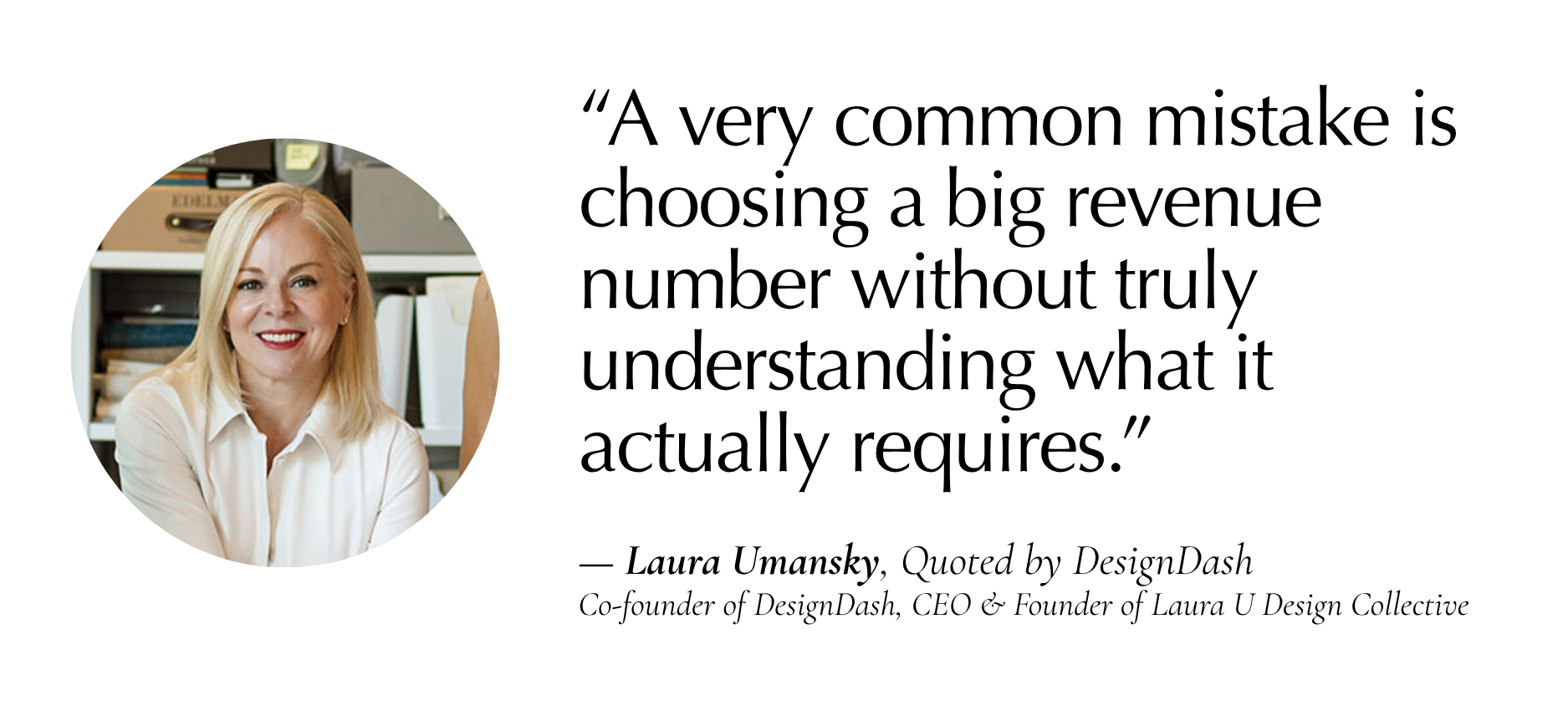
This might be the easiest mistake to make because the number comes first and the consequences come later. A firm owner picks a larger revenue target, feels energized by it, and only months later starts noticing the pressure that came with it. More projects need to close. More people need to be hired. More marketing has to happen. More systems have to be built. More decisions pile up at the top. The number may still be possible, but the business has to work way harder than it did before. For example, Laura explains that “Doubling revenue might mean doubling the team, doubling the marketing effort, or dramatically increasing project size.”

As a firm owner, you must think beyond the number itself. What would have to change for that target to work? Would the current team be enough? Would the principal still be the bottleneck on every important decision? Would project management hold up? Would the client experience hold up? A firm can want more revenue and still not be ready for the version of the business that would produce it.
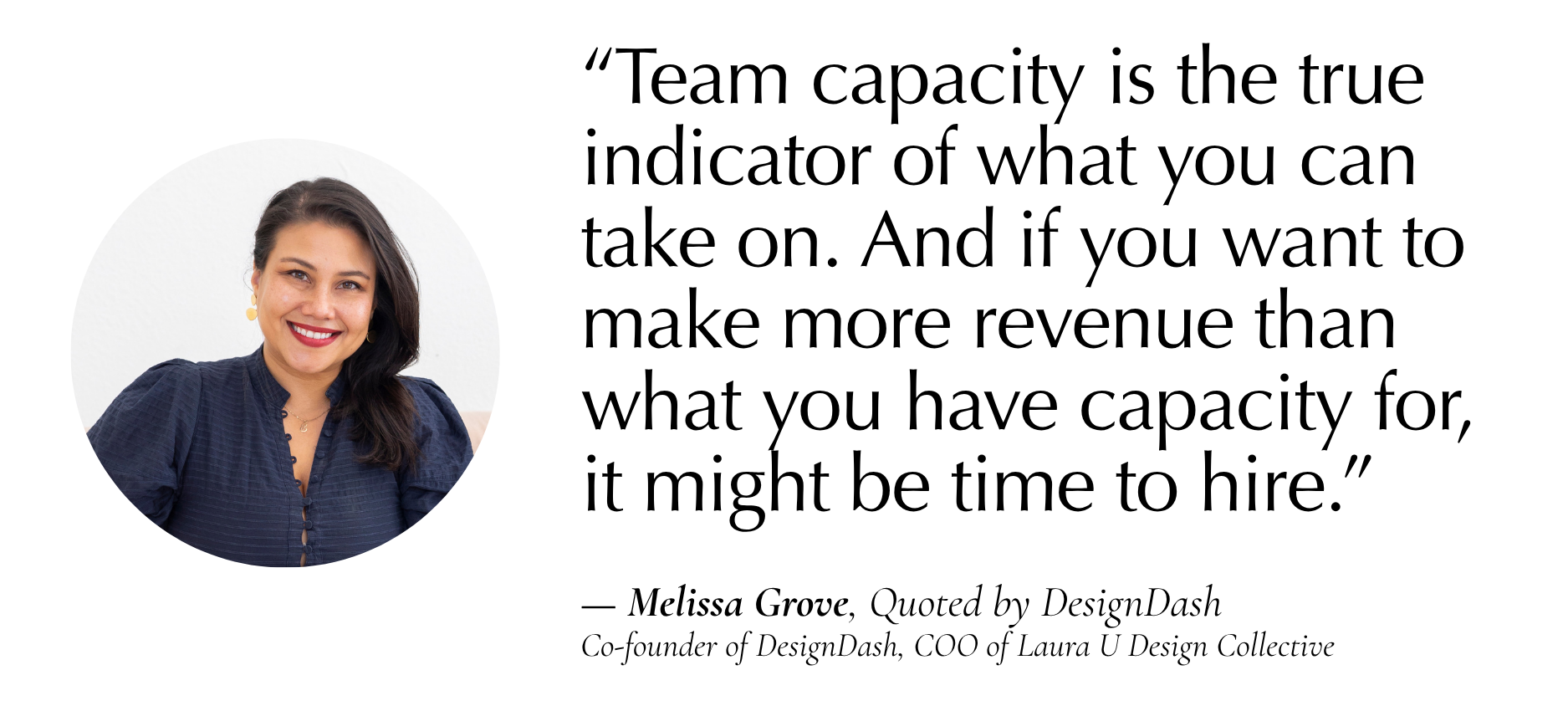
Hiring changes everything, so we understand why firm owners resist it. Payroll changes. Communication changes. Management changes. The firm may need better systems, clearer roles, and more oversight than it has now. Still, capacity doesn’t stretch forever just because the owner wants a bigger year. At some point the business hits a limit, and then the decision is more of an ultimatum than a choice: change the structure, change the target, or accept that the team is already full.
You need to project accurate revenue (and profit) (and firm capacity) way before you hit that point. Sometimes the issue isn’t ambition but rather the fact that the owner picked a number that better suits a larger team, a different project mix, or a firm with stronger systems than the one they have today. That doesn’t mean you came way out of left field, but it does mean that this is a future goal, not an immediate one.
Join DesignDash Growth Studio for More Content Like This
Laura and Melissa bring a level of clarity to conversations like these that only comes from actually running a firm at scale. As Founder and CEO and COO of Laura U Design Collective, they’ve had to make these decisions in real time, with real teams, real clients, and real financial pressure behind every choice. That’s obvious in how they talk about revenue. It’s grounded, specific, and tied to how a business actually operates day to day.

That same approach carries into the DesignDash community and Growth Studio. Their focus isn’t on chasing bigger numbers for the sake of it. Instead, Melissa and Laura prioritize helping firm owners build businesses that support the lives they actually want to live. That means thinking about profit, capacity, structure, and time, not just revenue targets that look impressive to peers.
If you’re trying to set more realistic goals for your firm, or even rethink what success should look like for you at this stage, their perspective is incredibly helpful.
Written by the DesignDash Editorial Team
Our contributors include experienced designers, firm owners, design writers, and other industry professionals. If you’re interested in submitting your work or collaborating, please reach out to our Editor-in-Chief at editor@designdash.com.
Related Posts

The Mid-Career Switch Series: How to Become a Brand Strategist
Whether you're contemplating a career shift or aiming to refine your e

Remote Leadership: Tips for Managing Creative Teams Across Time Zones
Effective remote leadership requires strategic communication, empathet

Epistemic Injustice: How Feminist Philosophy Explains Why Women’s Voices Are Undervalued in Creative Industries
Epistemic injustice reveals why women’s voices are undervalued in cr

How to Say No at Work and Home Without Alienating Anyone
Saying "no" can be challenging, but it's necessary. Here are 17 strate

Networking for Interior Designers: Building Professional Connections That Matter
LIKE 0 LEAVE COMMENT 0 7 min read Summary Reflection Questions Journal

The Mid-Career Switch: How to Become a Medical Illustrator
Medical illustration is a specialized field that combines artistic ski