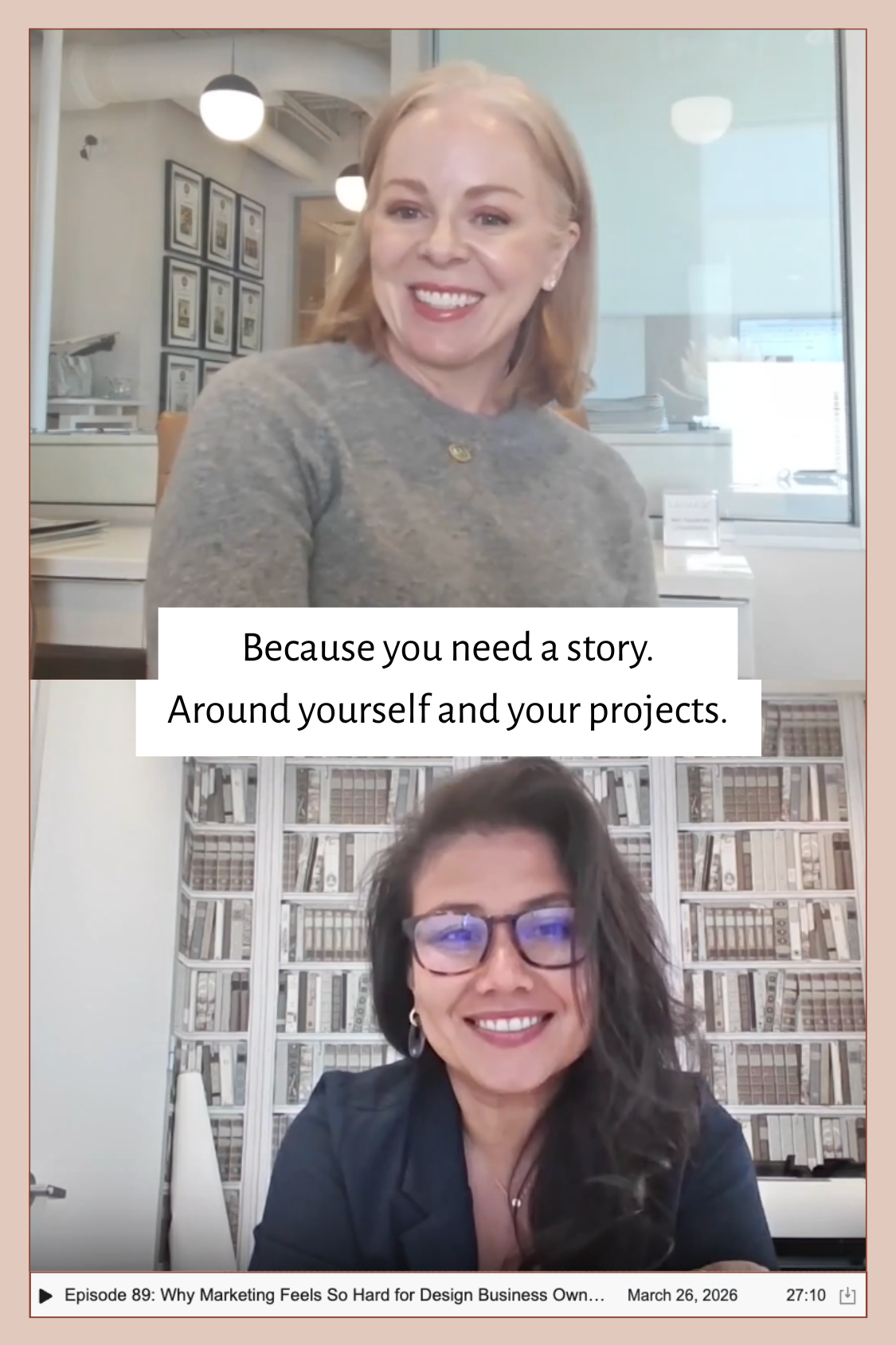
Why is Marketing So Hard Design Firm Owners, And How Do We Fix That?

 0
0
 0
0Summary
Marketing is hard when “marketing” functions as a catch-all. Laura and Melissa separate it into distinct jobs, then push firm owners toward three fixes: define the marketing category you’re prioritizing, write a story that makes your work legible to clients and editors, and set strategy and process before you start producing content.
Reflection Questions
Which marketing category has been consuming your time lately: PR, networking, digital marketing, traditional marketing, or advertising, and is that category actually the one your firm needs right now?
Can you explain your work in a short narrative that a client could repeat to a builder or friend, or do you rely on images to speak for you?
If your marketing goal is specific, what does success look like in numbers: qualified inquiries, press placements, vendor relationships, or a project mix that matches your target work?
Journal Prompt
Write one paragraph that answers Laura’s question: what do you want your photos and content to achieve, and who do you want to reach. Then write a second paragraph that names what you will stop doing for the next quarter so the plan has boundaries. Finish by listing the three marketing tasks that repeatedly create panic in your firm, and write one process change for each one that would prevent last-minute scrambling.
Marketing confuses firm owners because it seems creative, so it looks doable. Then it turns into a pile of tasks, and owners try to muscle through it on top of client work. In this DesignDash Podcast episode, Laura Umansky and Melissa Grove talk about why that happens, and what changes when a firm defines marketing by category, develops a clear story, and chooses a strategy that a team can execute. The three takeaways below distill their conversation into practical guidance for firm owners who want marketing to produce clearer results without driving them crazy.
Three Takeaways from Our Latest DesignDash Podcast
#1 Marketing isn’t one job, but design firms lump everything together
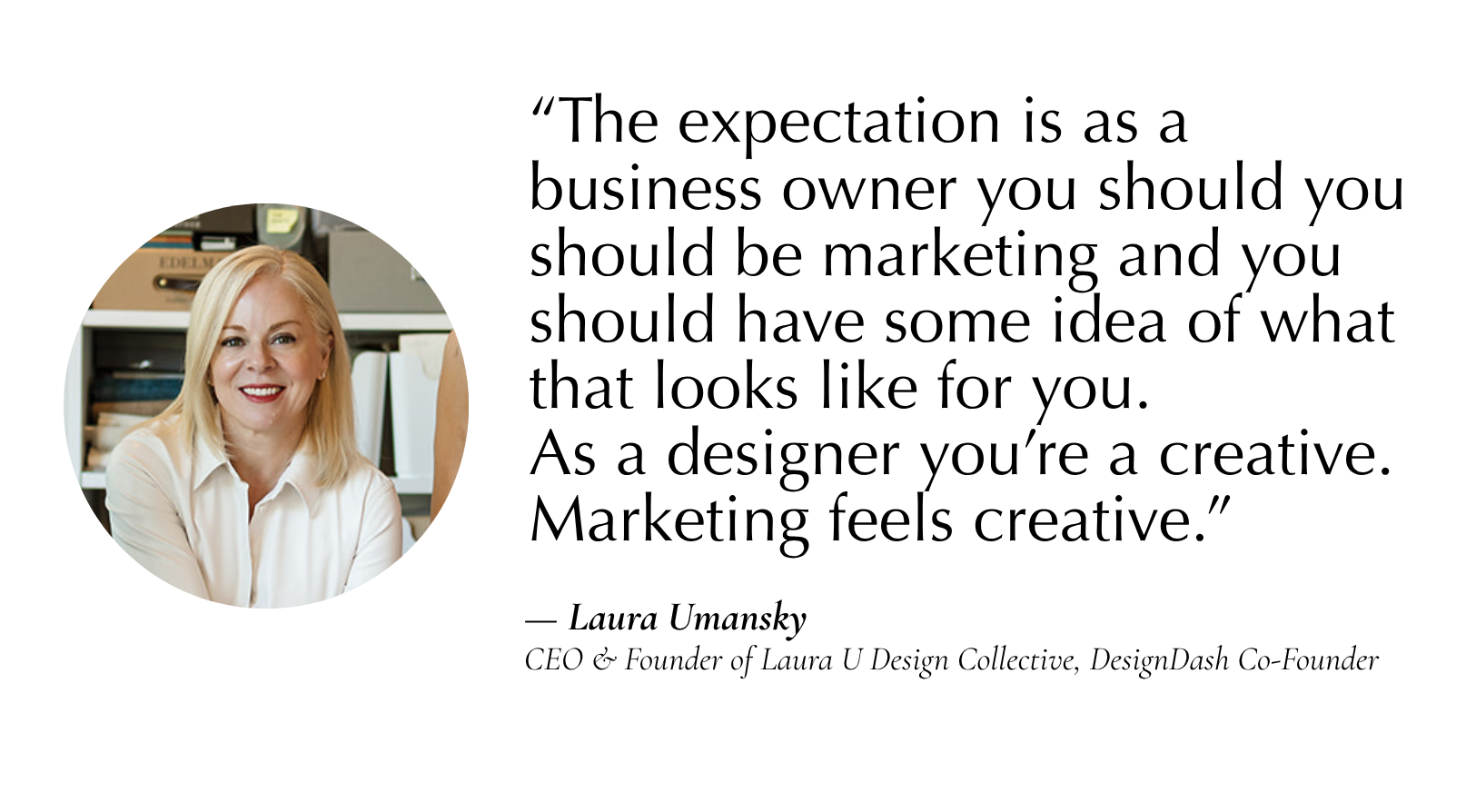
Laura Umansky frames marketing as an expectation problem before she considers it a skills problem. But because we view marketing as creative, we assume we can do it ourselves, or even that we should do it. So you turn it into a solo DIY, even when you have no marketing background. Unfortunately, this isn’t usually the wisest decision (for two reasons). First, ownership implies self-promotion, so marketing attaches to leadership even when the firm has no internal capacity for it.

Second, the creative identity of design encourages a false equivalence between taste and marketing competence. The work then drifts into personal effort instead of structured responsibility. It also drifts into scattered tasks, because marketing contains too many distinct functions for one vague label.The structural issue here is category confusion and conflation. Laura describes marketing as something that “seems so accessible,” because people reduce it to “posting on social media” or “going to events.” However, there are a lot of lines to draw.
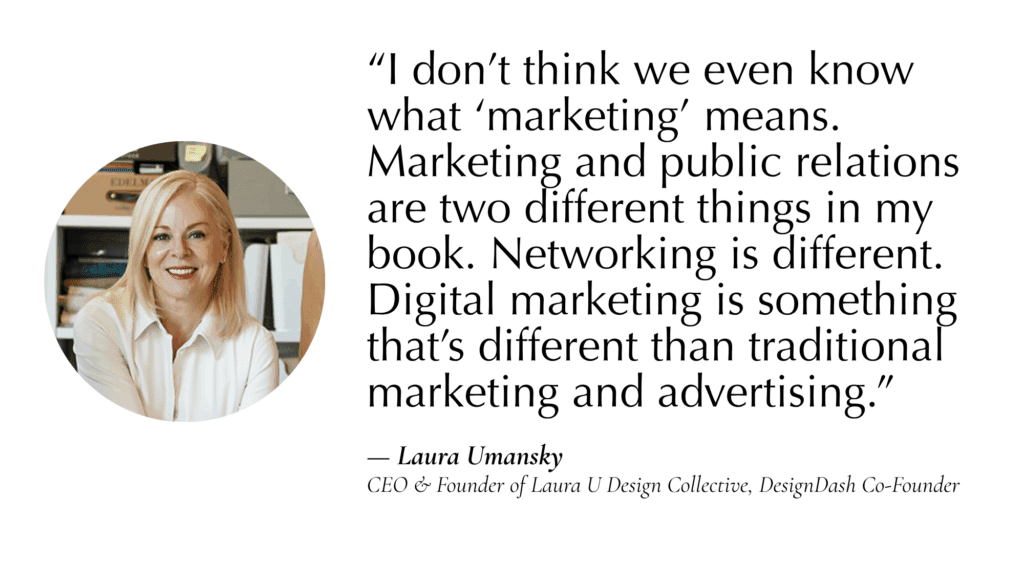
Each category requires different skills and different outputs. PR requires editorial positioning, pitching, follow-up, and long lead times. Networking requires contact capture, follow-up systems, and time allocated to relationships that pay off slowly. Digital marketing requires planning, content production, distribution, and measurement. Traditional marketing and advertising require budget, placement, and repetition. A firm owner can choose one category and do it herself, maybe. A firm owner can manage two categories with adequate support. But the categories don’t merge just because they’re grouped under the same umbrella.
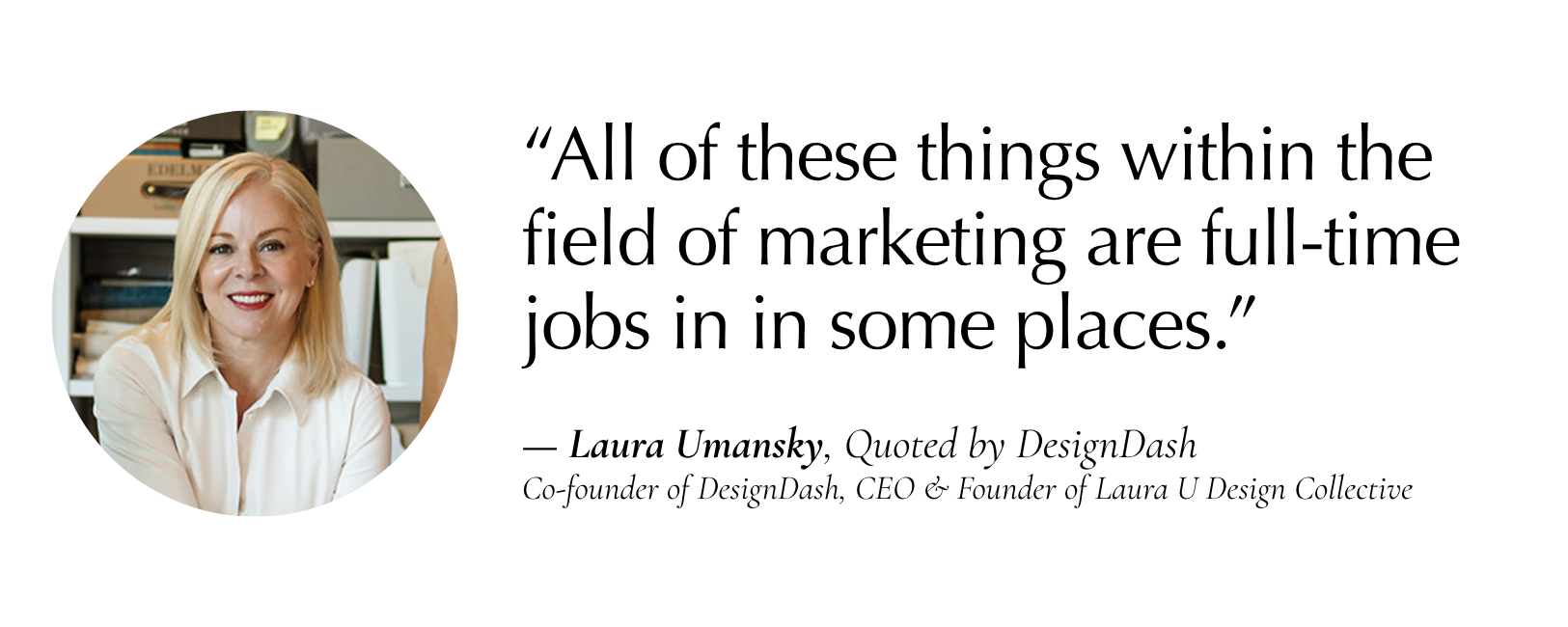
When firms assume they can just hire a “marketer” to handle everything, they often hire the wrong role and then fire the role after a disappointing quarter. A PR specialist can’t replace a digital marketing specialist. A digital marketing specialist can’t replace an ad buyer. Conflation creates mismatched expectations, then frustration, then more tactic switching.
Takeaway for Firm Owners
Write down what you mean when you say “marketing,” and separate it the way Laura does: PR, networking, digital marketing, traditional marketing, and advertising. Pick one priority for the next quarter, and tie your time and budget to that choice.
#2 A story has to come before content
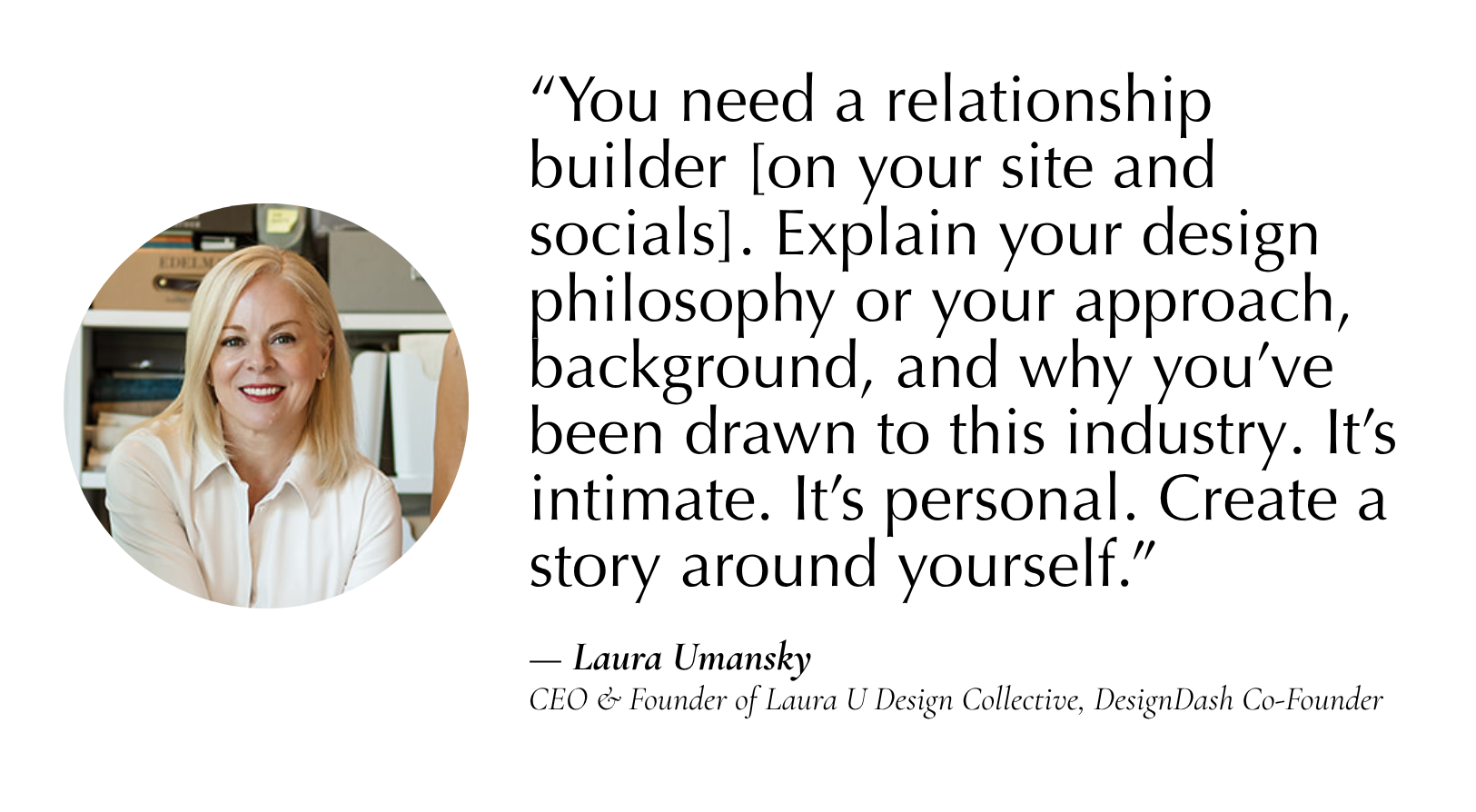
A lot of marketing advice starts with output. Post more. Share more projects. Improve your consistency. But Laura encourages all of us to pause and rewind. Start with a short written narrative that a stranger can read in two minutes and actually understand you. A one-page website won’t win you any awards, but it will force clarity, and that will increase the odds that you capture ideal clients. Clarify who you are, what you do, why you do it, and who you do it for. Without that language, images have no framework. People see taste, but they can’t define you. And if they can’t define you, they can’t repeat you to a friend, or a builder, or a potential client.
Fuel your creative fire & be a part of a supportive community that values how you love to live.
subscribe to our newsletter
*please check your Spam folder for the latest DesignDash Magazine issue immediately after subscription

This “story” is also a through-line that keeps content from turning into filler. A photo caption can either describe what the camera sees, or it can explain what the project solved. A portfolio can either read as a collection of unrelated looks, or it can show a consistent approach across different homes, budgets, and constraints. The story provides a framework for every marketing decision before you decide what to post, what to pitch, or what to put on the homepage.
“You still have to have a story. You have to have something to say. You have to have a narrative. When you’re pitching a magazine a project, everyone’s got a pretty house. What’s the story behind it?”
—Laura Umansky, DesignDash Co-Founder and Laura U Design Collective CEO/Founder
A project needs a reason beyond pure aesthetics. Editors want the constraint, the client problem, the architecture, the budget reality, the timeline, the unusual material decision, the renovation complication, the historical reference, or the logic that shaped your end result. That story exists in your head already. It just hasn’t been written down. Once it’s written, it supports multiple marketing categories at the same time. Website copy, captions, media pitching, and even sales conversations stop relying on improvisation. But again, you’re not the person who can handle all that at once (no one is).
Takeaway for Firm Owners
Write the story first. Put it on the website as the relationship builder Laura describes, then reuse the same core language in captions and PR pitching. The story gives the images a context instead of leaving them to stand alone.
#3 Strategy and aesthetics aren’t the same thing, and marketing is pointless without process
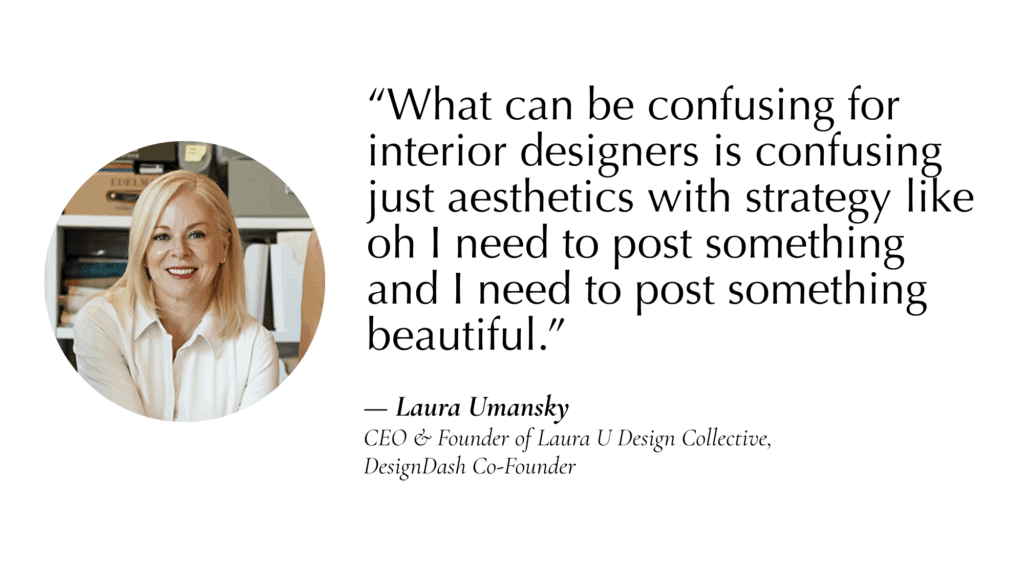
No one here is arguing against producing or posting beautiful work. After all, beautiful content is a baseline in this industry. Laura is simply arguing against treating beauty as a plan. A steady stream of attractive images can still leave a firm in the same place a quarter later with no clearer client mix, no clearer pipeline, and no clearer referrals. A whole bunch of marketing activity is happening, but the business intent is unnamed, so the work has no definition or real goals.
“What do you want to achieve through those photos, who do you want to reach, you know, like what what are you trying to get out of it?”
—Laura Umansky, DesignDash Co-Founder and Laura U Design Collective CEO/Founder
These questions will force you to make real decisions. If the goal is higher-budget residential projects, then your photos and written content need to emphasize scale, planning, and complexity. If the goal is hospitality, then they need to show repetition, durability, and public-facing spaces, not only a styled moment. If the goal is referrals from builders and architects, then whatever you put out there needs to communicate coordination, documentation, and trust, not only a finished reveal.
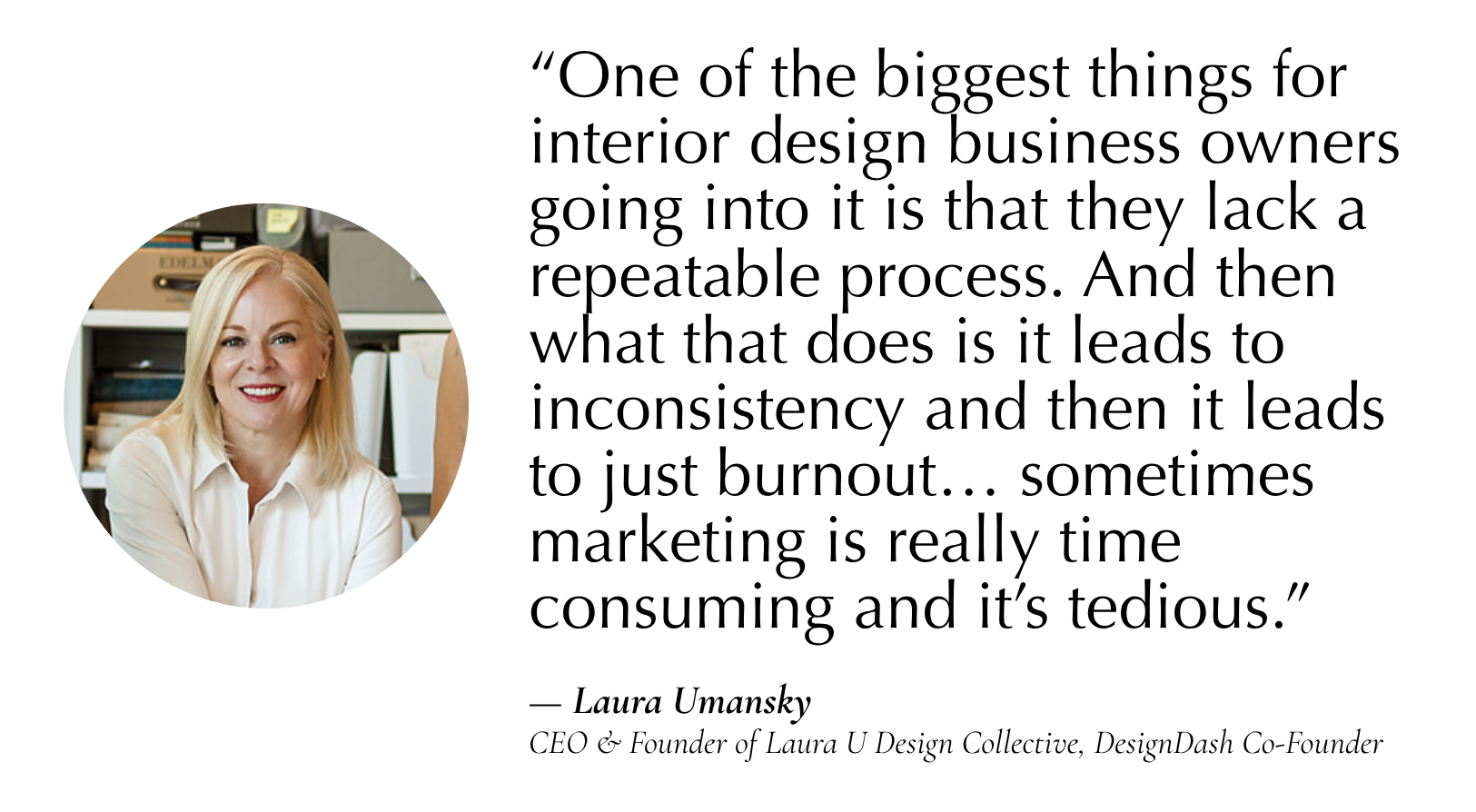
This connects back to the strategy question because vague goals invite vague execution. Marketing tasks that swallow time and attention include award submissions, social media management, and photo shoots. Those tasks require planning and coordination in order to be successful (or even published on time).

A photo shoot needs scheduling, a shot list, approvals, and someone responsible for the details. Awards require deadlines, image selection, writing, and credits that are actually correct. Socials need file organization and drafted captions, otherwise your manager or intern is simply scrambling on the daily. When your team rebuilds those systems from scratch each time, marketing turns into a recurring emergency. But you don’t have to do it all if you don’t have the time, the manpower, or the tools.
“You just do whatever you can and marketing works better when it’s organized.”
—Laura Umansky, DesignDash Co-Founder and Laura U Design Collective CEO/Founder
Takeaway for Firm Owners
Answer Laura’s questions in writing. Decide what your photos, portfolio blurbs, blog posts, and emails need to achieve and who they need to reach. Then build the process that supports that decision: a shoot schedule, submission deadlines, and a content archive your team can actually use.
Watch the Full Episode on DesignDash
If this article resonated with you, listen to the full episode. Thanks again to our hosts and founders Melissa Grove and Laura Umansky for being willing to share their perspectives and pain points with listeners.
Written by the DesignDash Editorial Team
Our contributors include experienced designers, firm owners, design writers, and other industry professionals. If you’re interested in submitting your work or collaborating, please reach out to our Editor-in-Chief at editor@designdash.com.
Related Posts

Mid-Career Switch: How to Become an Event Planner With No Experience
If you've ever dreamed of orchestrating unforgettable experiences, a m

Why Remodeling Is 2026’s Housing Industry’s Strongest Sector
California, Texas, and Florida account for more than 20% of U.S. remod

How to Attract High-End Hospitality Projects as an Interior Designer
Learn how to attract high-end hospitality design projects with these 7

Everything You Need to Know About Non-Alcoholic Spirits
From their health benefits and role in supporting various lifestyles t

How to Interpret ESG Scores While You Shop, Travel, or Invest
ESG scores rate the sustainability and ethical practices of companies,

Counting Down Our Most Listened-To Episodes of 2025: Jamie Young
On the DesignDash Podcast, enjoy Jamie Young's insights on building a