Could Design & Architecture Firms Benefit from Tariff Refunds?

 6
6
 0
0Summary
Tariff refunds are real, but they are tied to the importer of record, not necessarily the designer, architect, or client who experienced the price increase. While some firms that imported goods directly may have a clearer path, most interior design and architecture firms will likely see any benefit indirectly through vendors, suppliers, or future pricing adjustments. The ruling reveals just how complex procurement and pricing have become in the design industry.
Reflection Questions
Where does your firm typically sit in the procurement chain when sourcing imported goods, and how visible are those steps to your clients?
How often are tariff-related costs clearly itemized in your project invoices versus absorbed into broader product pricing?
If a vendor received a tariff refund, how might that realistically show up in your future projects or client relationships?
Journal Prompt
Think about a recent project where pricing shifted unexpectedly during sourcing or procurement. Where did those changes originate, and how were they communicated to the client? Reflect on how much of that pricing story was visible versus embedded within the final number.
Tariffs have been an unavoidable strain on our industry for years as they subtly (or not so subtly, in recent months) increased the cost of imported furniture, lighting, plumbing fixtures, stone, tile, and textiles. For many of us, those costs have increased gradually: a price increase here, a surcharge there, a vendor email noting “market adjustments” tied to global trade conditions.
Now, that conversation has turned on its head. Following a recent court decision, some D&A firms may be eligible for refunds on tariffs they already paid. If tariffs affected project costs, could any of that money find its way back to designers, architects, or their clients?
The answer, as it turns out, is complicated. While the ruling may have financial implications for certain companies, the structure of the refund process makes it far from a straightforward opportunity for most design and architecture firms.

What Actually Happened?
Earlier this year, the Supreme Court struck down the legal authority used to impose a significant set of tariffs. This set off a chain reaction across multiple industries. In response, the federal government began establishing a system to return funds to businesses that paid those import taxes.
According to reporting from Sean Noone at The Hill, U.S. Customs and Border Protection has already launched a refund portal that allows importers and their brokers to start submitting claims tied to those payments. The agency expects the process to unfold in phases, focusing first on more recent tariff payments and cases that meet specific timing and documentation requirements.
That scale is not insignificant. CBP reported that more than 330,000 importers collectively paid roughly $166 billion in tariffs across tens of millions of shipments. However, the most important detail is not the size of the refund pool but who actually qualifies to receive it. Refunds will go to the importers on record no matter who actually paid for the tariff in the end.
That distinction surfaces across multiple reports, including coverage in The New York Times, and it impacts nearly every downstream implication for the design industry. Business of Home echoes this point in its coverage of the home sector, noting that while many companies absorbed tariff costs, others adjusted pricing to reflect those increases. In other words, the financial impact of tariffs moved through the system in different ways depending on the company, the product, and the timing.
This creates a complex, layered situation for firm owners. Firms may have specified, purchased, or managed goods affected by tariffs, but that does not necessarily mean they were the ones who paid Customs directly. In many cases, the importer of record may have been a vendor, manufacturer, freight company, or broker rather than the design firm itself.
And that distinction between who paid and who ultimately bore the cost is what makes the rest of this conversation more nuanced.
Why the Importer of Record Detail Matters to Designers
The importer of record is the name Customs recognizes. That person or company appears in the government’s records when goods enter the country, and that record directs the refund process. Designers and architects may have technically led the transaction, but Customs may never have seen their names. A firm could have specified the chandelier, approved the quote, managed procurement, coordinated the receiver, and invoiced the client, while the actual tariff payment was initiated by a vendor, freight company, customs broker, or manufacturer.
NPR’s Stephan Bisaha illustrates the same issue through a homeowner who imported a sky-blue concrete sink from Bulgaria during a renovation. The sink cost him an additional $250 because of tariffs. When the portal opened, he tried to recover the money, but soon learned that the refund system was not built for most individual customers. NPR reports that refunds go to “whoever directly paid Customs as the importer of record, often a U.S. company.”
This small renovation example mirrors what happens across designer-led residential projects. A client may have paid more for an imported sink, fixture, stone slab, fabric, or light, but that doesn’t mean the client has a clear path back to the government. The same can be true for the firm. Unless the designer or architect was the importer of record, the refund may belong somewhere else in the supply chain.
Some firms do import directly. Others rely almost entirely on vendors, showrooms, dealers, freight forwarders, or builders. Architecture firms may be even further removed from the payment itself, especially when contractors or fabricators purchase materials. The ruling may touch the industry broadly, but the refund mechanics are much narrower than the project pricing conversation designers have been having with clients.
Fuel your creative fire & be a part of a supportive community that values how you love to live.
subscribe to our newsletter
*please check your Spam folder for the latest DesignDash Magazine issue immediately after subscription

Why the Design Industry Is Paying Attention Anyway
Even if many firms are not the importer of record, they have still lived with the consequences of tariff-inflated pricing. Imported furnishings, custom upholstery, lighting, plumbing fixtures, stone, tile, hardware, appliances, antiques, textiles, and wallcoverings all run through categories where global sourcing matters. A design firm may not have paid Customs directly, but it may have had to explain higher pricing, longer lead times, changing quotes, or vendor surcharges to clients.
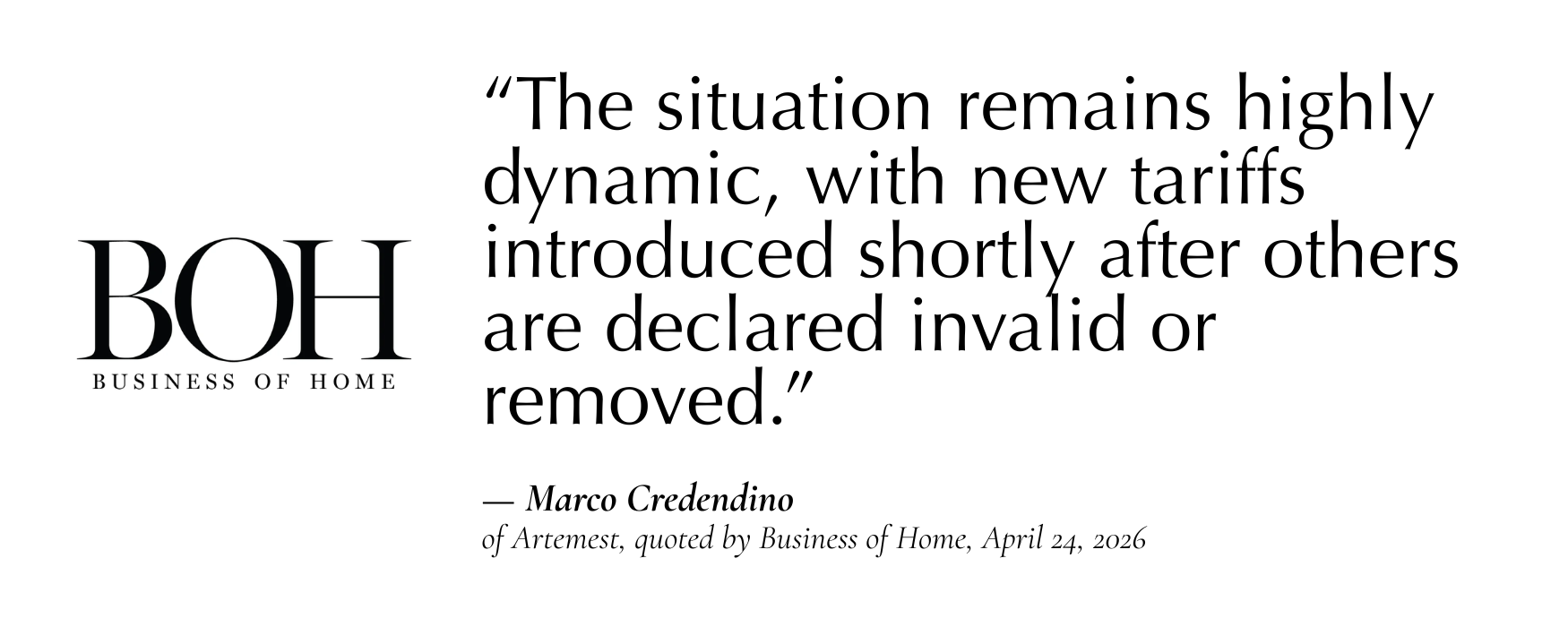
Business of Home’s Jen Fernandez captures this especially well through Artemest, the luxury e-tailer of Italian-made goods. Marco Credendino, Artemest’s founder and CEO, told BOH that the company is still evaluating whether it makes sense to file. His comments show why the design industry is watching this closely but carefully.
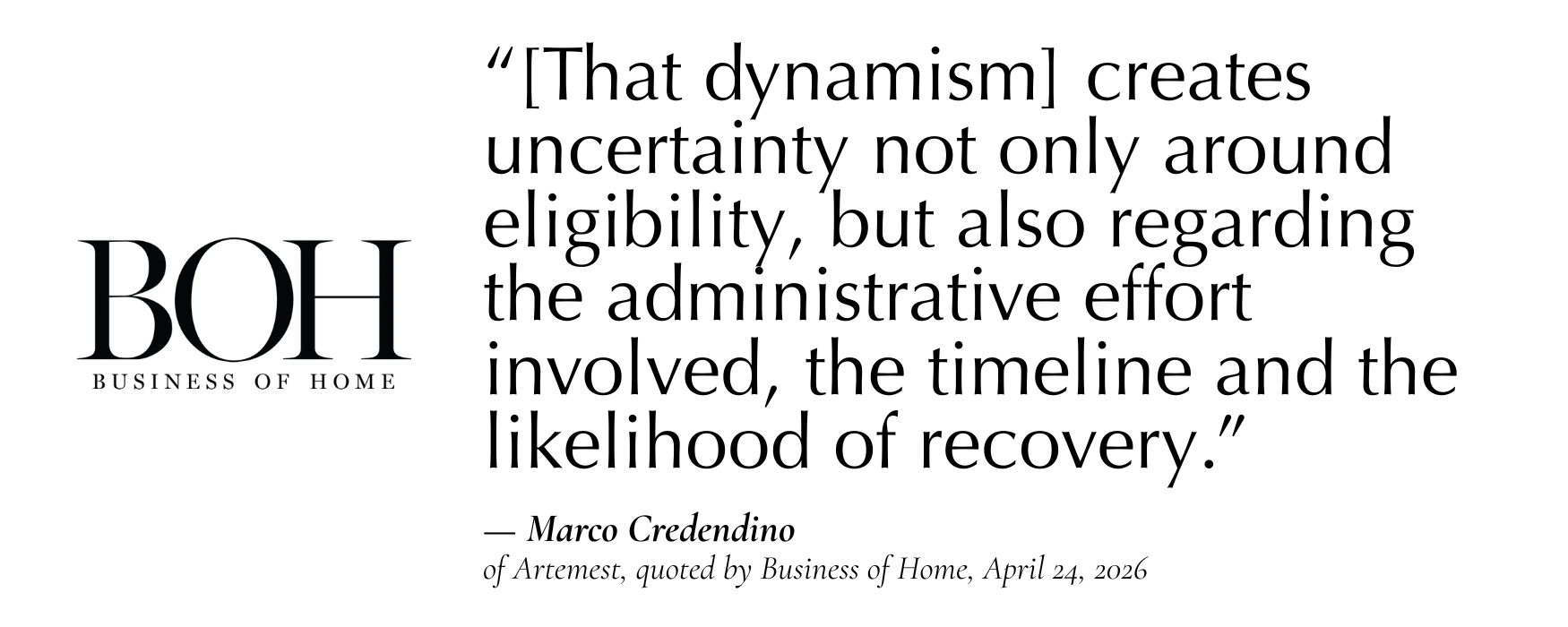
That uncertainty is familiar to anyone who has managed procurement over the last few years. Prices changed midstream. Vendors updated quotes. Freight and duties were folded into conversations that were already complicated by lead times, availability, and client approvals. BOH notes that Artemest absorbed much of the tariff burden rather than passing it on fully to customers, though it did raise prices in some cases to reflect fluctuations.
The problem for us is not only whether someone can file for a refund but whether any recovered money makes its way through the same chain that brought the cost increase to the client in the first place.
The Problem with Figuring Out Who Really Paid
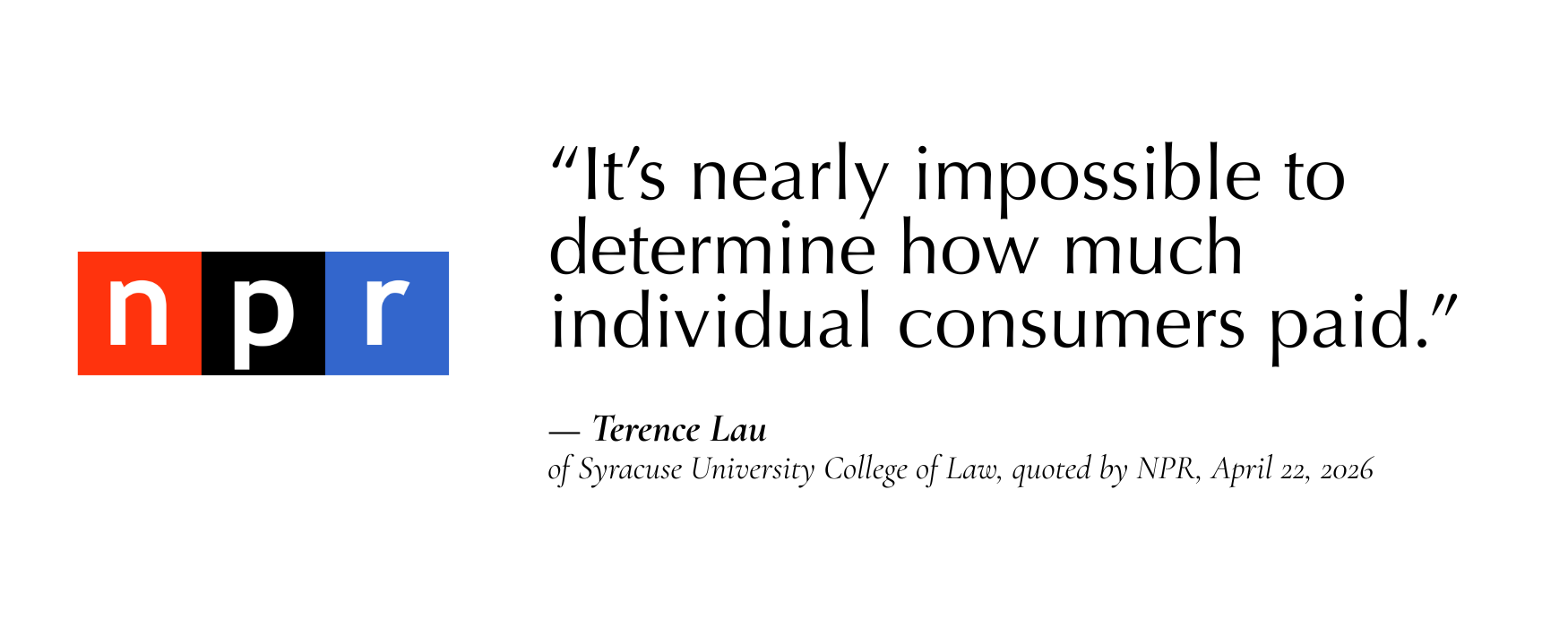
The phrase “who paid the tariff” sounds straightforward until you try to isolate that cost inside the actual project. In a showroom invoice, the tariff may have appeared as a line item. In a retail quote, it may have been buried inside the product price. In a custom order, it may have passed through several layers before anyone at the design firm saw the final number. NPR quotes Terence Lau, dean of Syracuse University College of Law, on how difficult this calculation becomes once costs reach consumers.
Robert Shapiro, an international trade lawyer and partner at Thompson Coburn, made a related point in the same NPR report. Tariff costs can move through vendors, distributors, retailers, and customers before the final sale. By that stage, the charge may no longer be identifiable.
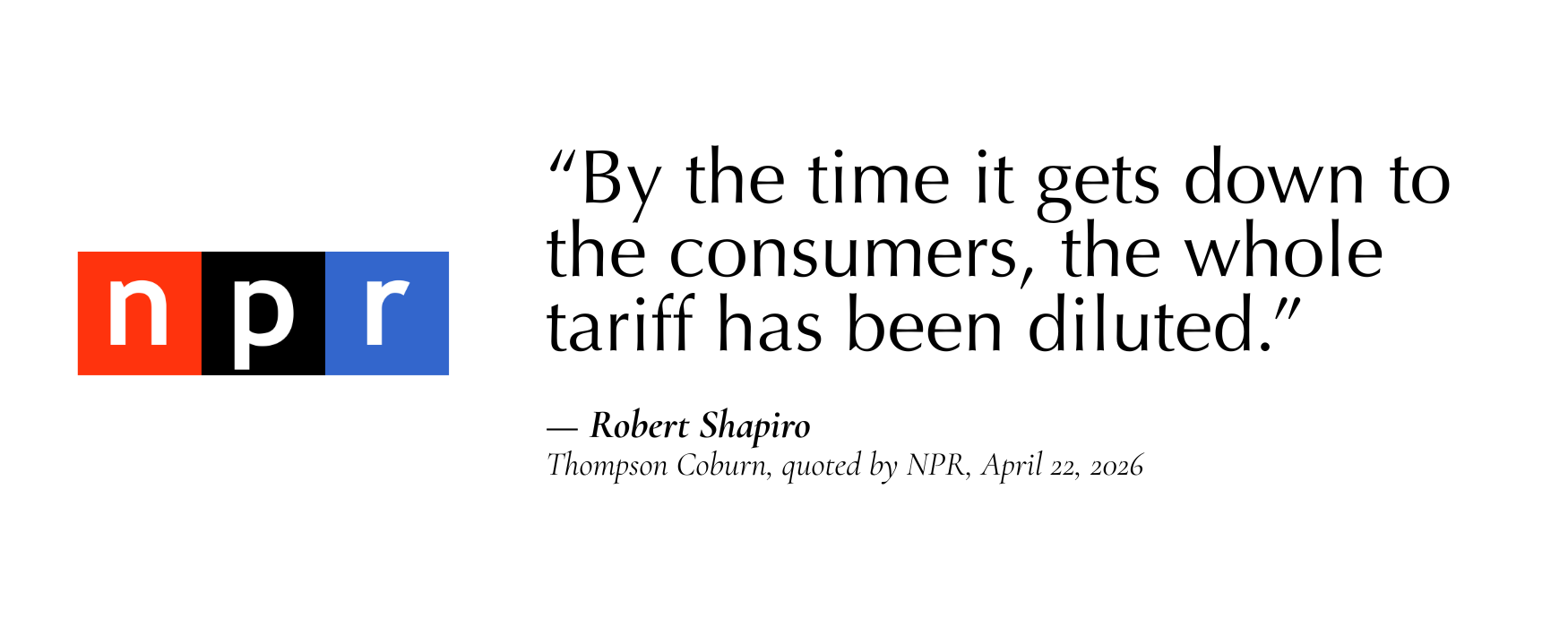
We can all picture how the tariff would be diluted in interior or residential design. A fabric may be woven abroad, purchased through a U.S. distributor, sold through a showroom, specified by a designer, fabricated into drapery, delivered to a receiver, and installed months later. The client pays for a finished window treatment package but not for a separate global trade ledger.
The same issue applies to stone, lighting, plumbing, case goods, and custom furnishings. The cost may be real and significant, but the paper trail may not be clean enough to connect a future refund to a past client charge.
Line Items vs. Baked-In Pricing
BOH makes a helpful distinction between companies that listed tariff fees separately and companies that raised prices more broadly. Businesses that broke out tariff fees as invoice line items may have an easier time allocating refunds if they receive them. A commercial textile distributor told BOH that it planned to return those line-item funds to customers, depending on timing, technicalities, and whether new tariffs were incoming.
That is a very different situation from a vendor who simply raised prices across a category. A chair that cost more in 2025 may have cost more because of tariffs, freight, labor, material costs, currency movement, or all of the above. Even if a vendor receives a refund, it may not be possible to identify the exact portion that belonged to a particular client’s order.

Artemest’s comments to BOH also point to this problem. Credendino said the company had not passed tariffs through to clients in full and that any recovered money would have to be assessed carefully. If a client saw a tariff fee clearly broken out, that’s one conversation. If the price of a fixture, fabric, or furniture piece simply increased during a volatile sourcing period, that’s an entirely different conversation.
Could Clients Expect Money Back?
Clients might ask, but most firms will struggle to answer. The broader consumer conversation is already tense. Tony Romm reports in The New York Times that consumers have filed class-action lawsuits against companies including FedEx, UPS, Costco, and Temu. Those lawsuits generally argue that companies should not profit twice by raising prices because of tariffs and then collecting federal refunds plus interest. Romm also quotes a group of lawyers in the Costco lawsuit.
The design industry is not the same as big-box retail, but the underlying tension is quite similar. If a client remembers paying a tariff surcharge on imported tile or lighting, they may reasonably wonder whether a refund could follow. If the cost was folded into product pricing, the question is even harder to answer and harder to document.
Shipping companies may have a clearer path because they sometimes charged tariff fees directly. NPR reports that DHL, FedEx, and UPS promised refunds in certain cases where customers paid tariff fees to them directly, because there is a paper trail showing what each customer paid. That’s very different from a client who paid a bundled price for a sofa, sink, or chandelier with no separate tariff notation.
What an Indirect Benefit Might Look Like
Any benefit to design and architecture firms would probably come through vendors, shippers, retailers, or suppliers rather than a check from the government. A freight company might refund a documented tariff charge. A showroom might issue a credit. A manufacturer might hold pricing steady for a while. A retailer might lower future prices or improve terms.
Romm reports in The New York Times that David French, executive vice president of government relations at the National Retail Federation, expected some companies to give money back in ways that may not look like direct itemized refunds.
That indirect benefit may be more realistic for many firms than a project-by-project reimbursement. A vendor could adjust future pricing. A supplier could offer credits on open orders. A freight partner could address charges with clearer documentation. Or the money may stay upstream if the company that receives the refund absorbed the original cost, decides not to distribute it, or cannot trace it to specific customers.
The design industry will probably see a mix of responses. That’s not especially satisfying, but it matches the way these costs initially presented in our projects.
Why This May Not Become a Windfall
The word “refund” makes the situation sound a lot simpler than it is. BOH reports that filing is already an administrative challenge, with early applicants experiencing technical difficulties in the portal. The same article notes that many home industry executives privately doubt refunds will truly be issued despite recent developments.
The Hill also reports that refunds are expected to process in phases, with the first phase limited to cases in which tariffs were estimated but not finalized or were still within a specific timing window. As of April 14, 56,497 importers had registered for CBP’s electronic payment system, making them eligible for refunds totaling $127 billion including interest, according to the agency.
The political element to this can’t be ignored, either. BOH reports that some major companies had not filed refund lawsuits, and Credendino’s comments about uncertainty suggest why many businesses may hesitate before treating any refund as guaranteed.
Even if refunds are approved, the money may not travel far. Some companies absorbed costs. Some passed them along. Some listed tariffs separately. Some adjusted pricing broadly. Those differences make a clean industry-wide benefit unlikely.

What This Reveals About Procurement in Design
Tariff refunds are a money story, but they’re also a procurement story. A single client-facing price in a design project can include international manufacturing, customs, freight, brokerage, warehousing, receiving, vendor markup, design procurement, delivery, and installation. Once those pieces are combined, pulling one cost back out months later is difficult.
This is especially true in high-end residential work. Firms may source antiques from Europe, stone from Italy, hardware from one country, fixtures from another, and textiles through multi-step distribution networks. A client may approve one proposal, but the path behind that proposal can involve several companies and several countries before anything reaches the home.
That’s why the tariff refund question feels so relevant even for firms that may never file a claim themselves. The ruling exposes how much global trade policy has impacted project pricing. It also shows how hard it is to reverse those costs after they pass through the procurement chain.
Final Thoughts: Possible Benefit, No Simple Answer
Interior design and architecture firms could benefit from tariff refunds in some cases. The clearest path would belong to firms that imported directly or paid tariffs through a broker or shipper with documentation. Many other firms will sit further away from the refund itself.
For most D&A firms, the bigger question is how vendors, manufacturers, retailers, shippers, and suppliers handle the money if they receive it. Some may issue credits or lower future prices. Others may keep refunds because they absorbed the cost themselves. Still others may have no clear way to trace the money back to individual orders.
So yes, design and architecture firms could benefit. But for most, the benefit will likely be indirect, uneven, and tied to the same complicated procurement systems that made tariffs so difficult to explain to clients in the first place.
Written by the DesignDash Editorial Team
Our contributors include experienced designers, firm owners, design writers, and other industry professionals. If you’re interested in submitting your work or collaborating, please reach out to our Editor-in-Chief at editor@designdash.com.
Related Posts
Are You About to Give Away Next Year’s Profit With This Year’s Pricing?
By October, you have nearly a year’s worth of information sitting ri

High Point Market Events You Shouldn’t Miss in October 2025
Plan your High Point Market week with DesignDash events in October 202

Here’s What to Expect at Heimtextil 2026 If You Head to Frankfurt
LIKE 4 LEAVE COMMENT 0 5 min read Summary Heimtextil 2026 runs January

The Symbolism of Sunflowers: Happiness, Vitality, Loyalty
From Indigenous North America to their use in European art and modern

The Enneagram System: Pseudoscience or Valuable Insight?
In fostering self-awareness and self-development, the Enneagram can be

These Are The Best Master of Urban Planning Programs in the U.S.
From M.I.T. to Cornell, the Master of Urban Planning (MUP) programs li