
Should Interior Designers Ever Engage in Spec Work?

 2
2
 0
0Summary
Most designers oppose speculative work on principle, but defining exactly what qualifies as “spec work” can be more complicated than that. Complimentary consultations, concept sketches, developer interviews, hospitality RFPs, and pitch presentations all occupy different places along the spectrum. This article explores why designers object to speculative work, where the gray areas begin, and how thoughtful boundaries can help firms protect both their expertise and their client relationships.
Reflection Questions
- Have you ever completed work before signing a contract because it felt necessary to win the project? How did that decision affect the rest of the engagement?
- Where do you personally draw the line between introducing your design approach and performing actual design work?
- How do you decide what belongs in a consultation, proposal, or interview before a client officially hires your firm?
- Have you ever walked away from a project because a prospective client expected too much before an agreement was in place?
- If a client asked for “just one quick floor plan” before signing a contract, how would you respond?
Journal Prompt
Think about the last prospective client who contacted your firm. Before a contract was signed, what information, ideas, or recommendations did you share? Looking back, do you believe those conversations demonstrated your expertise appropriately, or did they begin solving the client’s design problem before a professional relationship existed?
Most designers have been warned: NEVER do spec work. Professional organizations have echoed that position for years. AIGA encourages designers to be compensated fairly for their work and recommends that client relationships begin with a formal engagement rather than speculative proposals. Alvalyn Lundgren, who has written extensively about speculative work within the creative professions, takes an even firmer position, describing spec work as “unethical and inequitable.” In real life, however, the line between spec work and a serious project isn’t always so clear.
Imagine that a developer invites several firms to interview for a large residential project or a homeowner asks whether you’d be willing to sketch a preliminary furniture layout before signing a contract. Or a hospitality client distributes an RFP requesting concept boards from multiple firms. Or a prospective client schedules what they believe is a complimentary consultation but spends the meeting asking detailed questions about space planning and finishes.
Those situations don’t all feel the same, yet each raises the same underlying questions. Where, exactly, does speculative work start, and once it does, does it ever end? Will spec work ever give way to a real project? And if we engage in spec work, are we devaluing ourselves, the industry, and our peers?
What Designers Mean When They Say “Spec Work”
Speculative work generally refers to creative work completed before a client formally engages a designer and before compensation has been agreed upon. The expectation is that the work will eventually lead to a paid project, but there is no guarantee that it will.
AIGA defines speculative work as “work done prior to engagement with a client in anticipation of being paid.” The organization also draws an important distinction between speculative work and other forms of unpaid creative activity. Volunteer projects, pro bono work, internships, and design competitions might all involve uncompensated effort, but they don’t necessarily fall under the definition of spec work because the expectations surrounding them differ.
Many of us use the phrase “working for free” and “spec work” interchangeably, yet AIGA treats them as separate concepts.

Why Designers Object to Spec Work
Compensation isn’t the only issue here. Design projects require investigation before any solutions are posed or settled. This is an essential part of the design process. Designers study how clients live, identify constraints, evaluate alternatives, coordinate technical requirements, and develop ideas through multiple iterations. Asking for completed design work before that process has even begun skips many of the steps that ultimately produce good design.
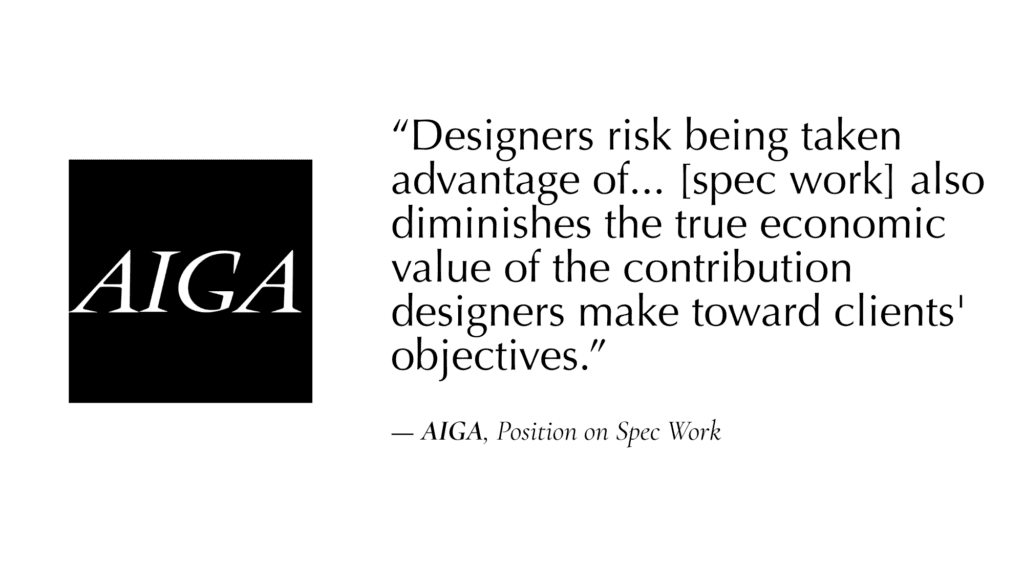
AIGA raises a similar concern in its position statement, noting that clients risk compromised quality because speculative work leaves little opportunity for research, thoughtful consideration of alternatives, or testing potential solutions. Designers assume additional risks as well, including uncompensated labor, diminished economic value, and questions surrounding ownership of intellectual property.
Spec Work Gray Areas That Can Either Produce Real Work or Replace It
One reason this discussion has persisted for so long is that very few firms operate entirely at one end of the spectrum. Some designers charge for every initial consultation. Others meet prospective clients before proposing a scope of work. Commercial firms routinely respond to requests for proposals, while hospitality projects often require presentations before a contract is awarded.
None of those situations are identical, and that’s exactly why defining speculative work is so difficult. AIGA acknowledges that reality in its position statement, noting that designers and clients ultimately decide whether to engage in speculative work and must accept the associated risks. The organization continues to discourage the practice, but it also recognizes that not every unpaid activity falls into the same category.
Consultations Aren’t Always Spec Work
An initial consultation gives both parties an opportunity to decide whether they want to work together. The designer learns about the project, the client asks questions about your unique process, and each begins evaluating whether the relationship makes sense.
The conversation changes once design solutions are posed. Suppose a prospective client asks where the sofa should go, whether a wall should come down, which cabinetry layout you prefer, or how they should approach a renovation before any agreement exists. Those recommendations might only take a few minutes to discuss, yet they rely on professional judgment that clients are seeking precisely because they haven’t hired a designer yet.
Time isn’t really what separates a consultation from speculative work. A fifteen-minute conversation can include substantial design advice, while a ninety-minute meeting might focus entirely on project goals, scheduling, and whether the relationship is a good fit. The more important question is whether the conversation has shifted from evaluating the project to solving it.
Fuel your creative fire & be a part of a supportive community that values how you love to live.
subscribe to our newsletter
*please check your Spam folder for the latest DesignDash Magazine issue immediately after subscription

Commercial Projects Don’t Always Follow the Same Rules
Commercial, hospitality, and developer projects complicate the conversation even further. Requests for proposals frequently require firms to introduce their approach, assemble project teams, discuss relevant experience, and sometimes prepare conceptual materials before a contract is awarded. Those expectations have existed for decades in many sectors of the design industry.
AIGA recognizes those differences as well. Its position statement notes that some design disciplines have historically relied on speculative presentations during the selection process, even while continuing to caution designers about the risks involved. That’s one reason discussions about speculative work rarely produce universal agreement. A residential designer meeting with a homeowner, a hospitality firm responding to an RFP, and a multidisciplinary practice pursuing a government project may all approach business development very differently.
What Are You Actually Giving Away?
Most designers are happy to answer questions before a project officially starts. In fact, those conversations are an important part of the client experience. Explaining your process, discussing timelines, reviewing budgets, or talking through how your firm approaches renovations helps prospective clients decide whether you’re the right fit for their project. Those conversations, however, aren’t the same as solving design problems.
The distinction between them is much less obvious after a client starts asking for recommendations. Should the kitchen be moved? Which furniture layout makes the most sense? Would built-in cabinetry work better than freestanding pieces? Is there enough room to enlarge the primary bath? Those questions might only take a few minutes to answer, but the answers themselves are rooted in professional knowledge, experience, and design thinking.
Perhaps that’s why the conversation surrounding speculative work has never been entirely about time. A designer can spend an hour getting to know a client without offering a single design solution. On the other hand, one thoughtful sketch on a floor plan can represent years of education and experience. AIGA’s position reflects that broader idea, emphasizing that professional designers should be compensated not simply for drawings or deliverables but for the value of their work and the intellectual property they create.
Sometimes Expectations Change Mid-Conversation
One reason speculative work can be so difficult to identify is that very few client meetings start with an obviously crossed line. Picture this very common scenario: a prospective client schedules an introductory consultation. The conversation starts with project goals, lifestyle, timing, and budget. Then someone asks whether the dining room should become an office. A few minutes later, they’re discussing whether a wall could come down or whether the kitchen island should rotate ninety degrees.
Before long, the meeting has shifted from evaluating the project to solving it. And the client could take that information, hire a GC or project manager, and use your design expertise without ever paying you. Or they might hire you for the full project. The issue is that none of those questions are inappropriate. They’re exactly the kinds of questions clients hire designers to answer all the time. The challenge is recognizing when a conversation has transitioned from introducing your expertise to applying it.

That’s why AIGA and other organizations emphasize defining boundaries between phases IMMEDIATELY. You must clarify what an initial consultation includes, what requires a design agreement, and when conceptual work officially starts. Clear expectations protect both the client and the designer, regardless of where a firm chooses to draw the line.
Every Firm Draws the Line Differently
And to that point, every firm draws the line differently. If there were a universally accepted definition of speculative work, this conversation probably would have ended years ago. Instead, firms continue developing different policies because their projects, clients, and business models aren’t all the same.
A residential designer meeting with a homeowner has different expectations than a hospitality firm pursuing a boutique hotel. A commercial practice responding to a request for proposals may be expected to assemble a team, discuss methodology, and prepare presentation materials before a contract is awarded.
Developers frequently interview multiple firms before making a decision. Public-sector projects often involve formal procurement procedures that require extensive submissions long before work starts. Professional organizations acknowledge those differences while continuing to encourage designers to think carefully about what they’re providing before an engagement exists.
Rather than prescribing a single rule, AIGA recognizes that different forms of unpaid work exist and carry different expectations. Volunteer work, pro bono projects, internships, competitions, and speculative proposals are not interchangeable, even if they all involve uncompensated time. Understanding those distinctions allows designers to make more informed business decisions instead of treating every unpaid interaction as inherently acceptable or inherently unethical.
Ultimately, every firm has to decide where its own boundaries belong. Some charge for initial consultations. Others credit consultation fees toward future projects. Some prepare paid concept packages before a full agreement is signed. Others won’t produce a single sketch until contracts are executed. None of those approaches automatically makes a firm more or less professional. What matters is that the boundaries are intentional, communicated clearly, and consistently applied.
“Spec Work” Is Really About Professional Boundaries
Speculative work is one of the design industry’s most polarizing topics because it forces us to consider whether professional expertise should be compensated, how creative work should be valued, and when ideas become deliverables rather than conversation. For some firms, the answer is straightforward: no design work before a signed agreement. Others intentionally build preliminary concepts, paid consultations, or interview presentations into their business development process because that’s how work is won in their market.
Neither approach eliminates the need for thoughtful boundaries. And we think that’s the more meaningful question to ask. Instead of wondering whether a particular meeting technically qualifies as speculative work, consider whether you’re providing professional value before expectations, compensation, and ownership have been clearly established.
Written by the DesignDash Editorial Team
Our contributors include experienced designers, firm owners, design writers, and other industry professionals. If you’re interested in submitting your work or collaborating, please reach out to our Editor-in-Chief at editor@designdash.com.
Related Posts

Staging Spaces: Should You Diversify into Real Estate Staging or Stick to Interior Design?
LIKE 0 LEAVE COMMENT 0 6 min read Summary Real estate staging offers i

Boredom as Self-Care: Why Doing Nothing Might Be Exactly What You Need
Boredom has scientifically-proven benefits. Learn how embracing boredo

The Science of Acoustics: How Sound Influences Interior Design
Sound is a powerful yet often overlooked element in interior design. E

The Psychology Of Color: Blue In Interior Design, Branding, And Beyond
Curious about how the color blue influences mood, behavior, and design

Celebrating Powerful Women in Commercial Real Estate
From Camille Renshaw of B+E to Zainab Mohammed of WASL, women are maki

What Should I Tell My Boss Before Leaving to Start My Own Interior Design Firm?
LIKE 14 LEAVE COMMENT 0 5 min read Summary Leaving a design firm to st