



Your Firm Made Money This Year. But Did You?

 0
 0
Summary
Reflection Questions
Journal Prompt
Now that we’re in early November, you probably have a pretty good idea of how 2026 went for your firm. Revenue might be up. You might have signed larger projects, purchased more furnishings than ever, or added someone to the team. Your accountant might even be telling you that the firm had a profitable year.
Now look at what you actually paid yourself.
We’re not talking about the revenue that came through or the profit number on your P&L. How much money did YOU make for the year, in whatever form you pay yourself? And how does that number compare with the hours you worked, the client projects you managed, the business development you did, and everything else that came with being the person ultimately responsible for your firm?
Making this calculation can be uncomfortable because firm owners are very good at paying everybody else first. Payroll has to go out and vendors need their money. The studio has rent, insurance, software, photography, marketing, taxes, and at least 900 other expenses. When cash is tight because a project stalled or a client paid late, the owner’s pay is cut first, right?
You can do that for a while and still have a business that looks successful from the outside. But eventually, you need to know whether the firm is making money for YOU, too. You built this thing! You deserve to be comfortable.

Five Questions to Ask Before You Call 2026 a Profitable Year
#1 What Did You Actually Pay Yourself This Year?
If you pay yourself through regular payroll, start there. Add any additional compensation you took from the business and figure out what actually came to you over the course of the year. Then compare that with the amount of time you spent working.
Let’s say you paid yourself $75,000 and worked an average of 50 hours a week for 50 weeks. That works out to about $30 an hour before you start thinking about the financial risk and responsibility that came with building the business in the first place.
Maybe you’re completely comfortable with that number because you’re intentionally reinvesting heavily right now. Maybe you’re building a team or putting money into a new studio. Fine. The important part is that you KNOW what the number is and have made a conscious decision about it.
Alexandra “Sandy” Hartley, founder of Alexandra Hartley Interiors and a longtime DesignDash community member, went through this exercise before joining Laura and Melissa for Episode 81 of the DesignDash Podcast.
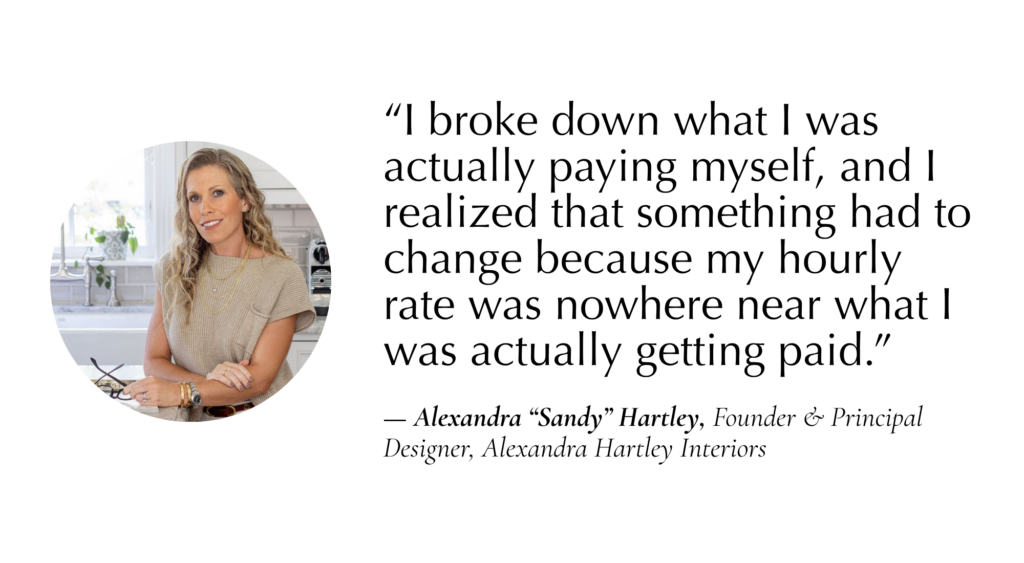
Sandy’s calendar was full at the time. She had plenty of client work and was working a LOT of hours, but once she looked at what those hours were producing for her personally, the business looked different.
Do the same calculation before you judge this year by revenue alone.
#2 How Much Would You Have to Pay Someone Else to Do Everything You Do?
Imagine you took a three-month sabbatical next year and the firm had to hire people to cover your work.
Someone has to design. Someone has to meet prospective clients and close projects. Someone has to review the team’s work, make senior-level decisions, talk with builders and architects, deal with difficult client conversations, keep an eye on the money, and make sure the business itself keeps operating.
Depending on the size of your firm, that could be one very expensive person or several different roles. Now compare that cost with what you paid yourself. Gail Doby, co-founder of Pearl Collective, addresses this in a January Business of Home article.
Doby asks design firm owners to look at whether they’re paying themselves appropriately, whether they have enough cash in reserve, whether they’re relying on debt, and whether they’re working client hours they never track or bill. She also cites 2024 industry data showing that the average interior design firm in that data set billed about $1.4 million and earned 7% in net profit.
A business can look profitable partly because the owner is doing $150,000 worth of work and paying herself $70,000 to do it. That doesn’t necessarily mean you need to write yourself an enormous check tomorrow. It DOES mean the difference belongs in your assessment of how the firm performed this year.

#3 Did You Put Your Pay Into the Plan From the Beginning?
A lot of owners do the math in the opposite order. Revenue comes in, expenses go out, and the owner takes whatever is available after everyone else has been paid. Our co-founder Laura (who’s also CEO and founder of Laura U Design Collective) sees this ALL THE TIME with other designers.
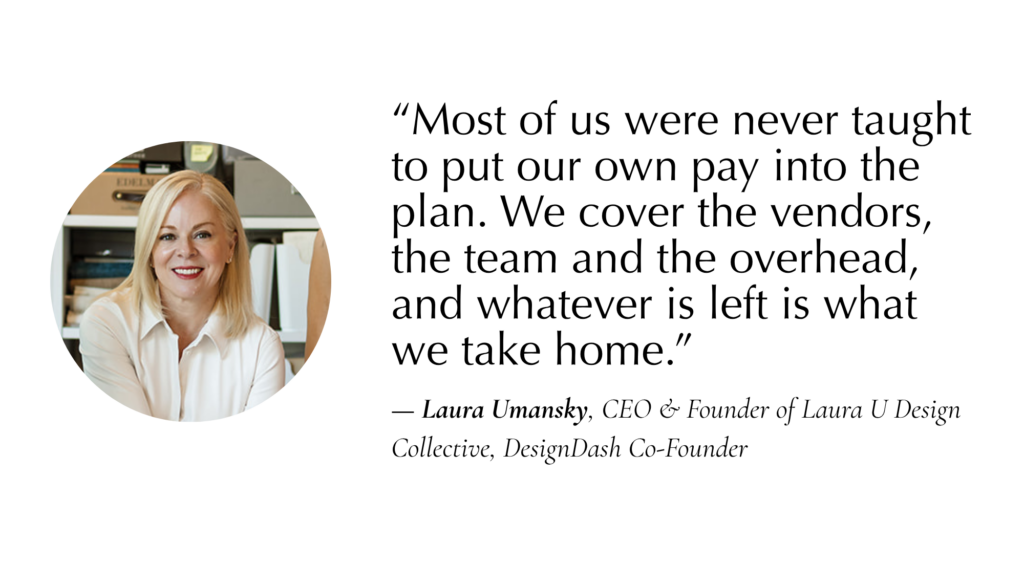
At Laura U Design Collective and DesignDash, Laura prefers to work backward from what the owner wants to take home. She uses 14% as a healthy net-margin planning target for LUDC and many residential firms, then uses that percentage to estimate the revenue needed to support the owner’s goal.
Using her simplified example, an owner who wants to take home $200,000 would need roughly $1.4 million in revenue at a 14% margin. If the firm currently produces $500,000 at that same percentage, the math comes to about $70,000.
That gap is too big to close by squeezing another project into an already full calendar.
You might need higher revenue, but now you have a reason for the number instead of choosing a growth percentage because 10% or 20% sounded good. You can start looking at larger projects, pricing, procurement revenue, staffing, overhead, and how many projects the team can realistically complete.
Your margin target might be different from Laura’s. What matters is having one and including YOUR compensation when you plan the business.
#4 Can Your Current Pricing Pay You Properly AND Produce a Profit?
This is an important test because raising revenue doesn’t automatically solve an owner-pay problem.
Imagine your firm bills $1 million, but you only pay yourself $60,000 because there’s never enough cash to take much more. If you increase revenue to $1.2 million while taking on more payroll, more project expenses, and more overhead, you could finish next year with the exact same problem on a larger scale. Melissa Houston, a CPA who writes about small-business finance for Forbes, contextualizes this in How To Know If Your Pricing Supports Your Cash Goals.
In an interior design firm like yours, that could mean your hourly billing rate is too low. Your flat design fee might not cover the hours the project actually takes. Construction coordination could have grown into a much larger part of your projects without a corresponding change in what you charge. Maybe your procurement compensation worked when you were personally placing a few orders and makes a lot less sense now that you’re paying a purchasing employee to manage hundreds of them.
Go through the services that produced most of your 2026 revenue and ask how much money was left after you paid the people doing the work, including yourself. If fair owner compensation wipes out the profit, don’t congratulate yourself on that seemingly impressive revenue number yet. You have a pricing problem to solve before you jump into 2027.
Fuel your creative fire & be a part of a supportive community that values how you love to live.
subscribe to our newsletter
*please check your Spam folder for the latest DesignDash Magazine issue immediately after subscription

#5 What Has to Change So You Aren’t Having the Same Conversation Next November?
Once Sandy calculated what she was actually paying herself, she started changing several elements of her business. She went back to hourly billing after realizing she had underpriced herself on fixed fees, and she told Laura and Melissa that the change gave her much more regular cash flow.
She also looked at where her time was going. A huge portion was client communication, invoicing, placing and tracking orders, scheduling deliveries, and other administrative work rather than design. That led to a much larger conversation about hiring back-office help so Sandy could spend more of her time doing the work that brought revenue into the firm.
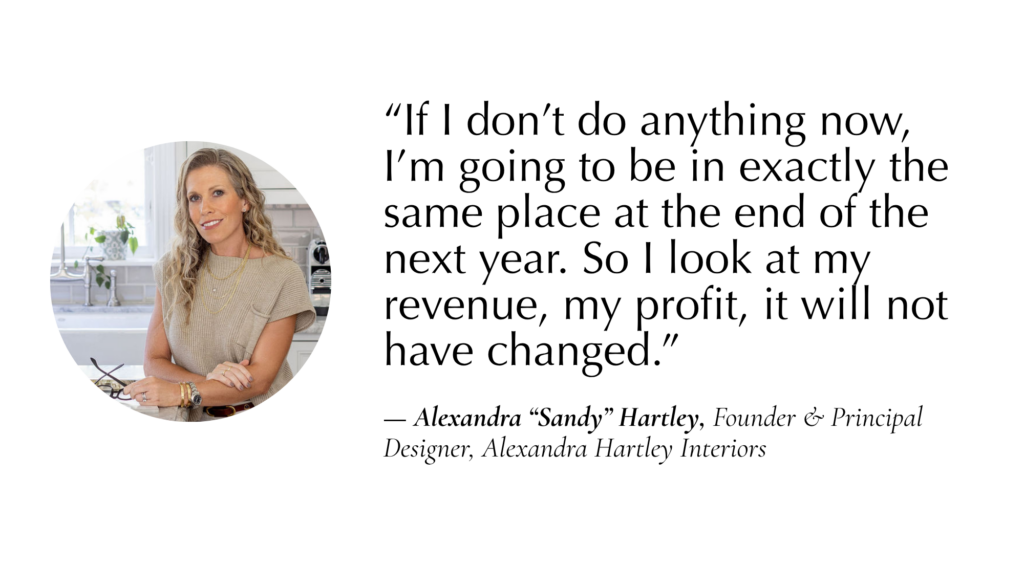
Your answer might not be hiring another employee because that might not be right for your firm. Instead, your solution could be a higher billing rate, a larger project minimum, better procurement compensation, fewer small projects, more consistent time tracking, or finally charging for work you’ve been doing for free.
You could also find that your firm made enough money this year but you made a conscious decision to reinvest rather than take more home. Great. That’s very different from reaching December and realizing you worked all year without ever deciding what you were supposed to earn. Sandy said something in her recent Women, In Their Own Words interview that applies here, too.
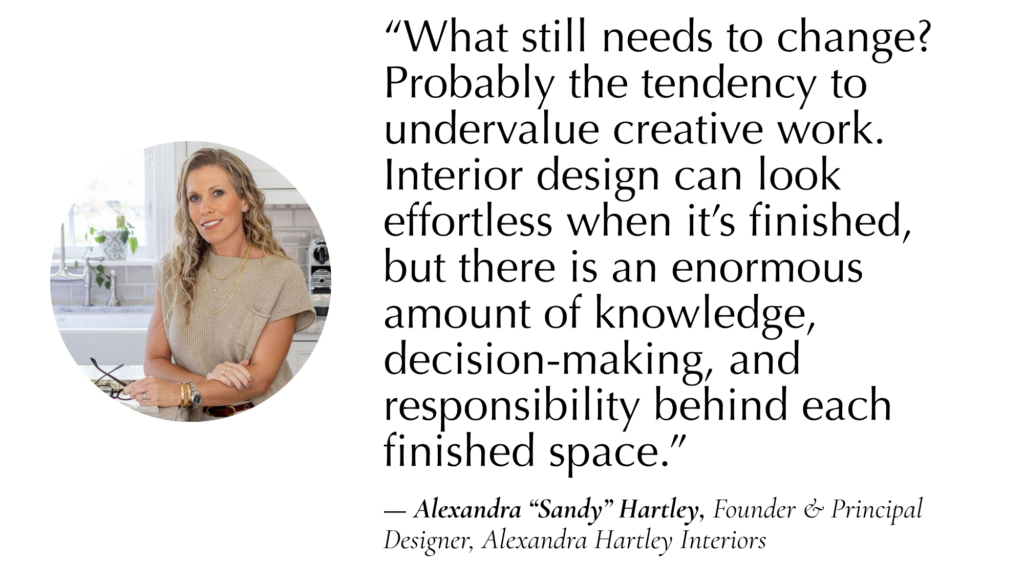
Designers spend a LOT of time convincing clients that expertise has value. Make sure you’re not the person undervaluing yours.
Your 2027 Revenue Goal Should Include YOU
There’s nothing wrong with reinvesting in your firm. You might decide that this is the year to hire, build cash reserves, increase marketing, move into a studio, or invest in systems that make your business easier to run.
But the owner shouldn’t accidentally finance all of that by underpaying herself.
Before you finalize your 2027 plan, figure out what you made this year, what you actually want to make next year, and what the firm has to earn to support that number. Then look at whether your pricing, project mix, margins, and team can realistically produce it.
You spent this year paying your employees, vendors, consultants, software bills, photographers, receiving warehouses, insurers, and everyone else involved in running your business.
Put yourself in the 2027 budget, too! You deserve it.
Written by the DesignDash Editorial Team
Our contributors include experienced designers, firm owners, design writers, and other industry professionals. If you’re interested in submitting your work or collaborating, please reach out to our Editor-in-Chief at editor@designdash.com.
Related Posts

How to Become a Jeweler: Career Tips for Aspiring Designers
If you're a creative with meticulous attention to detail and a desire

DesignDash Career Guide: What Does a Creative Technologist Do?
Creative technologists leverage the latest advancements in technology

What Do I Do If My First Client Ghosts Me After I Send the Proposal?
Learn how to respond when a PNC goes silent after receiving a proposal

Glowing at Every Age: Skincare Products for Mature Skin
Embrace your mature skin with confidence using formulas designed to en

Co-Working Session: Would Your Design Firm Still Run if You Stepped Away?

How to Attract High-End Hospitality Projects as an Interior Designer
Learn how to attract high-end hospitality design projects with these 7

POST COMMENT
You must be logged in to post a comment.