



Did You Build a Business You Actually Want to Keep Running in 2027?

 0
 0
Summary
Reflection Questions
Journal Prompt
By November, you’ve had nearly a full year to see what your normal week actually looks like. You know how often you answered emails after dinner, how much time disappeared into invoicing or order tracking, which clients needed constant attention, and how many things still came back to you because nobody else could make that decision.
You also know which parts of your job you still genuinely enjoy. Maybe you still love the first few weeks of a new remodel, when you’re figuring out the floor plan and pulling materials together. Maybe you love meeting with clients, walking a site with the builder, or seeing a home come together after a year of work.
So before you decide that you’re simply burned out or that you need fewer projects next year, separate the work you’d happily keep from everything you’d be thrilled to hand to somebody else. Because if you still love designing but hate the way your week is structured around running your business, you probably don’t need a different career.
You need to stop designing every year around the parts of your business that are making you miserable.

Five Questions to Ask Before You Build Another Year Around the Same Schedule
#1 Which Parts of Your Week Do You Actually Want to Keep?
Pull up your calendar from a few recent weeks and look at where your time went instead of relying on where you THINK it went. Look at the meetings, site visits, presentations, internal reviews, vendor calls, and everything else you can actually account for.
Then think about the work that probably never made it onto your calendar. Maybe you spent 40 minutes sorting out an invoice problem before dinner or another hour checking procurement because nobody else knew which orders still needed attention. You might have spent half a morning preparing for a client meeting that lasted an hour. Our co-founder Laura Umansky hears some version of this from designers in the DesignDash community all the time.
If you spent three hours designing and loved all three of them, that’s such valuable data. Keep that work on your calendar. If you spent the next two hours sending invoices, tracking freight, answering scheduling emails, and trying to remember whether the dining chairs ever shipped, but hated doing it all, that’s important data, too.
You’re trying to figure out which work you actually want more of in 2027 and which work you’re doing simply because nobody else is doing it yet.
#2 What Are You Still Doing Because Teaching Someone Else Seems Like More Trouble Than It’s Worth?
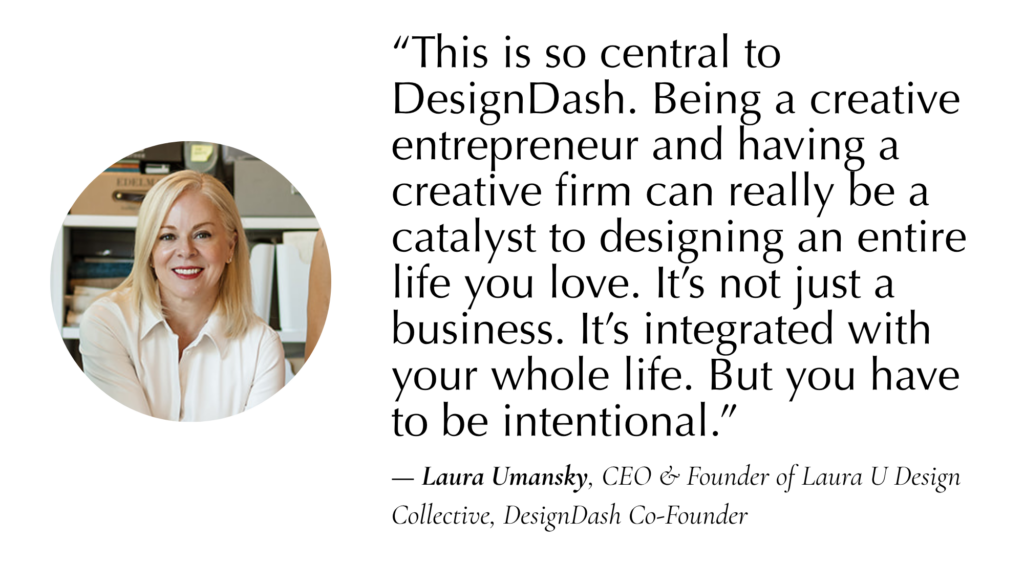
Laura started Laura U Design Collective as a solo entrepreneur 20 years ago, and she admits she made this mistake herself. She worked too much partly because building systems and trusting other people seemed harder than doing everything herself. In her words, “No shock to anyone, it wasn’t easier or safer. It was a lot more work, and I made a lot of mistakes.”
You surely have your own version of this, right? You think, “It’ll take me longer to explain it. I need to clean up the process first. Nobody knows this project as well as I do. I’ll hire after installation. I’ll deal with it when things calm down.”
And then another year passes and you’re still placing orders at 7 p.m. when you should be pouring a glass of wine or watching the latest on Netflix. Designer Betsy Wentz talked about this in an Architectural Digest article about operations, where she was quoted by Monika Biegler Eyers.
You might not even have to hire someone new; you could work with a contractor or delegate to employees you already have as long as their calendars aren’t too packed. Maybe someone else sends invoices. Maybe another person tracks orders and communicates with receiving. Maybe your senior designer can approve certain selections without waiting for you. Maybe an employee who’s already doing half of a job officially takes responsibility for the whole thing.

#3 If You Took a Week Off, Would Your Firm Survive?
Imagine you were completely unavailable for five business days. We’re talking NOT answering emails from the airport, NOT checking Slack before breakfast, and NOT telling everyone they can text you “if it’s really important.”
What would happen?
Would invoices still go out? Could someone answer the builder’s questions without forwarding everything to you? Would purchasing continue? Could a client call your studio and talk to someone who actually knew what was happening with her project?
If you’re already thinking, Well, invoices definitely wouldn’t go out, start there.
Krista Watterworth Alterman, founder of Krista + Home, wrote about changing the way she ran her business in a Business of Home article earlier this year. After years of saying yes, staying booked, and figuring things out as she went, she decided she didn’t want to keep doing that indefinitely.
Her answer was to take fewer projects, focus on more full-scope work, and put better systems and clearer boundaries behind the scenes. Your answer might have nothing to do with taking fewer projects. Maybe you want MORE projects next year and need another designer to make that possible.
Regardless, you need to figure out what would stop first if you stepped away. Maybe it’s invoicing. Maybe nobody else can approve a specification. Maybe your clients only know how to contact you. Maybe the information everyone needs is still mostly in your head.
Pick one of those problems and fix it before you add more work to 2027.
#4 How Much Work Followed You Home This Year?
Think about how often your workday actually ended when you said it did. Maybe your studio closes at 5:30, but you regularly sent invoices after dinner, answered client emails from the sofa, or spent Sunday morning working on proposals because you couldn’t find time for them during the week. A couple of late nights during a huge installation week are one thing. Three or four evenings every week for most of the year just isn’t sustainable.
Carolyn Rodz, co-founder and CEO of Hello Alice, talked about her own version of this with Laura and Melissa in Episode 62 of the DesignDash Podcast. Before moving with her family to Spain, she said she was terrible at shutting work off.
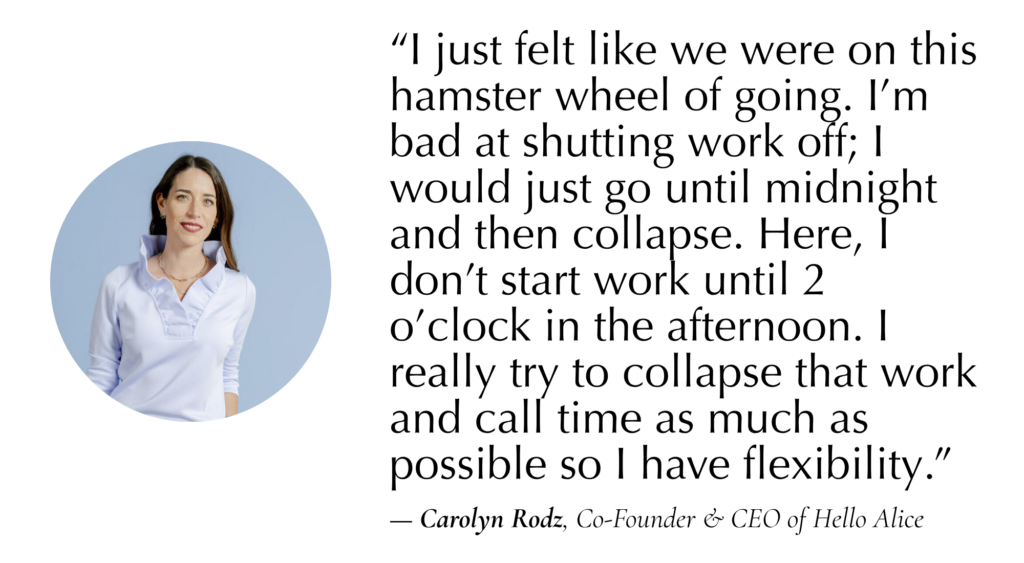
Carolyn still runs Hello Alice, and most of her team and customers are in the U.S. She just structures her day differently now. Her mornings in Spain are for painting, playing piano, spending time outside, and working on the historic property her family is renovating. She starts her Hello Alice work later in the day and told Laura and Melissa that she hadn’t realized how much guilt she used to have whenever she wasn’t working.
Moving to Spain probably isn’t on your December to-do list, but go back through a normal month and look at how much work happened outside the hours you actually wanted to work.
If invoicing took over Monday nights, could somebody else do it? If client emails regularly interrupted dinner, do clients need a clearer communication policy? If you always worked Sunday because proposals never fit into the week, maybe something else needs to come off your weekday calendar.
You don’t have to solve every one of these problems before January. But if you already know you don’t want to spend another year working every night, don’t make that your default plan again.
#5 What Do You Want a Normal Tuesday to Look Like Next Year?
Before you write “increase revenue by 20%” on your 2027 plan, picture a completely ordinary Tuesday in March (the holiday months are chaos, so don’t use November or December). What time do you start? How many active projects do you have? Are you spending most of the day designing, meeting with clients, reviewing your team’s work, or answering email? Who else is working with you? What are THEY responsible for? And what time are you done?
Maybe you truly do want a packed day. You might want two large renovations under construction, another project in design, and a full team working alongside you. Maybe you want to spend most of your day on design and client relationships while someone else manages procurement and invoicing. Or maybe you want to take on fewer projects because you’ve learned that six active clients at once is WAY too many for the way you like to work.
So take your 2027 business goals one step further. If you want more revenue, what do you want that money to make possible? If you want a larger team, what do you want those employees to take off your plate? If you want bigger projects, how many can you actually manage without going right back to answering emails every night?
You’re building the calendar you’ll eventually have to live with.
Fuel your creative fire & be a part of a supportive community that values how you love to live.
subscribe to our newsletter
*please check your Spam folder for the latest DesignDash Magazine issue immediately after subscription

Don’t Put the Same Problems Back on Your 2027 Calendar
By now, you probably know which parts of 2026 you’d happily repeat and which ones you NEVER want to do again.
Maybe you want every large remodel you can reasonably take. Maybe you never want to send another invoice yourself. Maybe you want to keep doing every presentation but stop tracking furniture shipments. Maybe you need another senior designer because being the only person who can answer a builder’s question is making your workweek ridiculous.
You don’t have to redesign your entire business before January. Pick the parts that made your weeks harder than they needed to be and decide what changes before you build next year around them again.
You already spent a year learning which parts of your business make you miserable. Please don’t put all of them back on your 2027 calendar.
Written by the DesignDash Editorial Team
Our contributors include experienced designers, firm owners, design writers, and other industry professionals. If you’re interested in submitting your work or collaborating, please reach out to our Editor-in-Chief at editor@designdash.com.
Related Posts

Dutch Design Week 2025: Interior Design’s Best & Brightest Return to Eindhoven
Dutch Design Week returns to Eindhoven from October 18–26, 2025, cel

How to Set Boundaries with Clients as a Firm Owner
You want to keep clients happy, but at what cost? In this post, we exp
Chien-Shiung Wu: More Than a Nobel Prize in Nuclear Physics
Chinese-American physicist Chien-Shiung Wu played an important role in

High Point Unplugged: Why HPXD Matters for Firm Owners
LIKE 3 LEAVE COMMENT 0 5 min read Summary High Point by Design (HPXD)

SHIFT Your Focus at the 2025 Chicago Architectural Biennial
From collective housing to material innovation, SHIFT: The 2025 Chicag

9 Talented Female Interior Designers in San Francisco to Follow in 2026
From Tineke Triggs to Noz Nozawa, here are ten talented female designe

POST COMMENT
You must be logged in to post a comment.