
Should Interior Design Firm Owners Ever Offer Discounts?

 0
0
 0
0Summary
Discounting can mean lowering an hourly rate, cutting billed time, sharing a trade discount, or marking down inventory the firm already owns. Laura Umansky and Melissa Grove argue that each of these decisions should be evaluated separately and tied to the firm’s actual business model. LUDC no longer lists courtesy hours on invoices or guarantees 15% off retail because both policies created extra work and no longer served the same purpose they once did.
Reflection Questions
- Which discounts, write-offs, or pricing promises does your firm currently use, and why were they introduced?
- Are those policies applied consistently across clients, or do they change when a client questions an invoice?
- What expenses do your design fees and product margins need to cover for your firm to remain profitable throughout the year?
Journal Prompt
Review one pricing policy your firm has used for several years. Write down why it was created, how much administrative work it requires, whether clients still value it, and what would change if you removed or revised it.
How Laura Umansky and Melissa Grove separate design fees from product margins, and why LUDC removed a discount it had used for 20 years.
Should an interior designer ever give a client a discount? Laura is careful at the beginning of Episode 100 to say that she and Melissa Grove are “pondering” the question rather than answering it. As we all know, a discount can take many different forms. A lower hourly rate, fewer billed hours, a shared trade discount, or a markdown on furniture the firm already owns will affect the business’ bottom line (and the client relationship) differently.
Laura U Design Collective, the firm where DesignDash co-founders Laura Umansky and Melissa Grove work as CEO and COO respectively, has changed its position on discounts over the years. The firm once listed removed hours as a “courtesy” on client invoices. Until recently, its contracts also promised clients 15% off retail on furnishings. Both policies started for a good reason, but now that reason might not exist anymore.
In this episode of the DesignDash Podcast, Laura and Melissa separate design services from product sales before they discuss where reductions might fit. They disagree about cut time in a few places, and Laura’s story about a hidden sale closet at Gucci complicates Melissa’s firm stance against discounts.

Three Takeaways from Episode 100 of the DesignDash Podcast: The Discount Trap Every Designer Falls Into
Design Services and Product Sales Are Two Different Conversations
At LUDC, revenue comes from two distinct areas. Design service fees pay for the work required to develop and manage a project. Product sales generate a margin on furniture and lighting as well as soft goods and other pieces purchased for a client. The firm calculates both carefully because both contribute to profitability.
The team doesn’t lower its hourly rates for individual clients. LUDC calculates those rates by role and compares each employee’s salary with the amount the firm must bill for that person’s time. A designer can’t normally charge $300 per hour, then charge one client $200 for the same service without changing how the first number will be interpreted. Melissa describes that as a positioning risk because the reduction can suggest that the original price included unnecessary padding.
Cut time is a separate issue. Laura may remove a small number of hours when a new employee needs extra time to learn the LUDC process. She may also cut time after a clear mistake or when the team spends far longer than expected on work the client never requested. Melissa generally opposes the practice because firms often make those reductions for unhappy clients or clients who are expected to resist an invoice. More agreeable clients may pay for the full process.
That difference can reward the client who complains. It can also reduce creative work to the number of minutes required to source one object. “There’s our expertise, our taste level, our creative judgment,” Melissa says. “All of those things are worth money outside of, okay, it took me 15 minutes to source this pillow.”
LUDC now records approved write-offs internally. The team can review whether training, estimates, or project management need adjustment. It no longer adds a courtesy line to the invoice. Melissa questions why the client needs to know that the firm removed five hours without being asked. The client receives the approved invoice, and the business keeps the information it needs.
Product Margins Pay for the Team Executing the Project
Trade pricing is not a secret. Retailers buy at wholesale and sell at retail, while designers purchase through trade accounts and establish their own product pricing. Some designers charge a higher fixed fee and share more of the trade discount. Others earn revenue through both design services and product sales. Laura and Melissa return to the same point several times: the right structure depends on the business model.
LUDC works as a reseller, but Melissa also describes the firm as a curator. The team has spent decades developing vendor relationships and learning where to source custom or trade-only pieces. Clients pay for the furniture as well as the research, access, judgment, procurement, and problem solving behind the purchase.
Fuel your creative fire & be a part of a supportive community that values how you love to live.
subscribe to our newsletter
*please check your Spam folder for the latest DesignDash Magazine issue immediately after subscription

Product margins also support salaries, bonuses, PTO, and the ability to retain employees during slower months. A solo designer can choose a structure that supports one person. A firm with three, five, or more employees has to meet payroll throughout the year, even when project revenue changes from one month to the next.
“I think that’s a big part of our business model, that we’re making a margin or making a markup on both design services and on furniture,” Laura says. “That’s why we are a profitable firm and we’re able to have a team that is properly compensated.”
The episode includes examples of designers who charge substantial hourly or fixed fees and share more of their trade pricing. Melissa does not like that model for LUDC, though she acknowledges that it may work elsewhere. Each firm has to know which expenses its product margin covers before it decides how much of the trade discount to share.
A Policy You Made 20 Years Ago Might Need to Be Reassessed
When Laura opened her firm, she promised clients 15% off retail on furnishings. The policy helped a new business compete, and it stayed in the contract for about 20 years. During that time, the team applied the reduction diligently to every applicable product.
But to add that deduction, the design and procurement teams had to spend extra billable time. The design team had to identify retail pricing for trade-only products. Custom pieces required research because no direct retail equivalent existed. Clients usually mentioned the discount once near the beginning and never brought it up again, but the team still completed the comparison for every proposal.
LUDC removed the fixed 15% promise from new contracts this year. Clients may still pay less than retail because the firm’s vendor agreements often make that possible. Laura can explain that a client’s savings may average around 15 percent, though the number varies by vendor. The firm no longer guarantees one percentage across every product.
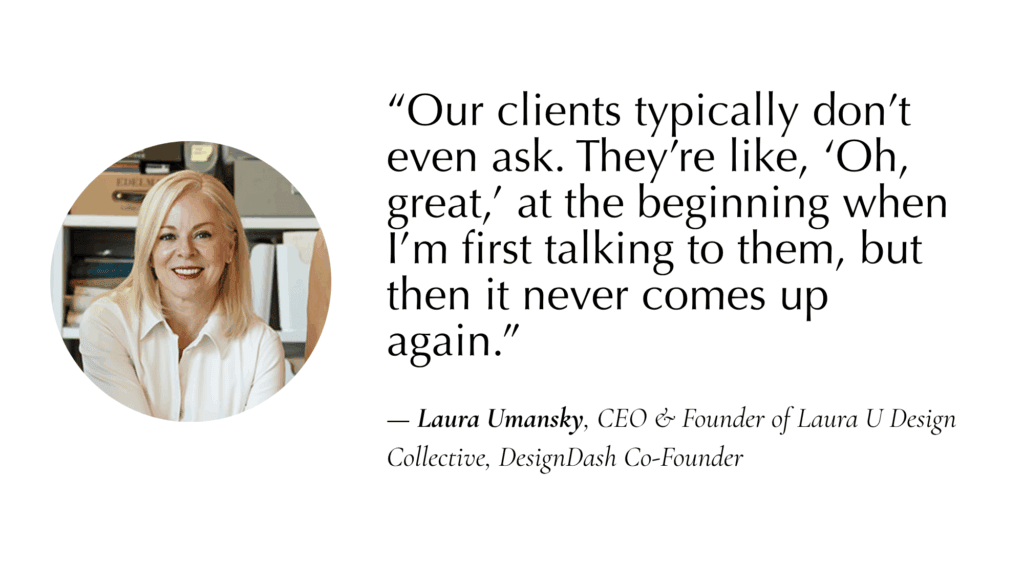
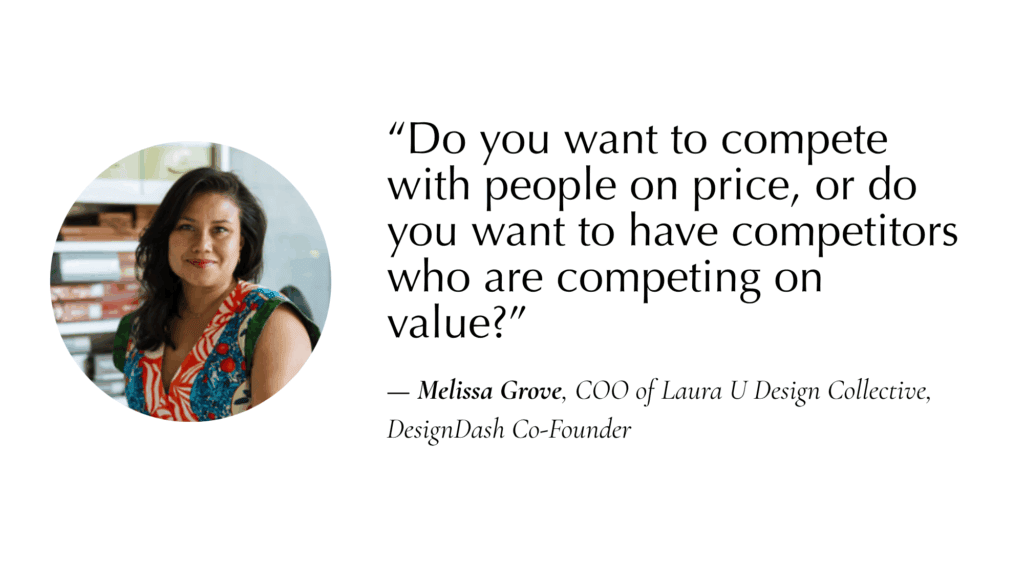
Laura started the discount because she wanted to compete as a new designer. Melissa argues that price-based messaging places a firm beside other businesses that also sell through price. A firm that wants to compete through expertise has to talk about the parts of its work that its ideal client values. That might include press, awards, one-of-a-kind pieces, market trips, custom fabrication, vendor access, or a multidisciplinary team.
As a case-study, Laura brings up the Gucci boutique in Aspen, where she lives with her family. The Aspen boutique has a discreet area with discounted pieces for preferred clients. Her sales rep might invite her into the space and show her a pair of feathered shoes that suddenly seems irresistible because the price has been reduced. Gucci owns that inventory, which is why this little anecdote connects to our overarching theme today.
A design firm might also own sofas, lamps, or accessories that need to be sold during a warehouse sale. A sofa sourced specifically for one client belongs to a different transaction because the firm never intended to keep it. As Laura and Melissa conclude, the business model determines which type of discount is under discussion.

Listen to the Full DesignDash Podcast Episode
By the end of the episode, Laura and Melissa have separated several transactions that are often grouped under the same word. Service fees, cut time, client furniture, and owned inventory each require their own policy. Before a firm changes the price, its owner should know which transaction is under discussion and why the original number exists.
Listen to Episode 100 of the DesignDash Podcast for Laura and Melissa’s full conversation about discounting, ideal clients, product pricing, and (as a fun little bonus) Laura’s relationship with her Gucci salesperson in Aspen.
Written by the DesignDash Editorial Team
Our contributors include experienced designers, firm owners, design writers, and other industry professionals. If you’re interested in submitting your work or collaborating, please reach out to our Editor-in-Chief at editor@designdash.com.
Related Posts

5 Podcast Episodes About Growing Your Design Team Intentionally Not Reactively
These 5 five podcast episodes explore how design firms grow through re

40 Business Contracts to Know as a Creative Entrepreneur
From Client Services Agreements to Intellectual Property Assignment Ag

Help! I Have a Difficult Interior Design Client Who Pays Really Well.
Struggling with a difficult but high-paying interior design client? Le

Turning Setbacks into Opportunities: Transform Challenges into Success
Learn how to turn setbacks into opportunities with resilience and a gr

Cybersecurity Law: Am I Legally Required to Protect Client Data from Cyber Attacks?
As an interior designer, you might have asked yourself which cybersecu

What is an Indemnity Clause, and Do You Need It in Interior Design Contracts?
What is an indemnity clause in an interior design contract? Learn how