
How to Balance Two Careers Until You’re Ready to Choose One

 0
0
 0
0Summary
You don’t need an immediate exit from your first career in order to build a promising second career. Content creator Jen White continues working in corporate sales training while developing a business she eventually hopes to pursue full time. In her DesignDash conversation with Laura Umansky and Melissa Grove, Jen discusses designing the second career around her existing schedule, waiting for predictable revenue before making a change, tracking income streams she can influence, protecting her creative energy, and giving herself time to develop the business. Laura connects that to her own experience building Laura U Design Collective over 20 years.
Reflection Questions
What skills from your current career are already helping you build the second one? Are there skills or professional relationships you would lose access to if you left too early?
Which parts of your second career work reasonably well within your current schedule, and which ones require so much additional time that you need to reconsider how you’re doing them?
If your goal is eventually to choose one career, what would you need to see financially before making that decision? Think about consistency over time rather than one unusually good month.
Journal Prompt
Think about the career you have now and the other career or business you’re trying to develop. Write down what your current work gives you beyond the obvious paycheck. Include experience, relationships, benefits, access to vendors or clients, professional credibility, skills you’re still developing, and anything else you would have to replace if you stopped tomorrow.
Then write down what would actually need to happen before you changed the balance between the two. Be specific. Maybe you need six months of predictable revenue, as Jen does. maybe you need a certain number of wholesale accounts, a waitlist for consulting work, enough savings to cover a year of expenses, or simply evidence that you still enjoy the second career after doing it seriously for a while. You might discover that you already know what you’re waiting for. You might also discover that you don’t actually need to choose one yet.
Interior designers have a lot of opportunities to build careers outside of their typical day-to-day of interfacing with clients and delivering finished homes. A firm owner might develop a furniture collection, license wallpaper, consult with another company, coach newer designers, teach, speak, create content, or start an entirely different business. Designers who still work for someone else might also be building their own firms at night and on weekends.
Doing two things at once can make sense for quite a long time. One career might provide reliable income while the other gives you room to test an idea without expecting it to pay your mortgage immediately. You might eventually choose one. You also might decide that you actually like having several parts to your career and have no interest in reducing or distilling everything down to one job.
In an older episode of the DesignDash podcast, Laura Umansky and Melissa Grove spoke with Jen White. Jen is a Chicago-based content creator who also has a full-time corporate career in sales training and enablement. She would eventually like content creation to become her primary business, but she’s equally clear that she isn’t willing to make that decision before the financial side makes complete sense.
This conversation between Jen and our hosts has obvious applications for designers, particularly those who are trying to build a second source of income while managing an already demanding first one. Below are five keys to balancing both without forcing a career decision before you actually have enough information to make it.
#1 Pay Attention to What Your First Career Is Teaching You
Jen’s two careers are very different on paper, but they aren’t completely separate conceptually (or applicably). She spent years in sales training, traveled around the country for work, presented to colleagues, and spoke at conferences. Public speaking wasn’t natural for her, either. She worked on it because her corporate career required that she do so.
Those years prepared her for the business she’s building now. She learned how to speak to an audience, teach, present ideas, and become comfortable watching herself on camera. None of that was originally done so she could build a social media business, but she uses all of it now.
You Probably Don’t Need to Start From Zero
The same can apply to designers who are thinking about a second career. If you want to coach or consult, years of client presentations and team management are relevant. If you want to design furniture, you already understand scale, materials, vendors, installation, pricing, and how clients actually live with what you specify. If you eventually want to own a firm and currently work for someone else, you’re learning how projects are managed before every mistake is on your own payroll.
Of course, experience in one area doesn’t automatically qualify you for another one. Product manufacturing and licensing have their own complications. Coaching requires a different relationship with a client. Running a firm requires financial and managerial responsibilities that employment doesn’t. But your current career might be giving you part of the education already, even if you’re increasingly interested in doing something else.
#2 Build That Second Career Around the Time You Actually Have
Laura points out that Jen is basically working two full-time jobs and asks how she manages both. Working from home helps; Jen can edit during an Uber ride, film something during lunch, respond to comments during downtime, and combine content-related events with plans she already wants to make.
More importantly, she changed what she created when the old approach demanded too much extra time. Jen used to make Chicago history content and genuinely liked researching it, but research added hours to a week that was already full. Vlogging made more sense because she could record parts of her existing life.
Some Good Ideas Are Too Expensive in Time-Spent
This gets complicated for designers because the second career is often creative too. Developing furniture after spending all day designing interiors can sound closely related until you’re reviewing prototypes at night, communicating with manufacturers, pricing a collection, photographing it, and trying to figure out wholesale. Coaching might sound fairly simple until every client needs preparation and follow-up. Starting your own firm while working for another one can involve an entirely separate set of proposals, contracts, bookkeeping, marketing, and sourcing.
Jen doesn’t argue that you should stop doing anything that takes a lot of time. She does pay attention when the amount of work no longer makes sense for what she’s trying to build. That might mean changing the format, reducing how often you do something, or deciding that a perfectly good business idea isn’t compatible with the rest of your life right now.

#3 Nail Down What Has to Happen Before You Give Up Reliable Income
When Laura asked whether there’s a breaking point where Jen would choose content creation over her corporate career, Jen admitted she’s already thought about it. She wants to run her own business full time. At the time of this conversation, her creator revenue changed too much from month to month, which made the prospect of putting all her eggs in that basket feel unstable.
Jen has spent decades working and has expenses based on the life she has now. The amount she needs before leaving a salaried career is different from what she might have needed at 23.
One Great Month Probably Shouldn’t Make the Decision for You
This is especially relevant to firm owners who are considering reducing client work because another part of the business is doing well. A large licensing check, a successful product launch, or several coaching clients might prove that people will pay you for that work right now, but it doesn’t necessarily tell you what that income will look like six months from now. Whether you’re a writer, an editor, a draftsperson, or a designer, many of us know how this feels after seeing AI swoop in and negatively impact our own income sources (or those of our family and friends).
This threshold will always be a personal one. Someone with employees, children, a mortgage, or significant firm overhead has to process risk-reward through a different equation than someone with very low monthly expenses. You can love the new direction and still need evidence before reorganizing your entire career around it. Actually, knowing exactly what would make you comfortable can make the waiting period less ambiguous because you have something more specific than “when the business is doing well.”
#4 Determine Which Parts of the Business You Can Influence
Jen was much more systematic about her second career toward the end of the previous year. She listed her different revenue streams in a spreadsheet and started asking how much influence she had over each one. Old YouTube videos still produced a small amount of advertising revenue. Posting long-form videos again could potentially increase it. Affiliate income was another category she could test.
That approach helped her distinguish between revenue that mostly depends on someone else making a decision and revenue where she can change her own behavior and see what happens. One casual Instagram Story about a bronzer produced more than $100 in affiliate income, which made her realize she had more influence over that category than she had assumed.
A designer could ask the same question across an increasingly complicated business. If you license a collection, you might have limited control over how much the manufacturer sells after the agreement is signed. If you consult directly, you have much more control over how many engagements you accept, although there is still the question of demand. If you sell a proprietary product yourself, you might control pricing and marketing while taking on inventory, fulfillment, and customer service in return.
None of this means every income stream needs to be directly controllable. Laura U Design Collective itself has different projects with different timelines and outside variables. But if you’re deciding whether a second career can eventually support you, understanding where the money actually comes from is considerably better than looking at one total revenue number.
Fuel your creative fire & be a part of a supportive community that values how you love to live.
subscribe to our newsletter
*please check your Spam folder for the latest DesignDash Magazine issue immediately after subscription

#5 Protect Your Creative Energy and Let the Business Change
Jen has already consulted with companies on social media strategy, which could easily become another revenue source. She also knows she doesn’t particularly want to spend all day running someone else’s social media. Makes sense. If she uses her creative attention on client accounts, she might have very little left for the business she actually wants to grow.
This is relevant to designers because adjacent opportunities can multiply pretty quickly once people know you can do multiple things. A firm owner could consult, coach, speak, teach, license products, create content, take on brand partnerships, and continue designing homes. Being capable of making money from all of those things doesn’t mean doing all of them at the same time makes sense.
You’re Allowed to Change the Second Career While You’re Building It
Jen’s own creator career has already gone through several versions. She started with YouTube, experimented with beauty and fashion, spent time making Chicago history content, and eventually found a format that let her include many interests within lifestyle content. She also sees several possible ways to make money in the future, including speaking, consulting, content, a podcast, and maybe eventually her own show.
This flexibility is so important if you’re developing something alongside an established design career. You might start thinking you want a furniture company and realize you prefer licensing. You might assume you want to coach designers individually and discover that you’d rather consult with established firms. You might start a side business with every intention of making it your only career and eventually decide you like the combination better.
Patience Is an Essential Part of Any Second-Career Plan
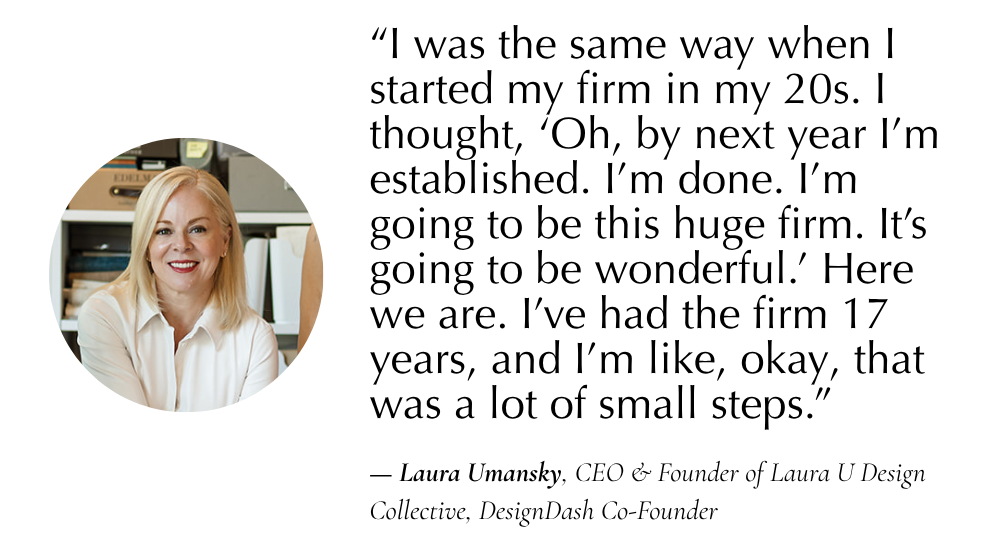
Laura’s experience building Laura U Design Collective adds an important counterpoint to Jen’s experience and argument. Jen says she doesn’t think she would have had the patience for this process in her 20s or 30s because she would have seen the goal and wanted to reach it immediately.
Jen actually keeps a note on her phone where she records milestones because progress is easy to forget while you’re still working toward the larger goal. She records things like a podcast appearance, a large brand deal, or hitting a follower milestone. The final career change hasn’t happened yet, but that doesn’t mean nothing has happened.
A designer building a second business could do something similar. Your first wholesale account, first paid consulting client, first licensed piece, first month when the new business pays its own expenses, or first time you turn down work because you genuinely don’t have capacity are all important information.

Final Thoughts
Balancing two careers can be exhausting, and there are obviously limits to how much work you can add to an already busy design business. But keeping both for a period of time can also give you financial and professional information that you would have had to guess about otherwise. You can see what people will buy, what work you actually want to repeat, how much time it takes, and whether the revenue is predictable enough to change your first career.
You might eventually choose one direction, which is Jen’s plan. You might also build a design firm and a product line for the next 20 years, consult a few times a month, or keep a separate career because you genuinely like both. It’s your decision to make.
Written by the DesignDash Editorial Team
Our contributors include experienced designers, firm owners, design writers, and other industry professionals. If you’re interested in submitting your work or collaborating, please reach out to our Editor-in-Chief at editor@designdash.com.
Related Posts

BDNY 2025: Jacob K. Javits Center, NYC, November 9th — 10th
BDNY 2025 returns Nov 9–10 at NYC’s Javits Center. Prepare for the

Eight Must-Attend Architecture and Interior Design Events in October
From Dutch Design Week's unique vision to the allure of Barcelona Desi
10 Enduring Italian Furniture Brands to Celebrate Before Salone
From understated luxury at Minotti to bold experimentation at Zanotta,

Looking Back on October 2025 High Point Market Trends
This article recaps Fall 2025 High Point Market and highlights the key

Comparing Illustration Software for Artists
Digital art apps and illustration software have revolutionized how art