
Saying “Yes” to Everything Will Dilute a Design Brand. Here’s Why.

 0
0
 0
0Summary
As your firm matures, saying yes to every opportunity no longer fuels growth. It blurs your positioning. Client projects, partnerships, visibility opportunities, and internal expansions all draw from different resources, and each one shapes how your firm operates and how it is perceived. Misaligned yes decisions dilute your portfolio, strain your team, and confuse your market. Strategic no decisions protect clarity. And when rejection comes back your way, it often provides useful information rather than a verdict on your ability. One well-aligned yes can outweigh dozens of no’s. The goal is not constant expansion. The goal is coherence.
Reflection Questions
Which recent yes decisions have strengthened your firm’s positioning, and which ones have introduced friction or confusion?
Where are you currently saying yes out of financial pressure, visibility anxiety, or social obligation rather than alignment?
If you looked at your last year of client work, partnerships, and public appearances, what would an outsider assume your firm specializes in?
Journal Prompt
Think about one opportunity you are currently considering. Write out, in detail, what this decision will require from your firm over the next twelve months. Who will be responsible? What standards might need to bend? What will your portfolio look like afterward? Then write the alternative scenario. If you decline, what short-term discomfort are you choosing, and what long-term clarity might that protect?
In the early days of your firm, every “yes” is like another pump of oxygen, but as time wears on and your firm matures, every misaligned “yes” is like a dab of differently colored paint in your brand’s bucket. One drop might not make a big difference, but soon enough, your paint is an entirely different color than what you started with. Saying “no” might be more frequent than saying “yes” at this stage, but that one little word is all that stands between you and a distinguishable, definable design brand.
Most influencers and psychologists who tout the value of “saying ‘no'” focus on “protecting your energy.” Is that valid? Yes. But in this context, the focus should be on keeping your firm legible, digestible, and easy understood by prospective clients, partners, vendors, collaborators, and future team members. Your firm’s portfolio should quickly and accurately communicate what you do and who you do it for. Any “yes” that doesn’t align with that is a dilution of your brand.
Why Firm Owners Feel the Pressure to Say ‘Yes’ to Everything
As Gail Doby wrote in a Business of Home article a couple years ago, “A scarcity mindset—the fear that more work will never come—holds many interior designers back from financial freedom.” It also prevents firm owners from creating a strong brand with lasting impact, one that matches their aesthetic and captures their core values. Worse yet, it often leads to accepting clients who are misaligned with your firm.
Doby warns against “saying yes to any project where someone is willing to sign on the dotted line [because] when you do this, you risk working with nonideal clients.” If you work with nonideal clients instead of those who fit your niche and accept your process, you experience more friction and (more often than not), end up with project photography you can’t use on your portfolio or on socials because it simply doesn’t align with your brand.
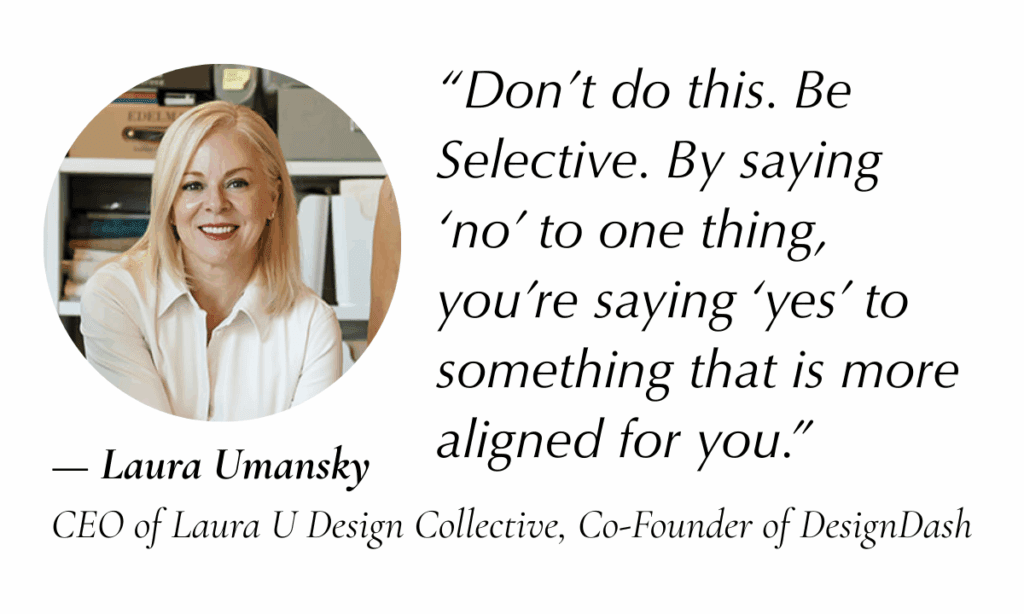
Laura Umansky, Co-Founder of DesignDash and CEO/Founder of Laura U Design Collective, agrees. It might be common industry advice to “Say ‘yes’ to everything,” but in Laura’s opinion, it doesn’t actually work.
Figuring Out How Much Each ‘Yes’ or ‘No’ Weighs
Saying no feels difficult partly because not all decisions are comparable. A client inquiry, a brand collaboration, a speaking invitation, and a media feature all draw from different resources. But when they land in your inbox, they often feel equally urgent and equally weighted. Without distinguishing between types of decisions, everything looks like an opportunity, and every opportunity looks like an obligation.
So, pause and ask yourself questions about resource allocation in addition to questioning alignment. What, exactly, will this decision require from the firm? Hours from the principal? Procurement bandwidth? Marketing time? A change in how the studio presents itself publicly? Some yes decisions demand operational commitment. Others alter perception. A few reshape internal structure. When you treat all of them as identical, you underestimate each the financial and reputational cost of each individual.
To that point, one way to think about this is not whether something is “good” or “bad,” but what kind of cost it incurs. Some costs are immediate and visible. Others pop up months later in the form of team fatigue, muddled messaging, or portfolio gaps. If you anticipate the type of cost attached to each decision, refusal feels less emotional and more analytical. Again, treating them as equivalent decisions creates confusion because the risk attached to each one differs.

Category One: Clients
Client inquiries are the easiest “yes” because they feel concrete. A signed contract means revenue. It means billable hours for your team. It means forward motion, increased recognition, and new photography. Even when alignment feels imperfect, it can seem manageable. You might tell yourself that you can guide the aesthetic. You might assume the process will smooth itself out once you’re in the thick of design development. You might believe that one project slightly outside your usual lane won’t affect anything long term.
Saying “no” feels different. It introduces uncertainty immediately. Turning down a funded project can trigger concern about cash flow, especially if you remember earlier years when inquiries were inconsistent. How can you say no to revenue now when mere months ago, you were scraping pennies together? There’s also social pressure. Clients talk. Builders talk. Real estate agents talk. Declining work can feel like a reputational risk, even when the fit is quite questionable. That discomfort makes it easier to rationalize a “yes”.
Beyond the risk that you’re allocating hours and creative energy to nonideal clients is the possibility that your portfolio will not grow an inch after the project has concluded. If the aesthetic direction drifts from your core body of work, you face a difficult choice during the reveal. Either you publish images that do not represent your firm accurately, or you choose not to publish at all. Both outcomes affect future inquiries. Prospective clients respond to what they see, not what you intended to communicate.
There’s also a subtler consequence. When a firm bends its process repeatedly for one client, internal standards soften. Team members learn that boundaries are flexible. Timelines adjust to accommodate personalities rather than production realities. Over time, those adjustments accumulate and erode your firm. The firm may still function, but it functions differently than it did before.
This is why the client “yes” or “no” is so consequential. It shapes revenue, workflow, team culture, and public perception all at the same time. Declining a misaligned client does not eliminate risk, but it does shift the type of risk you are willing to accept. Some firms would rather face a short-term gap in billing than a long-term distortion of their work. That decision depends on context, but it should be made consciously rather than by default.
Category Two: Partnerships
Brand partnerships are easy to say yes to because they feel like validation. A company reaches out. They want your name attached to theirs. There may be compensation involved. There may be product access, event exposure, or press. The invitation can feel flattering, especially if the brand has a larger platform or broader reach than your own. Even when alignment feels slightly off, you might assume the audience overlap is close enough to justify the association.
Saying no feels more complicated. Partnerships are relational. Turning one down can feel personal. You may worry about closing doors with a company that could grow into a stronger fit later. You may also feel pressure to maintain visibility in an industry that moves quickly. If other firms are collaborating widely, declining an offer can feel like opting out of the momentum that competitors are leveraging.
But audiences don’t typically separate sponsored work from core work. Over time, perception adjusts. Inquiries start to mirror the partnerships you accept. There’s also an accumulating internal effect when poorly aligned press is accepted. When revenue from partnerships starts to influence decision-making, creative standards loosen around those expectations.
A partnership should reinforce how your firm wants to be positioned. If it doesn’t, the short-term visibility may cost long-term clarity.
Category Three: Visibility
Visibility opportunities are easy to accept because they cost very little upfront. A panel invitation requires a few hours of preparation. A podcast recording fits into a single afternoon. A feature interview takes an hour or less now that responses can be jotted off and emailed day-of. The time investment seems minimal, and the upside appears open-ended. Exposure can feel like momentum, and momentum feels productive.
Saying no to visibility is harder than it sounds. Turning down an invitation can feel ungrateful or shortsighted. You may wonder whether the opportunity will ever present itself again. You may also worry about relevance. If other firms are speaking, publishing, and appearing regularly, opting out can create anxiety about being overlooked.
The risk of saying yes indiscriminately is narrative dilution. Each public appearance adds to the archive of how your firm is described. That’s the drop in the paint bucket we talked about in our intro to this article. If your speaking topics drift across unrelated subjects, audiences struggle to categorize your expertise. If your commentary shifts depending on the platform, your positioning blurs. Of course, it’s important to group your appearances by audience. Some will be directed towards other firm owners and designers; others will attract PNC attention.
Either way, remember that selective visibility builds authority over time. Scattered visibility just creates noise.
Category Four: Internal Commitments
Internal expansions can be the most tempting “yes”-es because they feel entrepreneurial. Think: launching a product line, adding procurement services, hiring a new leadership role, or entering a new market. Each decision promises growth and diversification. The excitement can be energizing for your team. It can also feel like evolution; that’s what a design firm that wants to scale should do, right?
Wrong. Saying no to internal expansion can feel counterintuitive, and turning down growth can seem like stagnation, but it’s not. You may worry about missing a strategic window. You may feel pressure to scale because peers are scaling. Expansion can boost your status in the industry, and restraint can look conservative from the outside.
But the risk of saying yes internally is structural strain. A new service introduces systems, oversight, and long-term accountability that your team (or leadership) might be entirely unable to accommodate. A new hire changes reporting lines and compensation obligations. A new division demands ongoing marketing, operations, and management attention.
A podcast appearance is one hour of your time and a blip on the internet, but internal commitments are far-ranging and embedded. Once clients expect a service, retracting it affects your credibility. Once a team member is hired, reversing course impacts morale. Internal yes decisions shape how the firm operates every week, not just how it is perceived by outsiders.
Growth is not inherently positive. It depends on alignment with capacity and direction. Expanding without clarity can stretch a firm thinner than intended. It can dilute your brand irreparably.
Fuel your creative fire & be a part of a supportive community that values how you love to live.
subscribe to our newsletter
*please check your Spam folder for the latest DesignDash Magazine issue immediately after subscription

Hearing ‘No’ Is Just As Valuable As Saying It
Firm owners spend a great deal of time learning how to decline opportunities. Much less attention goes toward understanding rejection when it comes back from clients, editors, or collaborators. Yet the two experiences will absolutely co-occur. As a studio clarifies its aesthetic, pricing structure, and audience, rejection often increases rather than decreases in both directions. Early in a firm owner’s career, growth may depend on accepting nearly every inquiry. Later, clearer positioning narrows the field, and fewer proposals convert.
Reframe Rejection As Information
Organizational performance expert Dr. T. Alexander Puutio writes in a 2025 Psychology Today article that people frequently interpret rejection as a final outcome instead of part of an ongoing process, but it only functions as an ending if we treat it that way. According to Puutio, “as long as we don’t stop at no, it simply becomes part of the path.” It informs us more than it hurts us.
In a design firm, that distinction is key to dealing with rejection. A declined proposal rarely reflects the quality of the work itself. A prospective client may want a faster timeline than the firm can responsibly deliver when other projects already in the pipeline are considered. An editor passing on a feature may already have similar coverage scheduled. A brand partnership may stall because marketing priorities shifted internally. The answer is no, but the information behind it is operational rather than personal.
Puutio also observes that people default to no because it preserves stability. Agreeing to something introduces risk, commitment, and scrutiny, while refusal protects time and reputation. Designers encounter this dynamic constantly in our work. For example, a homeowner hesitates before committing to a full-service engagement because the investment feels substantial. A collaborator declines participation because resources are already allocated elsewhere. Understanding rejection as risk management clarifies the exchange and takes the emotional sting out of every “no”.
Puutio further argues that rejection creates clarity by forcing individuals to evaluate whether a goal still justifies continued effort. It helps clarify the brand and the firm’s offerings. If higher fees lead to fewer signed projects, the firm must decide whether its positioning reflects long-term intentions. If repeated editorial pitches fail to gain traction, targeting or narrative may need refinement. Rejection narrows direction through accumulation rather than through a single decisive moment.
One Well-Aligned ‘Yes’ Outweighs Many ‘No’s
Puutio highlights what he calls an asymmetry of outcomes, writing that “one yes can outweigh a hundred no’s.” This aligns with what Laura said earlier. One aligned client can support months of work. One perfect publication feature can amplify visibility within the industry. One ideal partnership can introduce the firm to an entirely new audience. Because outcomes are unevenly weighted, rejection can be filtration. The market eliminates mismatches for you.
On the flip side, an absence of rejection can signal limited experimentation. Puutio notes that when one encounters little resistance, they may be operating too close to established comfort zones. Within a design firm, that might mean pricing safely, pursuing familiar publications, or collaborating only within existing networks. Expanding beyond those boundaries introduces uncertainty, and uncertainty increases the likelihood of refusal. But that tension often accompanies growth, even when progress feels incremental.

Final Thoughts
Over time, experienced firm owners develop a more measured relationship with rejection. T. Alexander Puutio encourages readers to “start counting no’s” and treating them as markers of effort and advancement toward the ideal instead of painful setbacks. Laura Umansky recommends that firm owners reframe saying no to one thing as “saying ‘yes’ to something that is more aligned for you.”
We hope this approach helps you view the unanswered pitches, declined proposals, and stalled collaborations you’ve experienced as evidence of outreach and refined positioning. Saying no defines the firm’s boundaries externally. Hearing no tests whether those boundaries communicate clearly enough to others. Both processes refine direction simultaneously, even if the improvement in brand alignment is gradual.
Written by the DesignDash Editorial Team
Our contributors include experienced designers, firm owners, design writers, and other industry professionals. If you’re interested in submitting your work or collaborating, please reach out to our Editor-in-Chief at editor@designdash.com.
Related Posts

When’s the Right Time to Bring Procurement In-House Instead of Outsourcing?
Learn the five key factors—costs, client service, scalability, and m

It’s Not All About Takashi Murakami! Female Superflat Artists We Love.
Through their diverse bodies of work, female Superflat artists navigat

Celebrating Famous Female Friendships in Honor of National Girlfriends Day
From Jane Austen and Anne Sharp to Audre Lorde and Adrienne Rich, let'

What’s On View at the Art Institute of Chicago During Design Chicago
Attending Design Chicago this October? From Pixy Liao to Paradise Lost

How to Balance Two Careers Until You’re Ready to Choose One
Jen White tells us how designers can balance two careers while buildin

How Transit-Oriented Development Can Transform America’s Southern Cities—And Women’s Lives
Transit-Oriented Development (TOD) has the potential to transform Sout