How to Handle Clients Who Want Everything Approved by Text

 0
0
 0
0Summary
Many interior designers communicate with clients by text message, but problems can arise when important project decisions become scattered across texts, emails, meetings, assistants, contractors, and family members. This article explores what can happen when text messaging becomes the primary method for approvals, why formal presentations still serve an important purpose, how documentation protects both designers and clients, and why communication problems often begin long before communication breaks down. It also examines when text-heavy communication can work successfully and how designers can determine whether a particular communication system supports clarity, accountability, and informed decision-making throughout a project.
Reflection Questions
How many communication channels are currently active on your projects?
Have you ever struggled to locate a client approval because it was buried in a text thread?
Which project decisions require formal documentation within your firm?
Are there situations where your current communication process creates unnecessary friction for clients?
Journal Prompt
Think about a project where communication became fragmented across texts, emails, meetings, contractors, assistants, or family members. What confusion emerged as a result? Were there opportunities to create more structure, or did the project reveal places where your communication process could become more flexible?
A client asks if you can send selections by text instead of scheduling a presentation. Another reviews every design recommendation from their phone while traveling. Someone else forwards screenshots to their spouse, who responds separately a few days later. Then there’s the client who prefers to communicate exclusively through an assistant and rarely checks email at all.
At first glance, these requests don’t seem particularly problematic. In fact, many designers already text clients regularly. Texting is fast, convenient, and often feels more personal than email. For busy clients juggling work, travel, family obligations, and construction projects, it can seem like the most efficient way to communicate.
The challenge is that project communication is also documentation, decision-making, accountability, and record-keeping. A quick text confirming a site visit is one thing. Approving furnishings, signing off on finishes, discussing budget changes, or authorizing revisions is something else entirely. Once important project decisions become scattered across text messages, emails, phone calls, meetings, assistants, spouses, contractors, and project managers, it can become surprisingly difficult to determine who approved what, when they approved it, and whether anything changed afterward.
The question, then, isn’t whether texting is good or bad but whether your communication system still works when texting becomes the primary way decisions are made. Before deciding how much flexibility to offer clients, you must first understand why communication systems exist in the first place and what can happen when those systems start breaking down.
And if you love communicating exclusively via text with clients, this article might not be for you! (That’s okay; take a look at a few others here.)

Text Messages Solve One Problem and Create Another
Why Clients Prefer Texting
A client’s preference for text messaging makes complete sense. Texts feel immediate. To send one, you don’t need to log into a client portal, draft a formal email, or set aside time for a meeting. A homeowner can respond while waiting for a flight, sitting between appointments, or standing in a jobsite. Texting has become the default communication method for nearly everything for nearly everyone.
Interior design clients are no exception. Some simply prefer the convenience. Others are managing demanding careers, multiple residences, extensive travel schedules, or family obligations that make traditional project communication feel cumbersome. From the client’s perspective, sending a quick text often feels like the most efficient path forward.
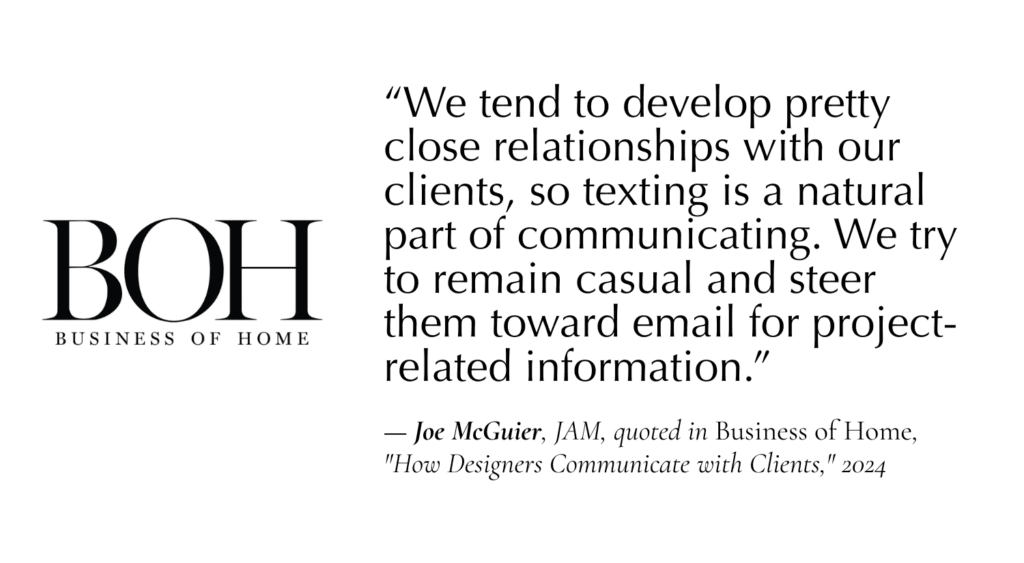
The fact that clients prefer texting doesn’t necessarily mean they’re trying to avoid your process. In many cases, they’re simply trying to fit a complex project into an already crowded schedule.
Why Designers Often Feel Differently
Designers, however, are weighing a very different set of concerns. A text message might be perfectly adequate for confirming a site visit or asking whether a sample arrived. Project decisions are another matter entirely. Furnishings, finishes, construction details, budgets, and timelines frequently require context that doesn’t translate well into a series of short messages.
That challenge is even greater when projects involve multiple people. A text sent to the client might not be seen by a spouse. An approval shared in a group message might never reach the project manager. A decision discussed over text might conflict with information contained in an email sent several weeks earlier. What begins as a simple effort to make communication easier can gradually create additional opportunities for confusion.
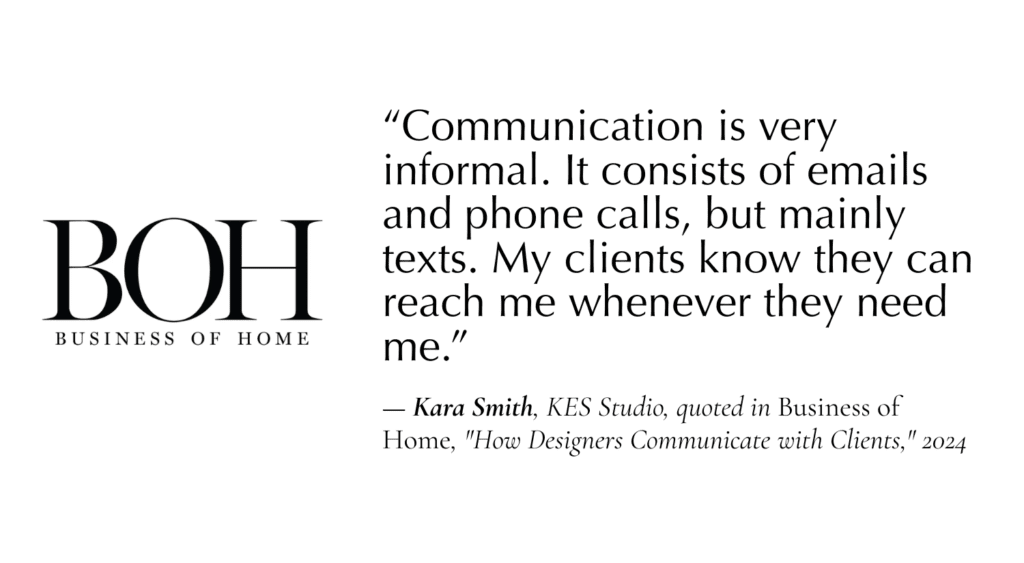
Many successful designers text their clients regularly. The issue isn’t whether texting should exist within the communication process but whether the communication system stays adequately organized once important project decisions begin flowing through multiple channels simultaneously.
What Gets Lost When Texts Replace Formal Presentations
A client who requests text-message approvals isn’t necessarily trying to avoid participating in the project. They might simply be trying to save time. Formal presentations require scheduling, preparation, and focused attention, all of which can feel difficult to accommodate when someone is balancing work, travel, family obligations, and an active renovation or furnishing project.
From the client’s perspective, reviewing a few screenshots by text can seem much more efficient than attending a one-hour presentation. If they can approve selections from an airport lounge or between meetings, why schedule a formal review at all?
But Designers Use Presentations Differently
Designers often view presentations differently. During a presentation, selections are reviewed together rather than individually. A fabric, a rug, and a lighting fixture might all look appealing on their own. Once viewed alongside one another, however, the strengths and weaknesses of each choice within the context of the entire project are easier to evaluate. Presentations also give us opportunities to discuss lead times, budgets, alternatives, and potential concerns before decisions are finalized.
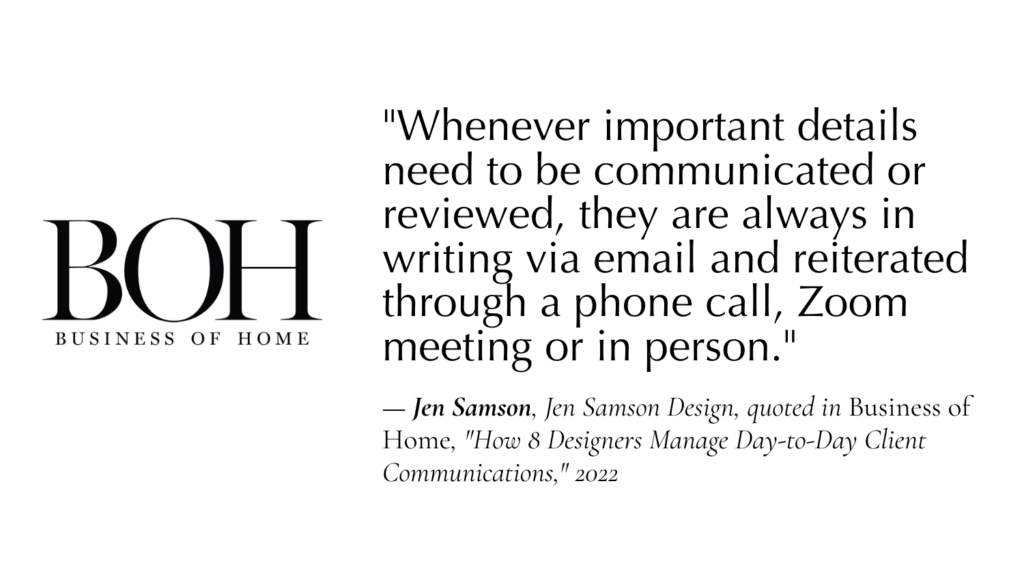
This is a dedicated time for client questions, as well. It’s so much easier to address client questions in this context, when everything is laid out before them, than in fragmented texts. A client might identify a concern, express a preference, or make a connection that never would have surfaced if selections had been reviewed individually over several days of text messages.
Context Influences Decisions
Most design decisions don’t exist in isolation. A client reviewing a sofa by text message might focus primarily on the upholstery color. During a presentation, that same client might also consider how the sofa relates to the rug, the drapery, the floor plan, and the overall budget.
The same principle applies to countless other decisions throughout a project. A finish selection might affect hardware choices. A lighting fixture might influence furniture placement. A seemingly minor revision might have implications for cost, lead times, or installation.
When selections are reviewed one at a time through text messages, those relationships can be more difficult to parse out. Formal presentations create an opportunity to evaluate decisions within the broader context of the project, which often leads to more informed conversations and, ultimately, more confident approvals.
Fuel your creative fire & be a part of a supportive community that values how you love to live.
subscribe to our newsletter
*please check your Spam folder for the latest DesignDash Magazine issue immediately after subscription

The Real Problem Is Documentation
Most projects don’t rely on a single communication channel. Designers exchange emails with clients, text contractors from jobsites, discuss selections during presentations, and follow up afterward with meeting notes. None of that is unusual. In fact, most projects require multiple forms of communication.
Problems tend to emerge when important decisions become scattered across those channels without a clear system for documenting them. A client approves a finish by text. A contractor references an older email. A spouse remembers a conversation differently. The project manager has notes from a meeting that took place several weeks earlier. Each person might genuinely believe they’re working from the correct information.
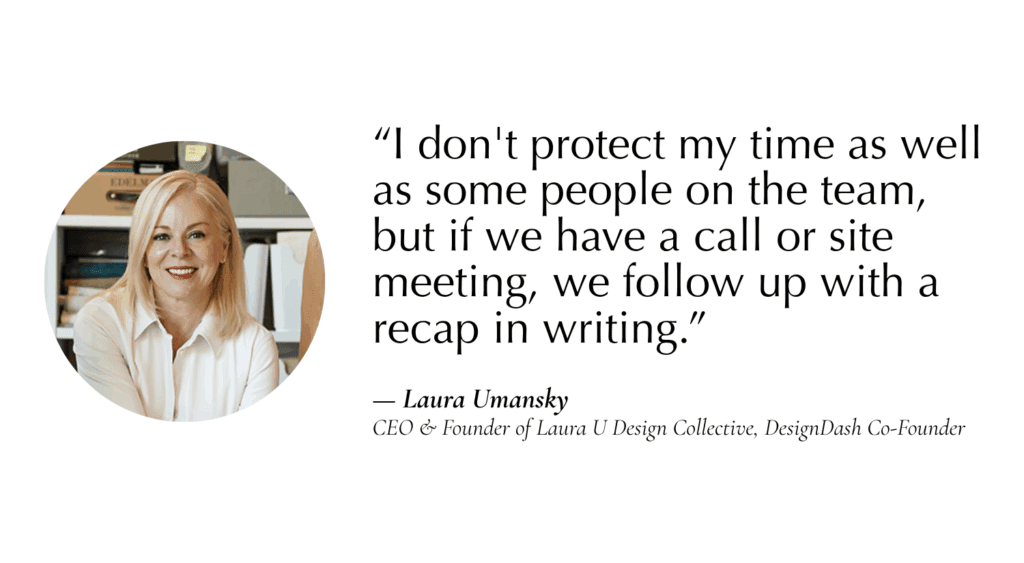
The difficulty is that communication records are even more important as a project progresses. A decision made six months ago might suddenly become relevant during procurement, construction, or installation. The larger and longer the project, the harder it becomes to rely on memory alone.
Documentation Protects Everyone
Documentation creates a shared record that allows everyone involved to reference the same information. That is particularly important when budgets are updated, specifications change, products are discontinued, or clients revisit earlier decisions.
A written record can also prevent minor misunderstandings from becoming larger disputes. If a furnishing was approved, a finish was selected, or a revision was requested, the project team should be able to determine when that decision occurred and who authorized it. Without that documentation, people often find themselves reconstructing events from memory, which is rarely reliable.
Good documentation protects designers, clients, contractors, and vendors alike. More importantly, it allows the project to keep moving forward when questions inevitably arise.
Communication Problems Usually Start Before Communication Breaks Down
Most homeowners complete only a handful of major renovation or furnishing projects during their lives. They aren’t expected to understand procurement timelines, construction sequencing, specification revisions, or the dozens of small decisions that influence a project behind the scenes.
As a result, clients don’t always know which concerns deserve immediate attention. They might dislike a design direction but hesitate to say so. They might assume a contractor already knows something that was only discussed with the designer. They might have budget concerns that never make it into the conversation at all.
Few designer-client communication problems emerge because someone intentionally withheld information or tried to mislead. No one’s trying to keep the client or the designer out of the loop. More often, a client simply doesn’t realize a particular concern is important until much later. By that point, selections may have been approved, orders may have been placed, or construction may already be underway.
Fragmented Communication Makes Assumptions Harder to Spot
When conversations happen during presentations, meetings, or structured reviews, designers have more opportunities to identify confusion before it becomes a problem. Text messages don’t always create those same opportunities because there isn’t an opportunity for natural, long-form question-and-response. Texts are for brief questions and even briefer responses.
A client might respond with a quick “looks great” without mentioning a concern that would have emerged during a longer conversation. A spouse might disagree with a selection but never participate in the discussion. A contractor might make an assumption based on incomplete information.
Communication problems typically develop gradually as small misunderstandings accumulate over time. By the time everyone realizes they’re working from different assumptions, reversing course can become far more difficult than addressing the issue earlier in the process.

Some Clients Can Successfully Work Primarily Through Text
After everything we’ve discussed, it’s important to acknowledge that text messaging isn’t inherently problematic. Some clients communicate exceptionally well through text. They respond quickly, provide clear feedback, make decisions promptly, and understand when a larger conversation is necessary. For those clients, text messaging can be an efficient and effective part of the communication process.
Other clients create confusion regardless of the communication channel. Misunderstandings can occur over email. Important details can be overlooked during meetings. Phone calls can generate conflicting recollections. Simply replacing text messages with another communication method doesn’t automatically solve those problems.
The Communication Method Isn’t Always the Problem
The real question isn’t whether text messaging is good or bad but whether the communication system works for the specific project and the specific people involved. A client who consistently reviews information carefully, asks thoughtful questions, and responds in a timely manner might function perfectly well within a text-heavy workflow. Another client might require more structured presentations, written summaries, and formal approval procedures to keep the project organized.
The Real Question Is Whether the System Works
Every project operates differently because every client operates differently. A communication approach that works beautifully for one client might create confusion for another. The goal isn’t to determine whether text messaging should always be allowed or always be avoided but to determine whether the communication system creates clarity, supports decision-making, preserves documentation, and keeps the project moving forward.
That’s why there is no universal rule. Some clients can successfully navigate an entire project with a significant amount of communication happening by text. Others benefit from more formal presentations, written approvals, and structured review processes. The best approach is the one that allows everyone involved to communicate clearly, make informed decisions, and remain aligned throughout the life of the project.
Written by the DesignDash Editorial Team
Our contributors include experienced designers, firm owners, design writers, and other industry professionals. If you’re interested in submitting your work or collaborating, please reach out to our Editor-in-Chief at editor@designdash.com.
Related Posts

Mid-Career Switch: How to Become an Industrial Designer
Are you considering a mid-career switch and wondering if industrial de

It’s Not You; It’s Me: How to Reject a Potential Design Project
Rejecting a potential interior design client can be uncomfortable for

These Are the Best Cameras for Nature Photography
The power to freeze a fleeting moment or reveal the tiniest details is
Get Ahead of These Common Interior Design Problems with Advice from Laura U
Laura shares her insights about the most common challenges designers f

Should You Hire an Interior Stylist for Project Shoots?
Often working in lock-step with your photographer, the right interior

Should You Ever Take On a “Friend Favor” Project as a New Design Firm Owner?
Learn how to navigate “friend favor” design requests without under