
Is Your New Hire the Problem, or Is It You?

 0
0
 0
0Summary
Reflection Questions
Journal Prompt
Your new employee keeps missing deadlines! She asks questions you thought you already answered! You correct her work TWICE! At some point, you start wondering whether you made the wrong hire.
Before you decide that’s the case, check your own management.
In Episode 90 of the DesignDash Podcast, Laura Umansky and Melissa Grove discussed what happens when firm owners make their first few hires and discover that managing people requires a completely different set of skills. Melissa estimates that 90% of the time when an employee repeatedly falls short, there’s probably something wrong on the management side.
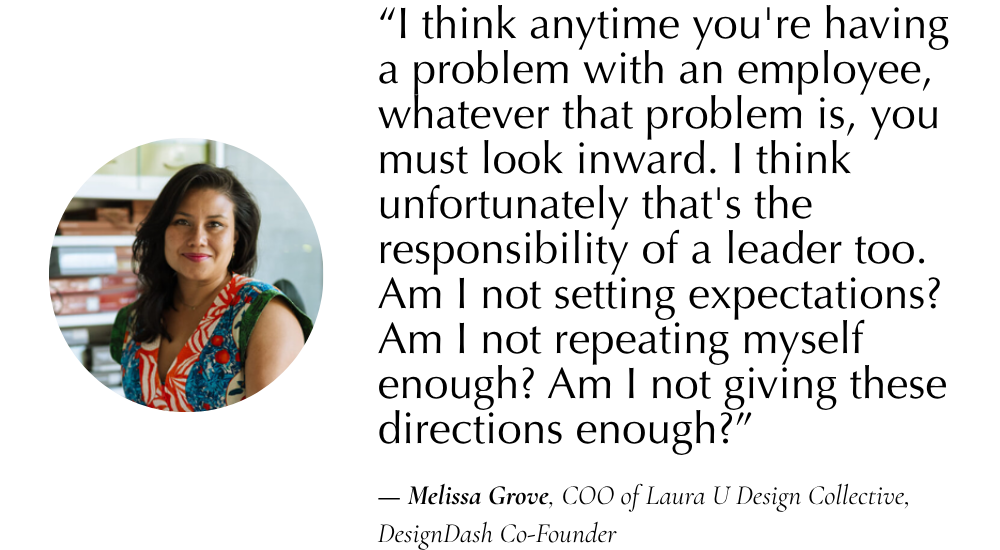
Here’s what to check before you decide your employee’s in the wrong.
Question 1: Did You Explain Enough?
You know your firm better than anybody you hire.
You know which vendor needs more info before an order’s released. You know which construction details need another round of reviews. You know which client absolutely needs a phone call instead of an email. You also know what went wrong the last time somebody skipped one of those steps.
But your new hire doesn’t know any of that.
A junior designer who has worked for a year hasn’t encountered the number of projects, mistakes, vendors, builders, and client situations that you have. That means she won’t automatically recognize every risk you see. Sometimes you’ll also have to repeat yourself.

Before you blame the employee after a first mistake, ask:
- Did I explain exactly what I wanted?
- Did I explain why we do it this way?
- Did I assume they knew something I never taught them?
- Have they encountered this situation before?
- Did I check the work after delegating it?
If the same mistake happens three or four times after you’ve corrected it, documented it, and discussed it again, you have a different problem.
Fuel your creative fire & be a part of a supportive community that values how you love to live.
subscribe to our newsletter
*please check your Spam folder for the latest DesignDash Magazine issue immediately after subscription

Question 2: Are You Managing Them the Way They Need?
Laura and Melissa don’t want the same type of instruction, just like you probably don’t like the same management style every one of your employees does. Laura generally wants the basic ground rules and enough autonomy to figure it out. Melissa manages people who want explicit reasons behind every step before they start working.
Neither approach tells you whether somebody is good at her job.
If you prefer independence, an employee who asks several questions can seem overly dependent. If you like detailed procedures, somebody who wants autonomy can seem careless. You still have to figure out how that particular employee processes information.

Melissa asks about prioritization and problem-solving during interviews, but she thinks it can take around three months to understand how someone receives instructions and feedback. That can be annoying when you hired somebody because you needed time back. Training still takes time.
And yes, you probably could do the task faster yourself. BUT DON’T. More on delegating here.
If you take the work back every time somebody is slower than you, you’ll still own all of it six months later.
Question 3: Was the Mistake Preventable With What They Knew?
Laura has seen employee mistakes cost LUDC a lot of money. She still asks whether the employee had enough experience to know why their decision was so risky.

Ask what caused the mistake, like:
- Training problem: They didn’t know the process.
- Experience problem: They didn’t know enough to recognize the risk.
- Communication problem: Your instructions were incomplete.
- Employee problem: They knew the process, received correction, and continued ignoring it.
The size of the mistake won’t always tell you which category it falls into. Laura can understand a costly mistake if the employee owns it and changes what they do afterward. She has much less patience for defensiveness, even when the original issue was relatively small. Melissa thinks accountability can sometimes be taught when leaders model it consistently.
Either way, pay attention to what happens after you correct an employee’s mistake.

Question 4: Is the Deadline Problem Actually Yours?
Someone misses a deadline. Your first thought might be that she’s disorganized. Before you decide that, take a look at her workload.
Melissa once worked 60 or 65 hours a week and still missed deadlines because her manager hadn’t realized how much work she had or told her which assignments should come first.
Laura had a similar problem at LUDC. Employees kept saying they were overwhelmed, and she eventually examined project commitments, utilization, and how much work the team could realistically complete.

Before calling somebody bad at time management, check:
- How many active projects are they working on?
- How many deadlines fall in the same week?
- Did you tell them which task comes first?
- Did you call several assignments “urgent”?
- Did you promise the client a timeline your staff can’t reasonably meet?
If several employees keep missing deadlines, the common denominator might be the calendar you created.
Question 5: Did You Actually Tell Them There Was a Problem?
Your employee can’t correct feedback you never gave her.
Melissa admits that she sometimes softens criticism because she doesn’t want to offend somebody or make the person think she’s assigning too much work.

If you say, “I’d prefer you do it this way,” when you actually mean, “You need to stop doing it that way,” don’t assume the employee understood the difference. Direct feedback also makes your next decision easier. It gives YOU more context.
Once you’ve clearly explained the problem, watch what the employee does. Does she…
- Ask questions?
- Correct her mistakes?
- Follow the agreed process?
- Make the same mistake again?
- Take responsibility when something goes wrong?
Now you’re evaluating performance with actual information instead of frustration.
Yeah, Sometimes It Really Is the Employee
Taking a long, hard look at your management first doesn’t mean coaching that new hire indefinitely or constantly reworking your own processes.
Melissa has little patience for an employee who refuses to follow an established procedure before understanding why the firm created it. She’s happy to reconsider a process after somebody learns it and proposes a better one.

Repeated mistakes, refusal to follow procedures, defensiveness, and an inability to apply feedback can all tell you that the employee isn’t right for the role.
Sometimes there isn’t a clean performance problem at all. Two capable people can have incompatible expectations around communication, collaboration, or decision-making. Laura and Melissa have worked together for eight years and have had plenty of disagreements themselves. They’ve figured out how to work together. They also acknowledge that not every professional relationship will.
You don’t need to prove that one person is objectively wrong before ending a relationship that neither person can make work.
Before You Let Someone Go, Check Five Things
Ask yourself:
- Did I explain the work completely enough for this person’s experience level?
- Am I giving instructions in a format this employee understands?
- Was the mistake preventable based on what the employee actually knew?
- Did I give them a realistic workload and clear priorities?
- Have I explicitly told them what needs to change and given them a chance to change it?

If you’ve done all five and the same problems persist, you can evaluate the hire with much better information than you had after the first missed deadline.
Written by the DesignDash Editorial Team
Our contributors include experienced designers, firm owners, design writers, and other industry professionals. If you’re interested in submitting your work or collaborating, please reach out to our Editor-in-Chief at editor@designdash.com.
Related Posts

How to Attract High-End Hospitality Projects as an Interior Designer
Learn how to attract high-end hospitality design projects with these 7

Advice We Wish We Had Before Starting Our Interior Design Firms
Interior designers share the advice they wish they had before starting

We Have Standards: State-Specific Licensing and Certifications for Interior Designers
Do you need an interior design license? Each U.S. state has its own un

Paths to Self-Publishing in the United States
Whether a seasoned author or an aspiring writer, understanding the dyn

Are You Hiring People Who Think Too Much Like You?
Learn how to hire people who bring different strengths, challenge your

What Should Design Firms Do When Products Are Backordered or Discontinued?
Backorders and discontinued products are part of interior design. Lear