
What’s a Third-Party Liability Clause, and Does Your Contract Need It?

 0
0
 0
0Summary
A third-party vendor liability clause clarifies that an interior designer is not legally responsible for errors, omissions, delays, damages, measurements, fabrication issues, or installation mistakes caused by independent vendors, contractors, fabricators, installers, or other third parties. These clauses help establish responsibility before a project begins and can reduce disputes when problems arise during procurement, construction, or installation.
Reflection Questions
Does your contract distinguish between work performed by your firm and work performed by independent vendors or contractors?
How does your firm handle situations where a third party makes a mistake?
Do your clients understand who is responsible for measurements, fabrication, installation, and warranty issues?
Journal Prompt
Think about the last project where a vendor, installer, contractor, or fabricator made a mistake. How much time did your team spend helping resolve the issue? Did your contract clearly define who was responsible for correcting the problem and absorbing any associated costs?
Welcome back to our series exploring clauses interior designers should consider including in client contracts to protect themselves and their firms. Today, we’ll discuss third-party vendor liability clauses, which help clarify what happens when a mistake originates with someone outside the design firm. As always, we recommend speaking with a licensed attorney before making significant changes to any legal agreement. This article is not legal advice, nor should it replace professional legal counsel.
What Is a Third-Party Vendor Liability Clause?
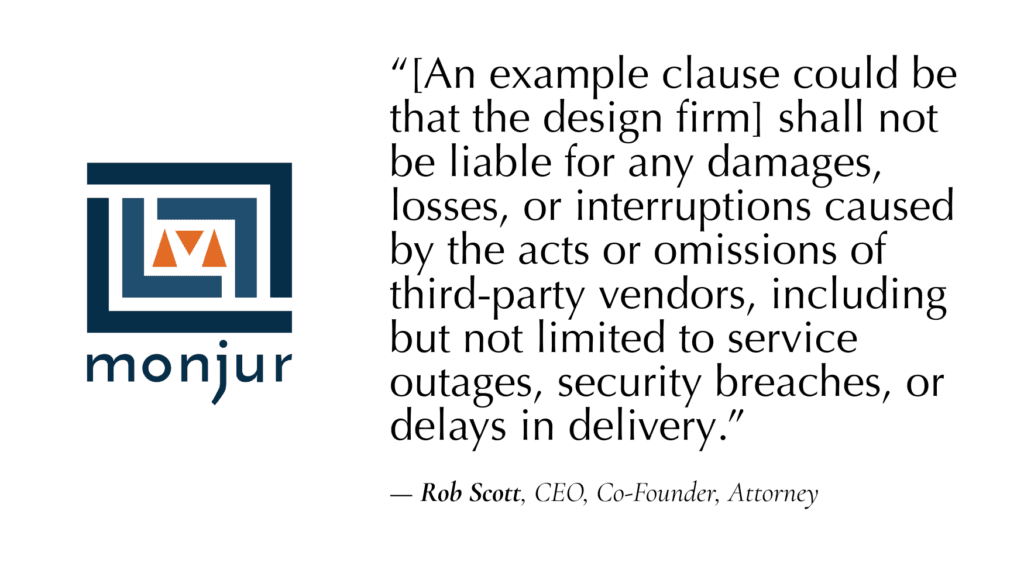
A third-party vendor liability clause explains that the designer is not legally responsible for mistakes made by independent companies or individuals involved in the project. Depending on the language used, these clauses may address fabrication errors, incorrect measurements, installation mistakes, shipping damage, construction defects, delivery delays, or other issues that occur outside the designer’s direct control.
Interior design projects involve many participants. Designers often coordinate with contractors, cabinet makers, fabricators, workrooms, receiving warehouses, movers, installers, electricians, plumbers, painters, and furniture vendors. The designer may communicate with all of these parties throughout the project, but communication alone does not create responsibility for their work.
Many clients understandably view the designer as the central point of contact. They may assume that anyone participating in the project works for the designer or operates under the designer’s supervision. In reality, many project participants are independent businesses responsible for their own work, decisions, and outcomes.
Who Counts as a Third-Party Vendor?
The answer to this question varies from project to project. A third party could include a custom upholstery workroom producing a banquette, a cabinet shop building millwork, a wallpaper installer hanging wallcoverings, a stone fabricator measuring countertops, or a furniture vendor manufacturing custom seating. Contractors, subcontractors, freight companies, and receiving warehouses often fall into this category as well.
This distinction is important because each of these businesses controls a specific portion of the project. The designer may create specifications and coordinate communication, but the actual fabrication, measurement, delivery, or installation may occur entirely under the vendor’s direction.
Why Do Designers Include These Clauses?

Designers are often the first call when something goes wrong. A custom dining table arrives with the wrong finish. A wallpaper seam separates after installation. A countertop fabricator mismeasures a slab. A furniture vendor misses a production deadline. A receiving warehouse reports damage during delivery. Clients typically contact the designer because the designer has been coordinating the project from the beginning.
Most designers will help navigate these situations. They’ll communicate with vendors, review documentation, coordinate replacements, and help clients understand their options. That involvement can create confusion about responsibility, particularly when contracts do not clearly distinguish between the designer’s role and the vendor’s role.
A third-party vendor liability clause helps establish those boundaries before any problems occur. The clause acknowledges that designers often participate in solving problems without accepting legal responsibility for mistakes they did not create.

Coordination and Responsibility Are Different Things
An interior designer may coordinate a countertop template appointment. The stone fabricator still takes the measurements. An interior designer may specify a custom banquette. The millworker still fabricates the piece. An interior designer may review installation schedules. The installer still performs the installation.
Clients sometimes view coordination as ownership of the entire process. Contracts help clarify that coordinating a project and performing the work are separate responsibilities. The companies responsible for fabrication, measurement, delivery, and installation remain accountable for their own work.
What Happens When a Vendor Makes a Mistake?
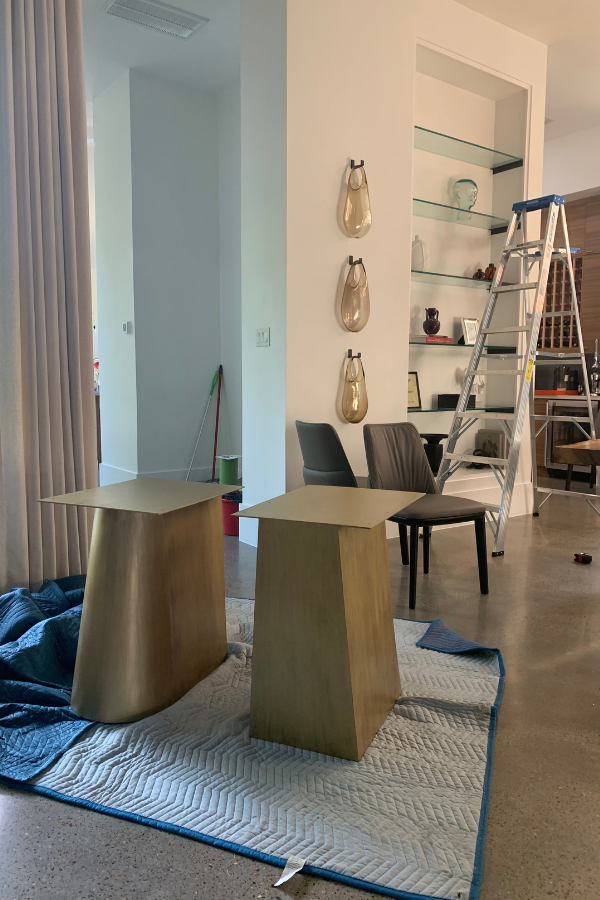
Every project encounters unexpected issues. Some are minor while others affect schedules, budgets, and installation dates. Imagine that custom drapery workroom we mentioned before produces panels at the wrong length. The designer might discover the problem during installation. The client will probably expect the designer to fix it. The workroom might need to remake the panels. Additional labor may be required. Installation dates might be kicked further down the road. Multiple conversations will likely occur before a solution is reached.
A similar situation can occur with custom millwork. A cabinet shop may build from an outdated drawing, misinterpret a dimension, or manufacture a component incorrectly. The designer may spend considerable time helping coordinate corrections. That effort does not necessarily mean the designer caused the error.
These situations are even more complicated when products pass through multiple hands before installation. A piece of furniture may move from the manufacturer to a freight carrier, then to a receiver, then to an installer, and finally to the client’s home. Determining where damage occurred sometimes requires documentation from several companies.
Documentation Becomes Important Quickly
When disputes arise, documentation will be one of the most valuable project-management tools available to you as the designer. Approved drawings, signed proposals, finish selections, measurement records, installation photographs, and written correspondence all help establish what was approved, what was fabricated, and where mistakes occurred. Many designers already maintain these records because they simplify communication throughout the project.
Clear documentation can also reduce misunderstandings between clients, designers, and vendors. If a fabricator builds exactly what was shown on an approved shop drawing, that information helps identify the source of a problem. If a measurement changes after approval, documentation helps establish when that change occurred and who communicated it.
Fuel your creative fire & be a part of a supportive community that values how you love to live.
subscribe to our newsletter
*please check your Spam folder for the latest DesignDash Magazine issue immediately after subscription

Why Client Approvals Matter
Many liability clauses specifically reference client approvals because approvals create decision points throughout a project. A client may approve furniture selections, custom dimensions, cabinetry layouts, wallcovering choices, shop drawings, or finish samples. Once those approvals occur, vendors often proceed with ordering, fabrication, or production. If a client later changes direction, determining responsibility becomes much easier when the approval process has been documented.
This concept appears frequently in discussions of custom fabrication. A designer may prepare specifications and review drawings, but the client ultimately approves the final version before production starts. Those approvals help establish a shared understanding of what will be built.
Shop Drawings, Measurements, and Sign-Offs
Measurements create some of the most common disputes in residential projects. A stone fabricator may measure a countertop. A drapery workroom may verify window dimensions. A cabinet shop may field-measure before fabrication begins. In each case, the vendor often controls the measurement process because the vendor controls production.
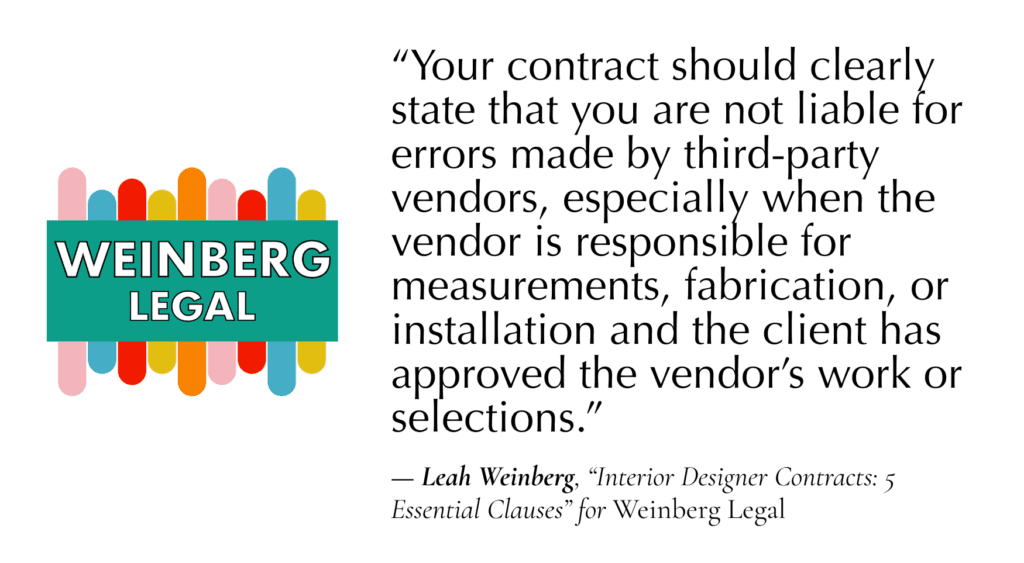
Weinberg Legal addresses this issue in a resource on their website. Designers might participate in discussions and review information, but the parties performing specialized technical work generally retain responsibility for executing that work correctly.
Does This Mean Designers Walk Away from Problems?
Not at all. Most designers work hard to help clients navigate problems when they arise. Strong client service usually means helping coordinate solutions even when the designer didn’t create the issue. Designers may communicate with vendors, negotiate replacements, review warranties, coordinate site visits, and help clients understand available options.
Clients value this support because project issues can be stressful and confusing. An experienced designer often knows who to call, what documentation is needed, and how to move a conversation toward resolution.
A third-party vendor liability clause won’t eliminate your need to coordinate when problems arise, but it will clarify to clients that helping solve a problem and causing a problem are different things. Designers can participate in the resolution process without accepting responsibility for work performed by independent companies.
Can Preferred Vendor Relationships Reduce Risk?
This question connects naturally to the preferred vendor clauses we discussed in a previous article. (See below.) Many designers build long-term relationships with vendors because those relationships create predictability. Designers learn how companies communicate, how they handle claims, how accurate their lead times are, and how they respond when problems occur. That knowledge can reduce uncertainty throughout a project.
Of course, trusted vendors can still make mistakes. Every business does. Longstanding relationships simply provide a stronger foundation for communication and problem-solving when challenges arise. A designer who knows exactly whom to contact often resolves issues much faster than someone navigating an unfamiliar vendor for the first time.
Where Should This Clause Be Included?
Third-party vendor liability language typically appears within the primary client agreement and may also appear in procurement agreements, construction-administration agreements, or project-specific scopes of work.
The language should clearly identify which responsibilities belong to the design firm and which responsibilities belong to vendors, contractors, fabricators, installers, and other independent parties. Clients should understand these distinctions before products are ordered or construction begins.
Like every contract provision discussed in this series, the specific wording should be reviewed by legal counsel familiar with your jurisdiction and business model. Small changes in language can create meaningful differences in how a clause operates.

Final Thoughts on Third-Party Vendor Liability Clauses
Interior designers coordinate extraordinarily complex projects. Furniture, lighting, millwork, stone fabrication, drapery, construction, installation, freight, and receiving often involve dozens of independent participants working toward a shared goal. When everything proceeds according to plan, responsibility feels straightforward. Questions emerge when mistakes occur.
A third-party vendor liability clause helps define responsibility before those questions arise. Designers often help solve problems created by vendors, contractors, and fabricators. That participation serves clients well and contributes to successful projects. At the same time, contracts should recognize that independent businesses remain responsible for their own measurements, fabrication, installation, and workmanship.
Clear expectations create better working relationships for everyone involved. Clients understand where responsibilities begin and end. Vendors understand their obligations. Designers can continue coordinating projects without assuming liability for work they weren’t responsible for.
Written by the DesignDash Editorial Team
Our contributors include experienced designers, firm owners, design writers, and other industry professionals. If you’re interested in submitting your work or collaborating, please reach out to our Editor-in-Chief at editor@designdash.com.
Related Posts
How Metal Thread Has Been Used in Fine Embroidery Throughout History
An art form that intertwines threads of myriad hues into fabric to cre

The New Black: Charcoal, Ink, and Graphite as Core Neutrals
Across showrooms, studios, and recent client projects, black-adjacent

From Oak Bluffs to West Tisbury: Beautiful Boutique Hotels in Martha’s Vineyard
Whether you're drawn to the elegance of meticulously restored historic

5 Easy Ways to Boost Your Creative Energy When You’re Burned Out
Burnout is common in interior design as emotional labor, logistics, an

Seven German Furniture Brands Known for Precision and Luxury
This guide profiles seven German furniture brands that pair engineerin

All About Designblok–Prague International Design Festival
Designblok is Prague's premier design week and the largest design fest