
How Transparent Should Interior Designers Be With Clients?

 0
0
 0
0Summary
Transparency doesn’t mean giving clients access to every internal debate, vendor problem, or half-formed idea. Laura’s approach is to give clients the information they need to understand and participate in their project without transferring the operational burden back to them. The important line is whether a problem changes something the client already approved. If it does, they should hear about it before they encounter the change themselves. Strong communication also depends on clear systems: deciding which channels are used for what, documenting major decisions, and setting expectations early enough that boundaries don’t seem arbitrary later.
Reflection Questions
Are you communicating enough for clients to understand meaningful changes without exposing them to every internal problem your team is solving?
Do your clients know where approvals, scope changes, and major decisions should be documented?
Have you defined which parts of the design process belong inside your firm and which decisions genuinely need client input?
Journal Prompt
Think about a recent project where communication became difficult. Was the problem too little information, too much information, or information delivered through the wrong channel? Write down what you would communicate differently if the same situation happened again.
We all want to be transparent with our clients; it saves time and makes miscommunications less likely. But everyone thinks about transparency differently. One designer might interpret transparency as giving the client access to every update, vendor delay, alternate selection, and internal debate. Another might communicate only the decisions that affect scope, cost, schedule, or something the client has already approved but has recently changed.
Laura Umansky, CEO and founder of Laura U Design Collective and co-founder of DesignDash, has changed where her firm draws that line over the last 20 years in business. Her firm has always worked around what she now calls the “guided design experience,” where clients receive clear, cohesive information without inheriting the full volume of work happening behind the scenes.
That philosophy still guides the way Laura communicates with clients, but one difficult project during the COVID-19 pandemic changed how she thinks about what clients need to know. What’s Laura’s take? The client doesn’t need to know about every operational problem, but they do need to know when the project they approved is changing in a substantial way.
How Much Should a Client Actually Know?
A design team can spend hours working through an issue before arriving at a recommendation. They might compare several materials, question an earlier direction, ask a vendor for another option, revise dimensions, and change their minds more than once before anything reaches the client. Laura keeps that unfinished thinking internal, always.
This filtering is part of the service a professional design firm provides. A client hires a design firm for its judgment, and judgment involves sorting through possibilities before presenting the ones worth considering. Inviting the client into every internal debate can make a relatively simple decision seem unstable or much more complicated than it ultimately is.
A presentation might include two or three thoughtful options, for example, without documenting the fifteen alternatives the team reviewed first. The client still understands the decision and can participate in it. They simply don’t have to inherit the full research process that produced the recommendation.
Everyday Operational Friction Should Stay Inside Your Firm
The same logic applies to smaller vendor problems. Say a rep stops returning calls, a sample has to be reordered, a shipment is running a few days behind schedule, but the delay won’t affect installation, or the team spends an afternoon tracking down a replacement part. Laura doesn’t think every one of those episodes needs to be a client update.
Yes, that means you’ll be absorbing a certain amount of friction on the client’s behalf. But it also preserves the client’s attention for decisions where their input is genuinely relevant instead of exposing them to decision fatigue, which isn’t productive in any client-designer relationship.
When Does Filtering Turn Into Withholding?
The line between withholding and protecting became much clearer for Laura during one particularly difficult project during Covid. Manufacturers were out of stock, shipping was unreliable, delays kept multiplying, and selections had to be revisited repeatedly. Laura’s instinct was to protect the client from all of it.
From the firm’s perspective, the problems were being solved. The project was still being managed, alternatives were being sourced, and the client wasn’t being asked to spend hours thinking about supply-chain problems they couldn’t fix anyway. But the problem became clear at installation. The clients loved the finished work, but they were unhappy to encounter several changes for the first time ever after walking into their home. Laura had filtered so much information that the clients had lost the opportunity to participate in decisions they considered important.
If Something They Approved Changes, Tell Them
Laura’s rule is clear and uncomplicated. If the client is going to encounter something materially different from what they approved, they need to hear about it beforehand. Now, she communicates any substantial change even when she’s handling it entirely on her end.
Her firm can still solve the problem before bringing it to the client. Laura might explain what changed, why it changed, and what she recommends doing next rather than sending a panicked update the moment something goes wrong. The client receives the information necessary to understand the change and make a decision, while the firm continues doing the investigative and operational work behind it.
What Else Should Be Internal?
Not every form of transparency improves the client relationship. Laura also keeps personnel conversations, coaching, and internal changes within the firm.
A client might need to know that their day-to-day contact is changing, but they don’t need the internal discussion that led to that decision. The same principle applies to disagreements among team members. A senior designer and project manager can have different opinions about a solution, work through them, and present the client with the final recommendation. The debate itself needs to occur inside the firm unless the competing options genuinely need client input.
Confidence Doesn’t Mean Pretending Nothing Went Wrong
There’s also a difference between protecting the client experience and pretending the project has encountered no problems. Interior design involves dozens of vendors, trades, deliveries, custom pieces, lead times, and people. Complications are inevitable across a long project. Clients generally understand that. What can damage trust is learning after the fact that a significant decision was made without them.
Laura’s COVID experience changed the way she balances those two responsibilities. She still wants the firm to absorb unnecessary noise that could pollute the client’s airwaves, but she doesn’t want the client to be surprised by any consequences (even if those consequences are technically solutions).
Fuel your creative fire & be a part of a supportive community that values how you love to live.
subscribe to our newsletter
*please check your Spam folder for the latest DesignDash Magazine issue immediately after subscription

Set Communication Expectations Before the Project Gets Too Complicated
Decide which channels are used for what. Communication can become difficult even when everyone is responsive. A client texts one designer, emails another, sends an Instagram post to the principal, and mentions a decision during a site visit. If your team communicates with clients this way, you’ll end up with four versions of the same conversation.
Several designers interviewed by Marina Felix for a 2022 Business of Home article described setting those expectations right away. Joe McGuier of JAM, for example, said his firm is comfortable texting with clients but directs project information toward email so the entire team can follow it. He notes that a four-person project team can lose information quickly when one person is receiving decisions privately by text.
That doesn’t mean every client relationship needs to be formal, but the team should know where an approval, budget decision, or scope change will be documented.
Put Important Decisions in Writing
Jen Samson of Jen Samson Design told Business of Home that her firm uses texts for reminders and quick logistical questions, but important information is written in email and then often discussed by phone, Zoom, or in person. Bradley Odom similarly keeps communication in writing early in a project, then adapts as he learns how much information a particular client wants.
Katie Labourdette-Martinez and Olivia Wahler of Hearth Homes Interiors make a similar distinction. They’re comfortable texting about appointments, tasks, and general questions, but prefer email for larger decisions because it creates a record everyone can return to later.
You always need a paper trail. A furniture approval made in February might not be installed until September. Nobody should have to reconstruct that decision from memory or scroll through six months of text messages.

Formality Can Change as the Relationship Develops
Long residential projects create close relationships. Designers spend time in clients’ homes, learn how their families live, hear about travel and schedules, and often work with them for several years. Communication naturally becomes more familiar over time.
Megan Evans told Business of Home that she begins projects formally because it establishes professional expectations, then allows the relationship to become more casual as trust develops. Her contract even includes communication expectations.

Bradley Odom describes a similar evolution. Early communication is formal and documented, but once the designer understands how a client likes to work, the relationship can loosen. Some clients want granular updates; others want very little information until a decision needs to be made.
A firm can accommodate those preferences without abandoning its own systems. One client might appreciate a weekly call and another might prefer a concise email summary. Major approvals can still follow the same documentation process behind both.
Boundaries Are Easier When They’re Established Early
Sherrell Neal of Sherrell Design Studio also told Business of Home that her approach changed after learning how important communication boundaries were. Texts are reserved for quick updates, while the design agreement explains office hours and how clients should contact the firm. Nonurgent weekend messages can wait until Monday without surprising anyone.
Those expectations are much easier to establish at kickoff than six months into a project. If a client has received immediate replies to late-night texts for half a year, changing that pattern later can seem arbitrary. If the communication structure is explained at the beginning, the client understands how the team works before the first difficult week arrives.

Good Client Communication Depends on Editorial Judgment
Laura’s guided design experience means that the team has to make constant decisions about information flow. What does the client need to know? What can the team resolve first? Which change needs approval? Which operational headache has no bearing on the client’s decision at all?
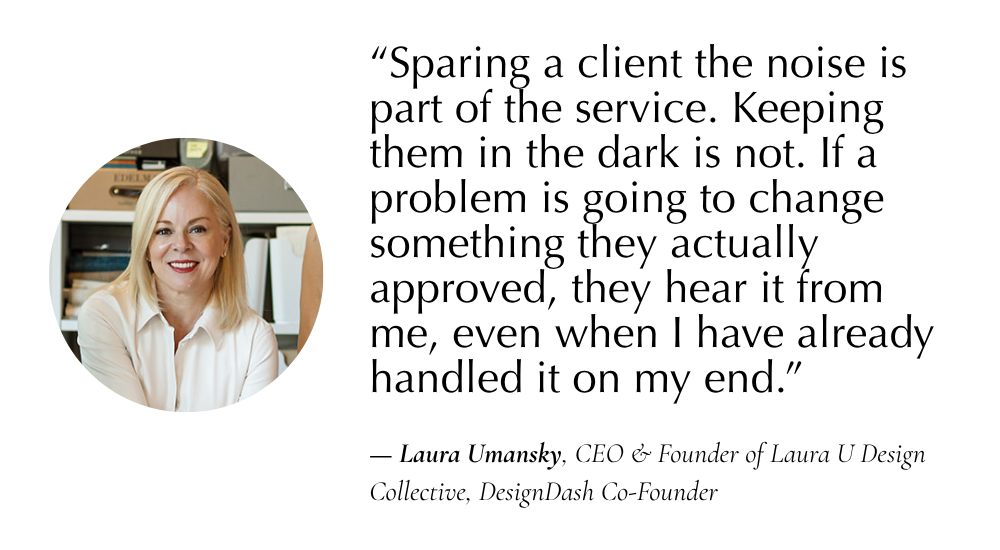
More communication doesn’t automatically create more trust. A client who receives every half-formed thought and vendor complaint can end up doing more work than they expected when they hired a full-service firm. Too little communication creates the opposite problem, especially when decisions change without the client’s knowledge.
Laura’s COVID project gave her a very practical test for that middle ground. If the firm is troubleshooting something behind the scenes and the approved design is unaffected, the team can usually keep solving it. If the solution changes what the client has already approved, the client needs to know.
Written by the DesignDash Editorial Team
Our contributors include experienced designers, firm owners, design writers, and other industry professionals. If you’re interested in submitting your work or collaborating, please reach out to our Editor-in-Chief at editor@designdash.com.
Related Posts

Public Speaking for Interior Designers
LIKE 0 LEAVE COMMENT 0 8 min read Summary Reflection Questions Journal

Masdar City: All about the 22 Billion Dollar Sustainable Eco City
Masdar City integrates advanced architectural design, cutting-edge ren

Stay Cozy in Style: The Best Fall Coats to Elevate Your Wardrobe This Season
From Sentaler's Baby Alpaca Wrap Coat to THE ROW's Garth Bouclé Coat,

What is Soft Minimalism and How Can I Capture the Interior Design Style?
Learn all you need to know about soft minimalism, the warm and natural
The Best Tools for Firm Owners Selected by Our WITOW Interviewees
Firm owners share the three tools they rely on most to run their firms

Should You Hire an Interior Stylist for Project Shoots?
Often working in lock-step with your photographer, the right interior