



The Hours You Forgot to Track Could Be Costing Your Firm More Than You Think

 0
 0
Summary
Reflection Questions
Journal Prompt
By the end of a normal workday, you can probably remember the major ways in which you spent your time. You spent two hours working on a presentation, met with a client, reviewed drawings with the builder, or drove across town for a site visit. All of these major moments are accounted for.
The trouble is everything around the big appointments you’ve fastidiously logged in your calendar. Like how you answered a builder question before lunch, called the workroom about COM yardage, found another fabric after the original was discontinued, reviewed an updated quote, and spent 20 minutes responding to a client who had “just one quick question.” By Friday, a lot of that work has vanished from memory.
Even a small amount of forgotten time adds up quickly. If one designer misses half an hour a day and bills at $200 an hour, that’s about $25,000 in client work over 50 weeks. Across three billable employees, you’re looking at roughly $75,000. You probably won’t miss exactly 30 minutes every day, of course, but you also probably have days when a lot more goes unrecorded.
And even if you charge flat fees, the missing hours are still costing you. You paid someone to do that work, and now your records make the project look faster and more profitable than it actually was. The next time you price a similar project, you could be working from the wrong number all over again.

Five Things to Check Before You Trust Your Time Records
#1 If You’re Entering Time Once a Week, You’re Probably Missing Some of It
There’s a big difference between remembering what you did and remembering how long you spent doing it. You might remember that you worked on the Smith project Wednesday afternoon, but was it two hours? Three? Did you stop halfway through to answer questions on another project? Did you spend another 25 minutes on Smith after dinner because the builder needed an answer before morning?
The farther away you are from the work, the harder those details are to reconstruct. Laura admits in Episode 55, The Hidden Profit Potential in Time Billing for Designers that she’s guilty of waiting until the end of the week herself.
LUDC encourages the rest of the team to enter time during the day or at least before they log off. They also bill in quarter-hour increments, so a 15-minute client task isn’t dismissed just because it wasn’t a meeting or a big block of design work.
You don’t need to make time tracking a second job. If you hate using a timer, try entering your hours after lunch and again before you finish for the day. If your team works better with a timer running in QuickBooks, Studio Designer, or another platform, do that. The system matters a lot less than whether people actually use it while they can still remember what they were doing.
And be honest about the quality of the information you’re collecting. “Eight hours, Jones Residence” might satisfy a timesheet requirement, but it won’t tell you whether those eight hours went to sourcing, construction documentation, client communication, or fixing a problem you created yourself.
#2 Pay Attention to the 15-Minute Tasks
A lot of our work happens in small increments. You choose the sofa, but then someone has to check the CFA, confirm the COM requirement, answer a question from the workroom, revise the quote, update the specification, and let the client know the lead time has changed.
The same thing happens with construction. A builder asks one question about a bathroom elevation, and the answer might involve checking the drawings, confirming a plumbing specification, talking to the senior designer, and sending revised information back to the site. What looked like a quick email could easily turn into 30 or 45 minutes. Houzz Pro’s Kyle Clapham makes this point in his guide How to Track Interior Design Time and Expenses.
Say one designer forgets four 15-minute tasks over the course of a day. That’s an hour. If that happens five days in a row, five hours of her week have disappeared from the project records. Whether you bill all five hours is a separate question, but you still paid her to work them.
Client communication is a big one here. Laura and Melissa talk in Episode 55 about using “correspondence” and “collaboration” in their time descriptions because the work is usually much more involved than simply “sending an email.” A designer could be reviewing drawings, answering three questions, confirming a selection, and coordinating information between the homeowner and builder in one email thread.
Look at the work your team is least likely to record. Travel between appointments, preparation before a client meeting, internal review, vendor calls, order questions, drawing revisions, reselections, site follow-up, and client correspondence are all good places to investigate. You might be surprised by which one is eating the most time.
Fuel your creative fire & be a part of a supportive community that values how you love to live.
subscribe to our newsletter
*please check your Spam folder for the latest DesignDash Magazine issue immediately after subscription

#3 Make Sure You’re Using the REAL Number When You Price the Next Project
Let’s say you charged a $40,000 flat design fee for a furnishing project and your records say the team spent 160 hours on it. That works out to $250 in design-fee revenue for each recorded hour before you account for payroll and overhead.
Now imagine that another project with the same $40,000 fee takes 300 hours. You’re down to about $133 per hour before payroll and overhead. That’s a very different project financially, even though the fee on both proposals was exactly the same. Accurate time records give you a way to figure out why.
Melissa talks in the same episode about comparing work that took 16 hours on one project with 32 hours on another. Maybe the second client needed more options. Maybe there were construction problems. Maybe the scope changed halfway through. Whatever happened, now you have something specific to investigate before you price the next one.
Look at the individual phases too. You might have estimated the design phase almost perfectly while construction coordination ran 40 hours over. Maybe sourcing was fine, but the client asked for so many revisions that your team spent twice as long on presentations as you expected.
That information can change the next proposal in several ways. You could raise the overall fee, budget more hours for a certain phase, change how you staff the work, or make your additional-services language much clearer. But you need a reasonably accurate record of the previous project before any of those decisions make sense.
This applies to flat-fee firms just as much as hourly ones. Alexii Friedman, founder of Studio Friedman in Philadelphia, told Business of Home’s Kaitlin Petersen that she has tried set fees and watched actual hours go well past what the firm projected. Her team now records time throughout the day. You can still send the client one flat design fee. Internally, you should know whether that fee paid for 160 hours or 300.

#4 Track the Time You Decide NOT to Bill Too
There are plenty of hours you shouldn’t pass along to a client. If your team orders a chair in the wrong finish and spends two hours fixing it, that should probably be on your side of the ledger. The same applies when someone misses an important dimension and has to redo a drawing.
You should still track those hours.
If you don’t, the project records make the work look cheaper than it really was. You also lose the chance to assess whether mistakes are happening often enough to deserve your attention. One incorrect order is annoying, but ten hours of avoidable corrections every month could point to a training or review problem.
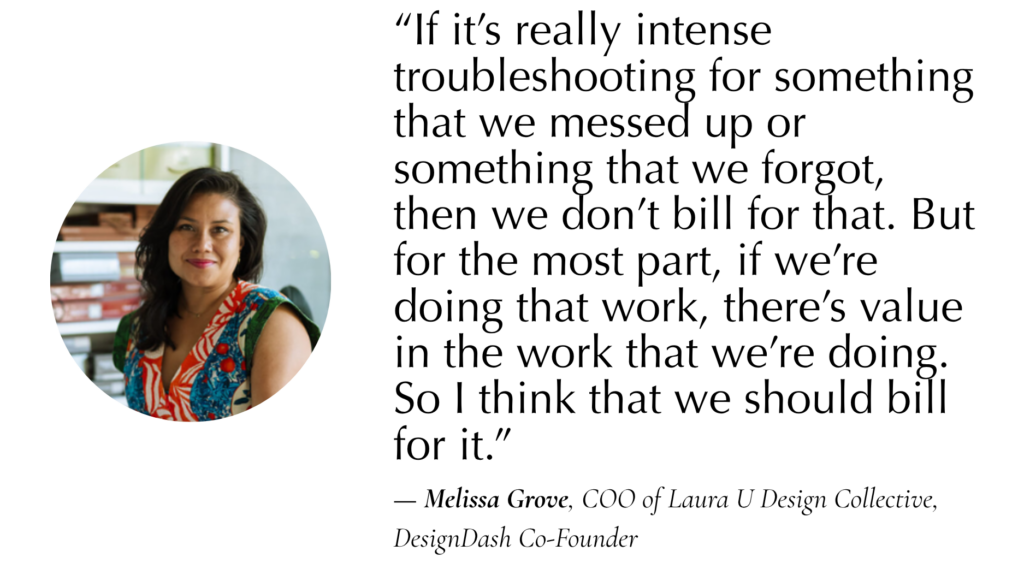
If a client asks for a new round of sofa options after approving the first one, someone is spending time on those new options. If the original sofa is discontinued before the client orders, your designer still has to find another one. Laura and Melissa bill for that reselection because neither situation was caused by a mistake inside the firm.
A lot of free work starts with: “Well, it was only 15 minutes.” Then there’s another 20 minutes tomorrow and half an hour next week. Eventually you’ve paid someone for several hours of client work that never made it onto an invoice.
You might be completely comfortable with that. Lots of firms intentionally absorb small amounts of time as part of client service. Just know how much you’re absorbing. If a project has 25 hours of unbilled work attached to it, that belongs in your assessment of whether the project made money.
#5 Missing Hours Can Throw Off What You Think About Your Team
Time tracking also gives you information about the people you employ. If you know what an employee costs the firm, how many hours she works, how many of those hours are billed to clients, and how much revenue those hours produce, you can start evaluating whether her billing rate and workload make financial sense.
LUDC uses designer salaries as part of the cost of providing design services because the firm is selling those employees’ time. Melissa describes their basic calculation near the end of Episode 55.
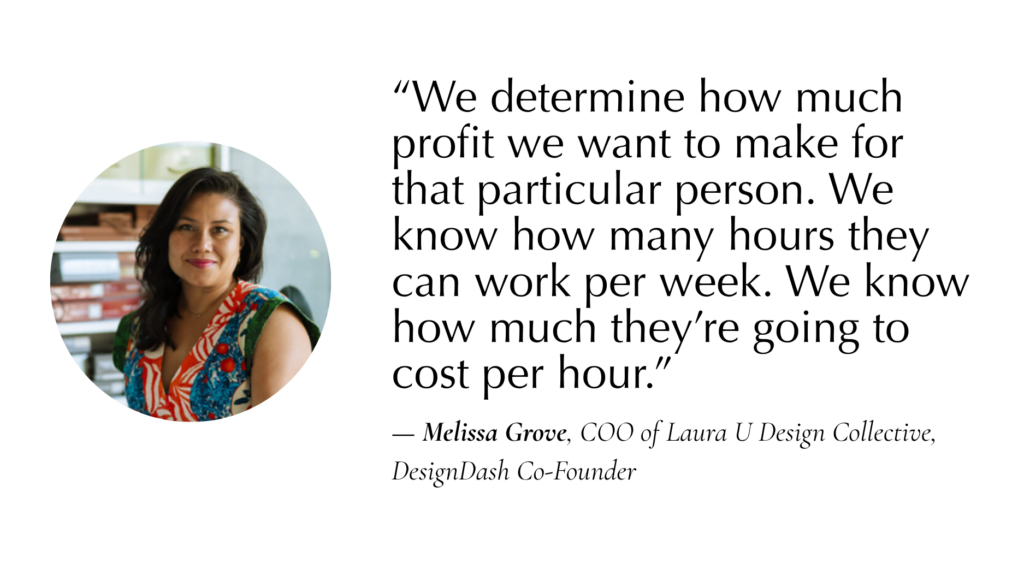
Now imagine a senior designer actually spends 30 hours on client work one week but only records 24. When you review the numbers later, you have six hours sitting in the wrong place. You could think she has more nonbillable time than she really does, or that she isn’t generating enough client revenue at her current billing rate.
Multiply that across a team and you can start making decisions from bad information. You might think someone has room for another project when she doesn’t. You could question a billing rate that would look perfectly reasonable if all of the client work were included. Or you could hire because everyone seems overloaded without knowing how much of their week is actually going toward billable projects.
LUDC has used a gross-profit target of around 52% for time billing, based in part on employee cost and the revenue generated from that person’s time. Laura is very clear in the episode that this is GROSS profit, not what she personally takes home, because the firm still has overhead to pay afterward.
You don’t need to use LUDC’s percentage. Your salaries, billing rates, overhead, and business model are your own. But if you’re going to calculate anything based on employee hours, start with hours you can actually trust.
Before You Price Another Project, Find Out Where the Hours Went
If you bill hourly, forgotten time has an immediate cost because some of the work never reaches the client invoice. If you work on flat fees, it’s easier to miss because the client has already paid the agreed amount. Your payroll covered those extra calls, revisions, site questions, reselections, and vendor problems either way.
The bigger problem can come later when you use incomplete time records to make another decision. A project that actually took 240 hours might look like a 180-hour project in your system. Then the next client comes along with a similar house and scope, and you price the work based on 180 hours again.
That cycle can go on for a surprisingly long time if nobody ever compares what the team ACTUALLY did with what made it into the time records.
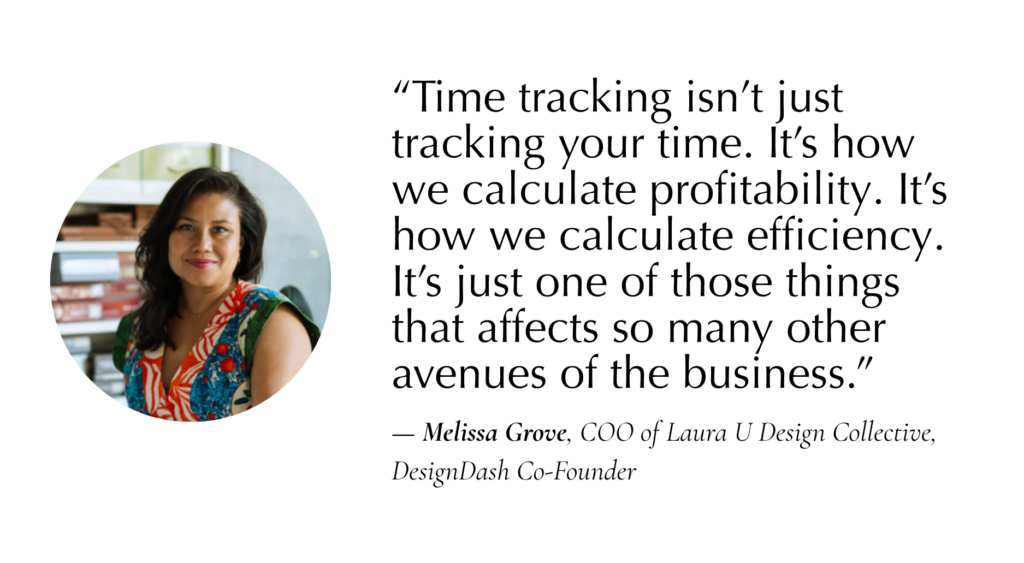
You don’t have to charge by the hour, and you certainly don’t have to bill every minute somebody records. But if your team spent the time, you need to know about it.
Track everyone’s work first. Then decide who covers what.
Written by the DesignDash Editorial Team
Our contributors include experienced designers, firm owners, design writers, and other industry professionals. If you’re interested in submitting your work or collaborating, please reach out to our Editor-in-Chief at editor@designdash.com.
Related Posts

From Concept Models to Construction: Best Beginner 3D Printers for Architects
With user-friendly designs and advanced features to try as you get mor

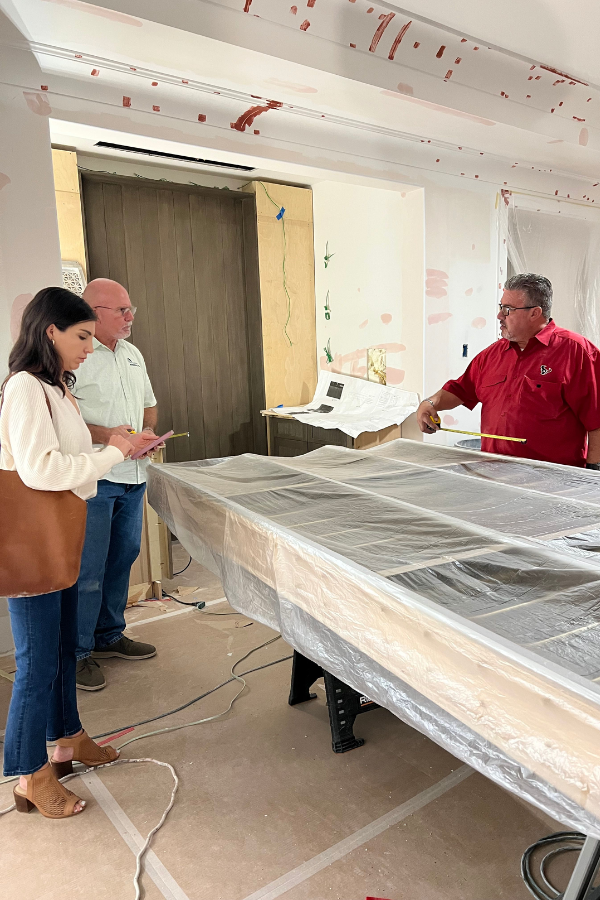
Is Your Design Firm Too Small to Serve New Clients?
If being busy is costing your firm clients, your firm might be too sma

The Remarkable Inventions of Hollywood Icon Hedy Lamarr
Alongside her cinematic achievements, Hedy Lamarr co-invented a techno
Which Intellectual Property Protections Do Interior Designers Actually Have?
Learn which parts of an interior designer's work are protected by copy

Our Favorite Wireless Noise Canceling Headphones for Focused Work
Not sure how to choose your next pair of noise canceling headphones? F

POST COMMENT
You must be logged in to post a comment.